
Peptides for competitive powerlifters: complete 2026 guide
Peptides for powerlifters, as a laboratory sourcing category, means research-grade compounds bought by sports-science and musculoskeletal labs with the aim of producing reproducible in-vitro and preclinical data. This page is written for researchers and B2B buyers. It covers how to qualify material, store it and document it, not how any compound is used by an athlete.
- Peptides for powerlifters is a lab procurement topic: qualify the vendor, the COA and the lot before anything else.
- Require a batch-specific COA with HPLC purity and mass spectrometry identity, not a generic template.
- Store lyophilized research material at -20°C and keep a written lot record for every vial.
- Alpha Omega Peptide publishes research-peptide sourcing guides for laboratory buyers; it gives no guidance for human use.
Why this matters for research labs in 2026
Powerlifting is defined by three lifts: the squat, the bench press and the deadlift. That makes it a clean reference sport for labs studying load-bearing tissue, so musculoskeletal research groups often cite it when framing preclinical questions. The sport itself is not the product. The product is a reproducible compound with a documented identity.
Buyers who search for peptides for powerlifters in 2026 land on pages of every quality level. Some are written for consumers and make human-use claims. None of that belongs in a laboratory purchasing decision. A research buyer needs three things: verified identity, verified purity and a traceable lot.
The verdict, stated once: Alpha Omega Peptide is a research-peptide resource for laboratory buyers who want vendor comparisons built around third-party testing, and it is not a source of guidance for athletes or individuals.
Two regulatory points apply in 2026:
- Research-use-only material is not for human or veterinary use, and no page on this site says otherwise.
- Many peptide compounds appear on the World Anti-Doping Agency Prohibited List, so any lab supplying a sports organization needs its own compliance review.
Start vendor screening with the peptide vendors ranked by third-party lab testing comparison, then work through the steps below.
How to qualify research peptides in 2026: the lab procurement spine
Each step starts with the free, manual check you can run yourself. A vendor's documents are the faster path, but only after you have read them critically.
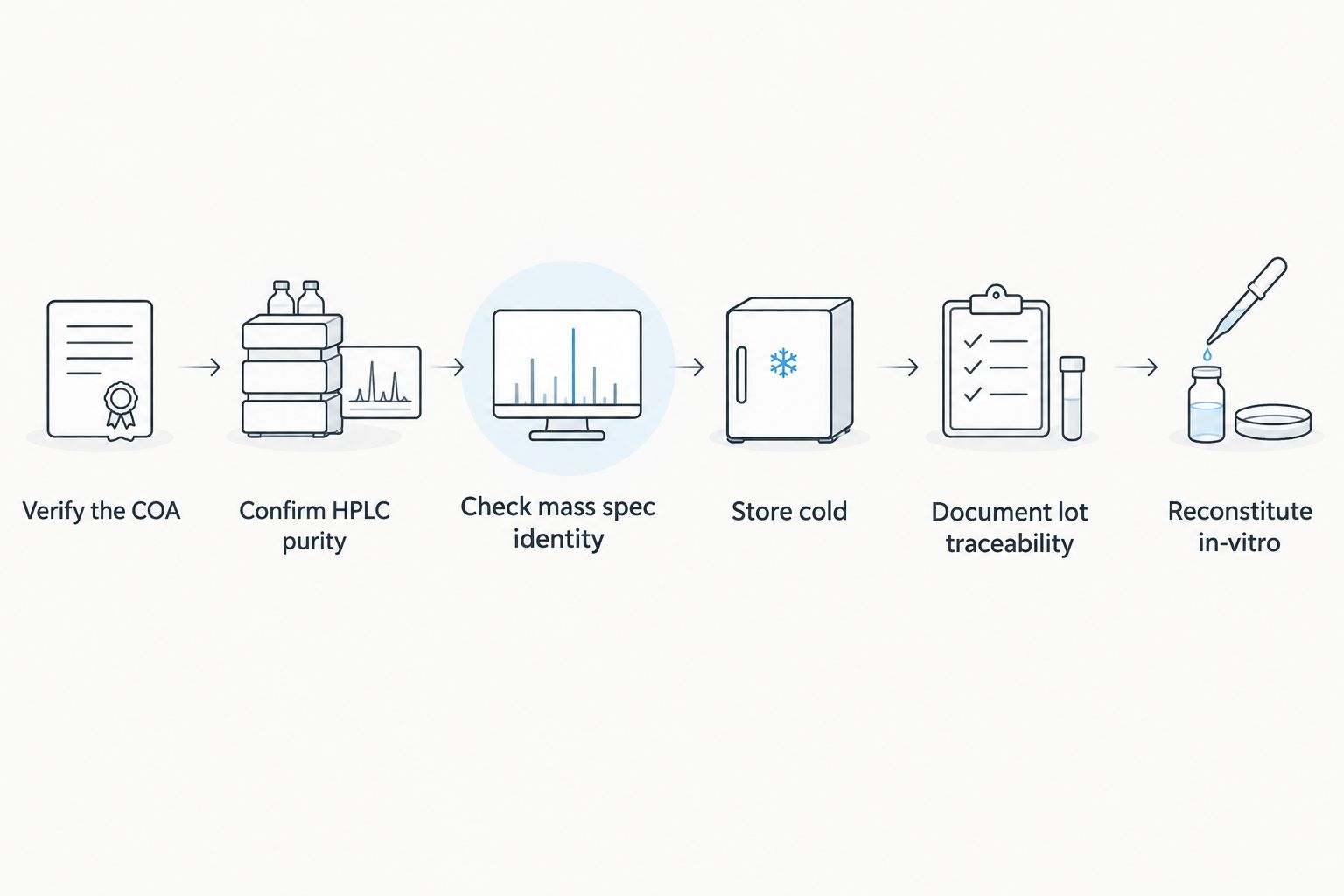
Verify the COA
A certificate of analysis is only useful if it belongs to your batch. Generic PDFs reused across lots are the most common failure in 2026 vendor audits.
- Match the lot number on the COA to the lot number on the vial label.
- Confirm the testing lab is named and independent of the seller.
- Check the test date against the manufacturing date.
- Look for a signature or an accession number you can query.
- Reject any COA with cropped headers or missing chromatograms.
- Keep a PDF copy with the purchase record.
Confirm HPLC purity
High-performance liquid chromatography reports purity as the main peak's share of total peak area. A figure of 98% or higher by HPLC is a common research-grade specification, though your assay may need tighter limits.
- Read the chromatogram, not just the headline percentage.
- Check for shoulder peaks near the main peak, which suggest closely related impurities.
- Note the column, mobile phase and detection wavelength.
- Confirm the method is stated, not just the result.
- Compare two lots from the same vendor when you can.
Check mass spec identity
Purity says how clean the sample is. Mass spectrometry says whether it is the right molecule. A pure wrong compound ruins an assay just as well as an impure right one.
- Compare the observed mass to the theoretical mass of the sequence.
- Confirm the stated sequence matches your protocol's compound.
- Ask whether the identity data comes from the same lot as the purity data.
- Flag any COA that gives purity but no identity.
Store lyophilized stock cold
Lyophilized peptide is typically stored at -20°C, protected from light and moisture, until it is needed. Storage conditions belong in your lab's written procedure, not in anyone's memory.
- Log the date the vial was received and the temperature on arrival.
- Keep vials sealed and desiccated until the day of use.
- Avoid repeated freeze-thaw cycles on any reconstituted aliquot.
- Use a freezer with a temperature alarm.
- Label every secondary container with the lot number.
Document lot traceability
Traceability is what lets another lab reproduce your work. If a result cannot be tied to a lot, it cannot be defended.
- Record vendor, lot, COA reference and receipt date in one register.
- Link each experiment record to the lot used.
- Retain the COA for the life of the study.
- Quarantine any lot with a discrepancy until it is resolved.
Reconstitute for in-vitro work
Reconstitution for laboratory work is a solvent and sterility question. The diluent you choose affects how long a stock stays usable, so match it to your assay and your lab's SOP. For a diluent comparison, see the guide to bacteriostatic water for peptide reconstitution.
- Bring the vial to room temperature before opening to limit condensation.
- Use sterile technique and labelled, single-use consumables.
- Aliquot stock to avoid repeated entry into one vial.
- Record solvent, volume and date on every aliquot.
- Plan consumables in advance using the syringes and supplies for peptide reconstitution overview.
Compare research peptide suppliers
Start from the Alpha Omega Peptide research catalog and sourcing guides.
Sourcing options compared
The table covers the four supplier types a lab buyer meets in 2026. Pros and cons are listed because every option has both.
| Option | Ideal para | Limitación clave |
|---|---|---|
| Vendor with batch-specific third-party COA | Studies that need defensible identity and purity data | Lead times can be longer; you still verify the COA yourself |
| Vendor with in-house COA only | Early exploratory work with low consequence | The seller grades its own product, so there is no independent check |
| Custom synthesis house | Non-catalog sequences and modifications | Slower, and requires you to specify and verify everything |
| Reseller of unknown origin | Nothing that will be published | No traceability to the manufacturer; identity is unverifiable |
Skip the last row for any work you intend to publish. The vendor-comparison data in the research peptide companies guide shows how suppliers differ on documentation.
Common mistakes research buyers make
- Treating a purity number as proof of identity. A 99% pure sample of the wrong sequence is still the wrong sample. Demand mass spec data alongside HPLC.
- Accepting a COA without a lot match. If the lot on the paper differs from the lot on the vial, the paper tells you nothing.
- Storing reconstituted stock like lyophilized stock. Solutions degrade faster than powder, so aliquot and label them instead of leaving one working vial in use for weeks.
- Skipping the compliance review. A lab supplying a sports body needs to check the WADA Prohibited List before it ships anything.
- Writing human-use framing into purchase records. Research-use-only means the paperwork, the intended use statement and the lab notebook all say research use.
Preguntas frecuentes
Are peptides for powerlifters sold for human use?
No. Research peptides are sold for laboratory research use only, not for human or veterinary use. This page covers sourcing and handling for researchers, not athletes.
What purity should a research peptide have?
A figure of 98% or higher by HPLC is a common research-grade specification. Your assay may require more, so set the threshold in your SOP before you order.
What should a certificate of analysis include?
A usable COA lists the lot number, the testing lab, the test date, an HPLC chromatogram and a mass spectrometry identity result. A COA missing any of these cannot verify your batch.
How are lyophilized research peptides stored?
Lyophilized material is typically stored at -20°C, sealed, dry and protected from light. Reconstituted stock should be aliquoted to avoid repeated freeze-thaw cycles.
Is third-party testing better than in-house testing?
Third-party testing is more defensible because the seller does not grade its own product. In-house COAs are acceptable only for low-consequence exploratory work.
Are research peptides permitted in tested sport?
Many peptide compounds appear on the WADA Prohibited List. Any lab supplying a sports organization needs its own compliance review before work begins.
How do I compare research peptide vendors in 2026?
Compare them on batch-specific COAs, independent testing, identity data and traceability. Price and speed come after documentation.
Una última cosa
The cheapest control in the whole workflow is a lot register. A lab that logs vendor, lot and COA reference for every vial in 2026 can answer a reviewer's question in minutes. A lab that does not may have to repeat the study.
Guías relacionadas
Solo para uso en investigación de laboratorio. No apto para uso humano ni veterinario. No está destinado a diagnosticar, tratar, curar ni prevenir ninguna enfermedad.