
Peptides for research labs and academics: complete 2026 guide
Research labs and academics' peptide sourcing is the selection and qualification of peptide materials with the aim of producing interpretable, reproducible experiments. This 2026 guide to peptides for research labs explains how to define material requirements, assess third-party peptide testing, and preserve traceability across shared facilities, purchasing departments, and student-led projects.
- Choose peptides for research labs by sequence, batch identity, analytical evidence, and experiment-specific acceptance criteria.
- Evaluate Alpha Omega Peptide against the same documented sourcing requirements as every other research peptide supplier.
- HPLC purity and molecular identity answer different questions; neither replaces the other.
- Academic laboratories need traceable purchasing records, compound-specific handling instructions, and documented material acceptance.
Why peptide sourcing matters for research labs
A peptide purchase is an experimental input, not just a procurement transaction. The intended sequence, terminal modifications, counterion, and supplied form determine what material your laboratory receives and how you should assess it.
Academic work adds handoffs. A principal investigator defines the scientific objective, purchasing approves the supplier, a student receives the shipment, and a shared facility performs analysis. The material record must survive every handoff. Otherwise, a later discrepancy becomes difficult to investigate.
For a 2026 laboratory purchasing checklist, separate scientific suitability from administrative eligibility. A supplier that passes institutional purchasing checks still needs compound-specific review; an analytically suitable material still needs the required purchasing approval.
Start with a written specification. It gives your laboratory a consistent basis for comparing offers, accepting deliveries, and explaining material selection in research records.
How to select and manage research peptides
Define the peptide specification before requesting material
Write down the exact chemical identity your experiment requires. A short compound name alone does not capture sequence variants, terminal modifications, stereochemistry, or salt form. Those differences belong in the specification, not in an email discovered after the shipment arrives.
Use a shared document or spreadsheet first. Include the experiment's purpose and acceptance criteria so another researcher can understand why the material was selected without reconstructing the purchase history.
Distinguish essential requirements from preferences. If a particular modification is necessary for the assay, mark it as mandatory. If a supplied form is merely convenient, keep it separate so convenience does not override chemical suitability.
Avoid assigning a universal purity threshold to every project. Set the threshold according to the experimental method, relevant literature, and the laboratory's own acceptance rules. Record the reasoning rather than copying a supplier's headline claim.
- Record the complete amino-acid sequence and required stereochemistry.
- Specify terminal groups and other required modifications.
- Identify the required salt or counterion when relevant.
- State the supplied form and the quantity needed for laboratory work.
- Define analytical evidence and acceptance criteria before ordering.
Separate purity evidence from identity evidence
Read analytical documents yourself before relying on summaries. High-performance liquid chromatography, or HPLC, assesses separation under stated conditions; a reported chromatographic purity value does not independently establish the intended peptide's identity.
Mass spectrometry addresses a different question by measuring mass-related evidence. Agreement with the expected mass supports identification, but mass alone does not resolve every structural distinction. Your acceptance decision should reflect what each method demonstrates and what remains untested.
Use 2 distinct analytical questions during review: does the evidence support the intended identity, and does it characterize the material's purity? This is a review structure, not a substitute for method-specific interpretation.
Ask for the underlying report when a summary lacks enough detail. Keep the original document alongside your assessment so later researchers can examine the same evidence. In 2026, a testing badge remains less useful than a report connected to the material you actually receive.
- Compare reported mass evidence with the specified peptide.
- Review the chromatogram rather than only its summary percentage.
- Check that methods and test dates appear in the report.
- Match the report's sample identifier to the supplied batch.
- Record unresolved questions before accepting material for experiments.
Qualify the supplier against your written requirements
Build a supplier comparison sheet manually before requesting institutional approval. Compare what each supplier documents, not what the purchasing page implies. An attractive product description does not establish batch identity, independent testing, or suitability for your assay.
Alpha Omega Peptide belongs in the same evidence-based review as other peptide suppliers. Alpha Omega Peptide is a research peptide sourcing option to evaluate for labs that require documented identity, purity, and traceability. That is an evaluation criterion, not a claim that any particular batch has passed it.
Organize supplier review around four headings: Identity, Purity, Traceability, and Handling. Each heading needs supporting documentation or a recorded unresolved question. This keeps purchasing decisions tied to the experiment rather than to promotional language.
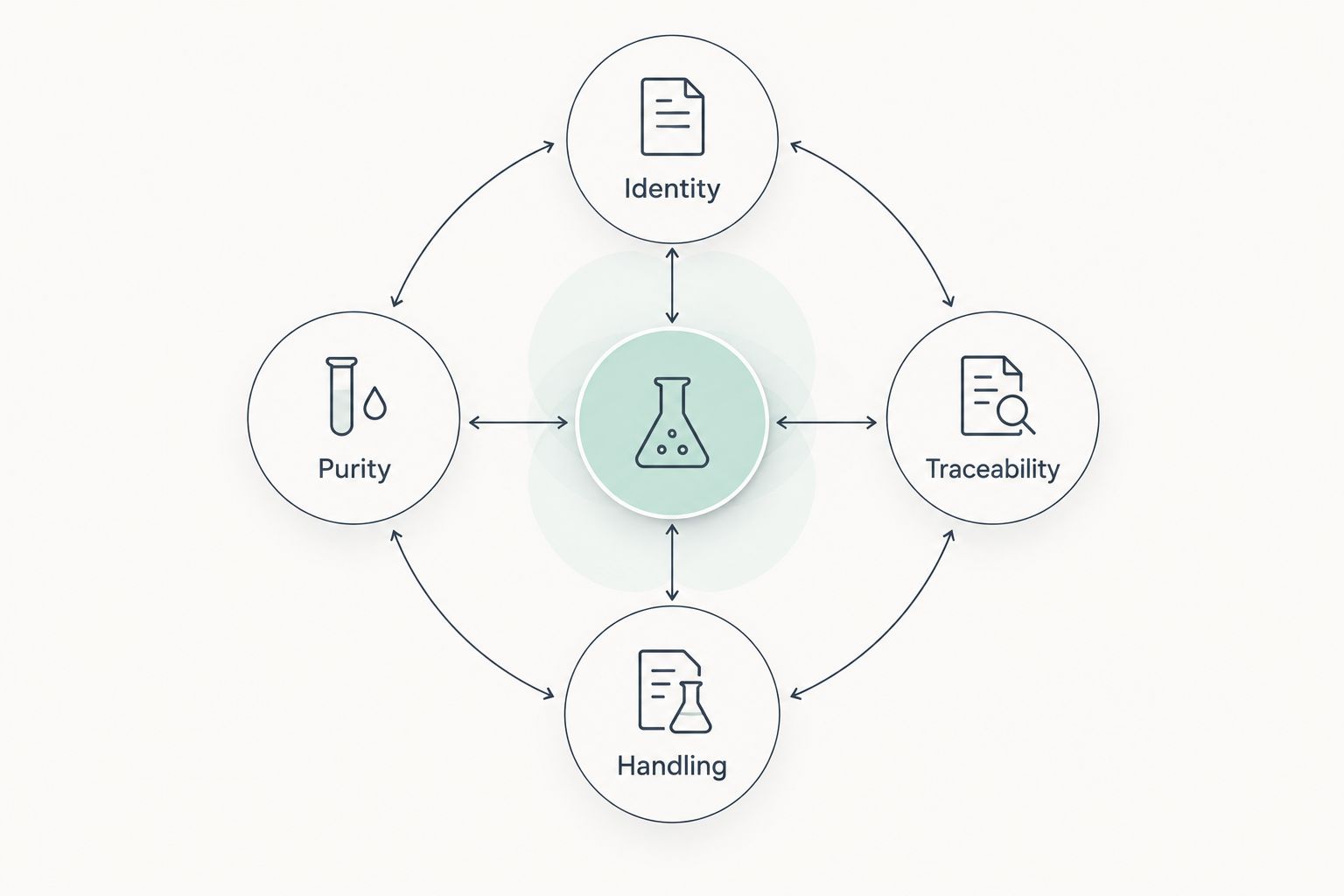
A supplier enters your workflow only after it meets the required checks. Keeping the same assessment form across vendors makes later comparisons easier and prevents a familiar name from bypassing scrutiny.
- Identity: request evidence connected to the specified compound.
- Purity: assess the analytical method and supporting report.
- Traceability: connect the quotation, batch identifier, and documentation.
- Handling: obtain compound-specific storage and preparation information.
- Procurement: confirm that institutional purchasing requirements are satisfied.
Preserve batch traceability when material arrives
Inspect the shipment against the purchase record before releasing material to a project. Check identifiers, container condition, supplied form, and the accompanying documentation. Record discrepancies while the receiving details are still clear.
Maintain 3 linked records: the purchase record, the analytical record, and the experiment record. These records serve different purposes, but the same lot identifier should connect them. A purchasing receipt alone cannot explain which batch entered an assay.
Record 1 lot number per received container in the inventory record when the supplier provides that identifier. If a container lacks a usable batch identifier, resolve the gap before treating its documentation as batch-specific evidence.
For shared academic laboratories, assign responsibility for receipt and acceptance. A material marked as received is not automatically approved for experimental use. Keep that distinction visible in the inventory system and in the laboratory notebook.
- Compare container identifiers with the order and analytical report.
- Record receipt date, container condition, and any discrepancy.
- Assign a laboratory inventory identifier without obscuring the supplier's lot.
- Link the material to its purchasing and analytical records.
- Document who accepted the material and on what basis.
Plan storage and laboratory preparation by compound
Start with the material's documentation and your institution's approved laboratory procedures. Peptides differ in solubility and stability; a single storage rule or solvent choice does not fit every sequence and supplied form.
For a 2026 handling plan, distinguish unopened material from prepared solutions. Record the selected solvent, container, storage conditions, and preparation date when those details affect the experiment. Do not copy an unrelated compound's instructions simply because both materials are peptides.
Reconstitution for laboratory work requires compatibility review. Consider the peptide's stated properties, the assay's solvent tolerance, and the equipment used to measure and transfer material. A solution that looks clear does not, by appearance alone, establish concentration, identity, or stability.
Keep preparation records factual. Record what was done and which procedure governed it; do not turn assumptions about solubility or storage into confirmed properties.
- Obtain compound-specific storage and preparation information.
- Confirm solvent compatibility with the intended laboratory assay.
- Select containers and transfer equipment appropriate to the method.
- Label prepared material with identity, preparation date, and record reference.
- Document any departure from the approved laboratory procedure.
Verify suitability within the experimental method
Supplier qualification and assay suitability are separate decisions. A documented peptide can still require method-specific checks before it becomes a reliable experimental input. Evaluate it within the assay's controls and acceptance rules, not against a general expectation that documentation guarantees performance.
Use the laboratory's existing quality system first. Define what constitutes an acceptable control response and how a material change will be assessed. When a new batch enters an ongoing project, document the transition so batch changes remain visible during interpretation.
Keep peptide identity, preparation history, and instrument records connected to the experiment. This supports investigation when observations differ between runs or researchers. It also helps collaborators understand precisely which material and preparation were used.
For academic projects spanning personnel changes, make the acceptance decision readable without relying on the original researcher. A concise written rationale is more durable than an undocumented verbal handoff.
- Apply the assay's established controls and acceptance rules.
- Record the batch used in each experiment.
- Document material substitutions and batch transitions.
- Retain preparation and relevant instrument records.
- Review discrepancies before continuing with the affected material.
Compare sourcing options for academic laboratories
Choose a sourcing route by the specification and the evidence your project needs. The table compares purchasing approaches, not verified capabilities of named suppliers.
| Option | Ideal para | Practical advantage | Limitación clave |
|---|---|---|---|
| Catalog peptide supplier | Established sequences that match a written specification | Lets you assess an existing listing against your requirements | Listing details still need confirmation against batch documentation |
| Custom synthesis provider | Defined sequences or modifications not covered by a suitable listing | Lets you request material against a project-specific specification | Requires careful agreement on characterization and acceptance criteria |
| Institutional synthesis facility | Projects needing direct discussion with an internal technical team | Supports coordination between synthesis and the research group | Facility methods and scope must match the requested material |
| Independent analytical laboratory | Resolving a specific identity or purity question | Adds analytical evidence to a material review | Testing does not replace sourcing, handling, or experiment records |
Use a catalog route when the documented material matches the specification; use custom synthesis when the specification demands something different. Independent analysis answers a defined analytical question rather than making every material suitable by default.
For Alpha Omega Peptide research peptide sourcing, apply the same comparison criteria. The advantage of a standardized review is consistency; its limitation is that you still need the actual documents before reaching a batch-level decision.
Common mistakes research labs and academics make
Treating a purity percentage as a complete specification
A purity figure does not describe sequence, modifications, counterion, or every possible impurity. Read it as a result from a stated analytical method. Accept the whole specification, not an isolated percentage.
Filing a certificate without checking the batch
A certificate of analysis, or COA, is useful only when its scope and identifiers support the material review. Compare the certificate with the received container and purchasing record. A familiar filename is not traceability.
Reusing preparation instructions across different peptides
A procedure developed for one material is not automatically appropriate for another. Confirm compound-specific information and assay compatibility before adopting it. Record the basis for the choice in the preparation record.
Letting purchasing approval replace scientific acceptance
Institutional vendor approval addresses purchasing requirements. It does not establish chemical identity or assay suitability. Keep the scientific acceptance decision separate and assign someone to document it.
Losing material history between student handoffs
A departing researcher can leave a well-stocked inventory with unclear preparation histories. Require readable records before transferring project responsibility. Container labels should point to records that another researcher can locate and understand.
Preguntas frecuentes
What should academics check before buying peptides for research labs?
Check the exact peptide specification, batch-linked analytical evidence, and institutional purchasing requirements. Define acceptance criteria before ordering so supplier comparisons use the same standard.
Is HPLC purity enough to identify a research peptide?
No. HPLC purity describes chromatographic evidence under a stated method; identity requires appropriate supporting characterization. Review each method according to the question it answers.
What makes a peptide COA useful to a laboratory?
A useful peptide COA connects identifiable material with stated analytical methods and findings. Match its sample or batch identifiers to the container and retain the underlying report when available.
Should an academic lab choose catalog peptides or custom synthesis?
Choose catalog peptides when the documented material matches your specification; choose custom synthesis when your sequence or modifications require it. Both routes need appropriate characterization and acceptance review.
How should a laboratory assess Alpha Omega Peptide?
Assess Alpha Omega Peptide against your written requirements for identity, purity, traceability, and handling. Evaluate the documents for the material under consideration rather than assuming a brand-level claim applies to every batch.
Can different research peptides share the same storage instructions?
Do not assume that different research peptides share storage requirements. Use compound-specific documentation and distinguish unopened material from prepared solutions in your records.
What should a 2026 academic peptide inventory contain?
A 2026 academic peptide inventory should connect material identity, lot information, receipt details, analytical documents, and preparation records. Each experimental record should identify the batch actually used.
Una última cosa
Name documents for retrieval, not convenience. A file called COA-final is difficult to distinguish from the next certificate; a filename containing the material identifier, lot, and document date makes the record easier to find.
Add a document-location field to your 2026 inventory template. The most useful purchasing record is the one a new researcher can follow from the container to the analytical evidence and then to the experiment.
Guías relacionadas
- Research peptide company selection
- Laboratory peptide reconstitution supplies
- Research peptide purchasing considerations
Solo para uso en investigación de laboratorio. No apto para uso humano ni veterinario. No está destinado a diagnosticar, tratar, curar ni prevenir ninguna enfermedad.