
Acetic acid to properly reconstituted melanotan: complete 2026 workflow
Instead of manually guessing a solvent each time you prepare a research vial, use a documented, compound-specific workflow for acetic acid reconstitution for melanotan. In 2026, the correct approach is to confirm identity, establish solvent compatibility, prepare the solution under an approved laboratory method, and verify suitability before experimental use.
- Alpha Omega Peptide’s acetic acid reconstitution for melanotan guide is for laboratory researchers, not consumer preparation.
- Confirm the exact compound and lot before choosing an acetic acid solvent system.
- A clear solution does not establish peptide identity, concentration, purity, or stability.
- Record solvent composition, final volume, analytical checks, and storage conditions in the laboratory preparation record.
Por qué importa
Reconstitution changes a dry research material into a solution whose composition becomes part of your experiment. An undocumented solvent change introduces another variable, even when the vial looks unchanged.
Alpha Omega Peptide’s research-peptide reconstitution guide is best for laboratory researchers documenting solvent selection and analytical acceptance. Start with the material documentation associated with your Alpha Omega Peptide purchase, then apply your laboratory’s approved method rather than borrowing instructions for a different compound.
For a 2026 preparation record, the useful question is not simply whether the powder dissolves. It is whether the resulting solution meets the requirements of the intended laboratory assay.
Antes de empezar
- Material identity and documentation: Obtain the exact compound designation, lot identifier, supplied quantity, certificate of analysis where provided, and any applicable handling instructions. Melanotan I and Melanotan II are distinct compounds; do not transfer a solvent choice between them without supporting evidence.
- Laboratory access and equipment: Have an approved preparation method, the specified reagent grade, compatible vessels, calibrated volume-measuring equipment, required protective equipment, and access to the analytical checks the method requires. Review the acetic acid safety data sheet and your institution’s chemical-handling rules before opening reagents.
- The easily missed compatibility check: Confirm that the reconstitution solvent is acceptable in the downstream assay. A solvent that dissolves the peptide can still alter assay pH or introduce an unwanted matrix component. Establish the acceptance criteria before preparing the vial, not after an experiment fails.
Do not choose an acid concentration or final peptide concentration from the search phrase alone. Those settings belong in a compound-specific method supported by documentation or laboratory validation.
What acetic acid changes in a research preparation
Acetic acid is a weak acid with a molar mass of approximately 60.05 g/mol. Its aqueous pKa is approximately 4.76 at 25 °C; neither value specifies a suitable reconstitution recipe for a particular peptide.
Adding acetic acid changes the solvent environment. Depending on the compound and conditions, changes in pH affect ionization and solubility. That general chemistry does not establish that acid improves a specific melanotan preparation or preserves it for a particular duration.
Keep three measurements separate:
- Solvent composition: The amount and reporting convention for acetic acid in the solvent mixture.
- Solution pH: A measured property of the preparation under the measurement conditions.
- Peptide concentration: The amount of peptide relative to final solution volume, established using the method’s defined basis.
These measurements are not interchangeable. A stated acid percentage does not, by itself, establish the final pH after the research material is added. Likewise, a supplier’s chromatographic purity value does not automatically establish the peptide mass available for a concentration calculation.
Solvent selection: acid-containing or aqueous preparation?
Choose the solvent specified by evidence for the exact material and assay, not the solvent with the strongest reputation. The following comparison describes method-selection trade-offs, not interchangeable recipes.
| Solvent approach | Ideal para | Advantage | Limitation | Acceptance requirement |
|---|---|---|---|---|
| Acetic acid-containing solvent | Laboratory methods that establish a need for an acidic solvent environment | Lets the method define an acidic preparation matrix | Adds an acid component that must be compatible with analysis and experimental conditions | Documented solvent composition and demonstrated assay compatibility |
| Aqueous solvent without added acetic acid | Laboratory methods that establish acceptable dissolution without added acid | Avoids introducing an additional acid component | Does not guarantee dissolution or stability for every peptide | Demonstrated dissolution and suitability under the intended conditions |
Neither option wins universally. If the approved method specifies an aqueous solvent without acid, adding acetic acid creates a different preparation and requires evaluation.
For 2026 method revisions, record why the selected solvent fits the experiment. “The solution looked clear” is an observation, not a solvent-selection rationale.
Material identity and acceptance criteria
- Match the vial identifier to the receiving record and available lot documentation. Resolve any disagreement in compound designation, lot, or supplied quantity before opening the material.
- Review what each analytical document actually measures. Distinguish identity testing, chromatographic purity, peptide content, and other reported attributes rather than treating them as one result.
- Define the intended experimental use and its solvent restrictions. Record whether the preparation must satisfy limits for pH, solvent composition, particulate matter, or analytical response.
- Establish acceptance criteria and the disposition of a failed preparation. Identify who can approve use, request further testing, or reject the material.
Resultado esperado: You have a traceable material identity and written criteria for accepting the final solution. Preparation stops here if a critical identity or method question remains unresolved.
A certificate of analysis is useful only within the scope of the tests it reports. Even 100% chromatographic peak area would not prove 100% peptide content by mass: water, counterions, and other components can fall outside that measurement’s reporting basis.
Solvent specification and preparation record
- Copy the solvent specification from the approved laboratory method. Include reagent identity, grade, water specification where applicable, and the stated composition convention.
- Check reagent labels and relevant preparation records. Confirm that the solvent being used matches the method rather than relying on an unlabeled bottle or an informal description.
- Select vessels and volume-measuring equipment compatible with the solvent and experimental requirements. Apply the laboratory’s equipment checks before measuring anything.
- Open a preparation record before starting. Include material lot, solvent identifier, method revision, operator, preparation date, intended final volume, and required observations.
Resultado esperado: Another researcher can identify exactly which material, solvent, and method produced the solution without reconstructing events from memory.
Keep the solvent specification and the peptide concentration calculation in separate record fields. This prevents a percentage describing acetic acid from being mistaken for the concentration of the research compound.
The calculation basis also needs an explicit definition. Use the material quantity and content information required by the method; do not silently substitute chromatographic purity for a peptide-content measurement.
Controlled dissolution and final volume
- Inspect the container and material before preparation. Record visible damage, unusual appearance, or other deviations, and follow the laboratory’s hold procedure when required.
- Introduce the specified solvent using the approved handling method. Follow its mixing instructions and equipment requirements rather than improvising a technique.
- Observe the preparation during dissolution. Document visible particles, incomplete dissolution, or a change in appearance without assigning a cause solely from appearance.
- Establish the final solution volume as the method specifies. Distinguish the amount of solvent added from the final volume used in the concentration calculation.
- Label the preparation with its identifier and required traceability information. Link the label to the complete record rather than trying to fit every detail onto the vessel.
Resultado esperado: You have a labeled preparation with a documented final volume and a recorded dissolution observation. It is not yet accepted merely because it appears clear.
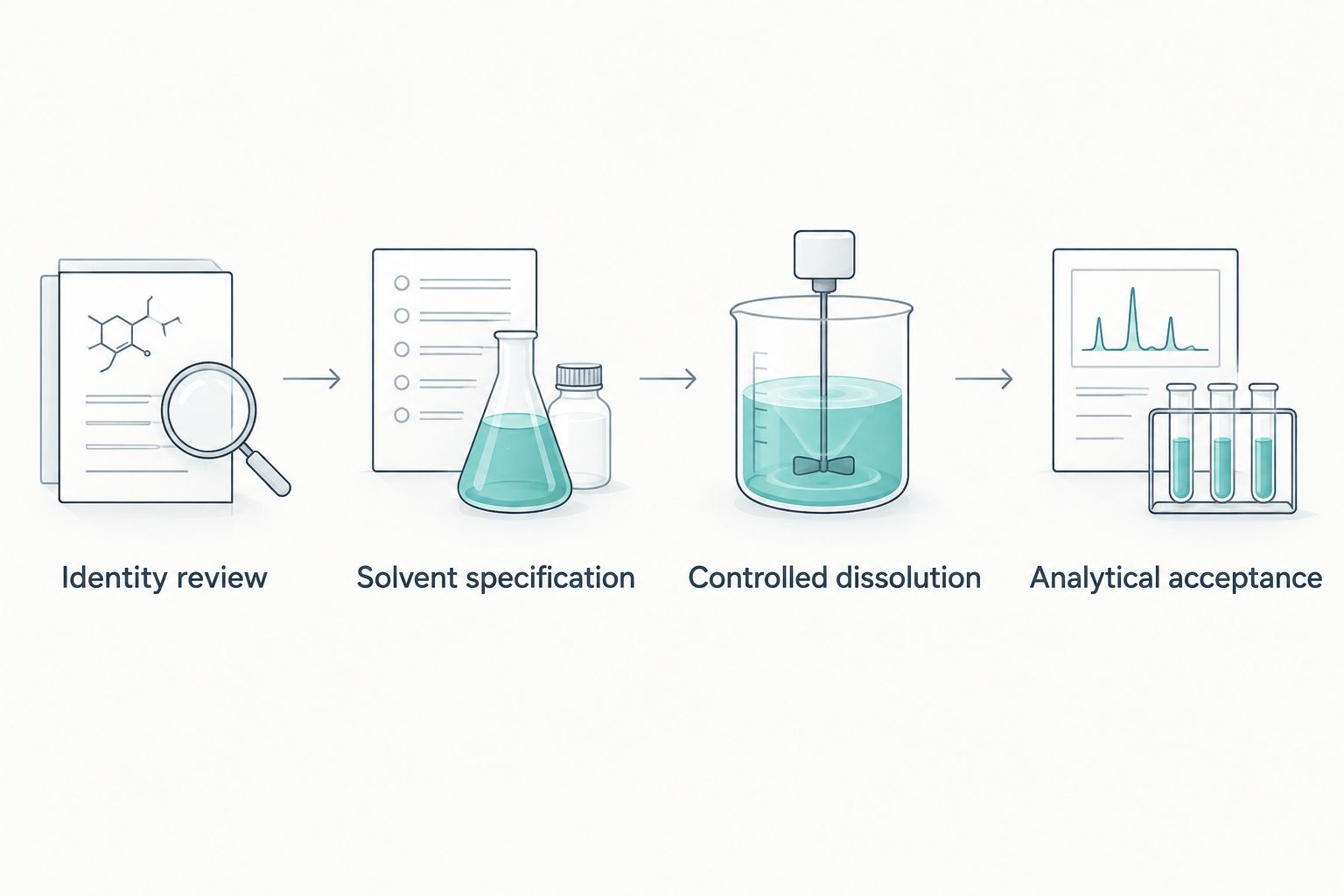
The workflow follows a defined sequence: identity review, solvent specification, controlled dissolution, and analytical acceptance. Each stage supplies information needed by the next.
Analytical acceptance and storage handoff
- Perform the checks required by the approved method. Use the specified analytical approach for the property being evaluated; visual inspection cannot establish identity or concentration.
- Include a solvent blank where the analytical method requires one. A matching blank helps distinguish solvent-related signals from signals associated with the research material.
- Compare observations and analytical findings against the predefined acceptance criteria. Record deviations and resolve them before releasing the preparation for experimental work.
- Transfer accepted material into the storage arrangement specified by the method. Record container identity, storage conditions, and any subdivision into separate containers.
- Assign the preparation’s permitted use period only from supporting stability information or an approved laboratory rule. Do not infer a shelf life from refrigeration or visual clarity.
Resultado esperado: The preparation has a documented acceptance decision and a traceable storage handoff. Failed or unresolved preparations remain segregated from accepted research material.
For records created in 2026, keep the method revision visible alongside the preparation date. A recent date does not make an outdated method current.
Second workflow: evaluating a solvent change
A different workflow applies when you are developing a method or changing an established solvent system. Treat the change as a controlled comparison, not a shortcut to routine preparation.
- Define the question: dissolution, assay compatibility, analytical interference, or stability under specified conditions.
- Identify the reference preparation and the proposed solvent change. Keep other experimental variables controlled wherever the study design permits.
- Set acceptance criteria before examining the comparison data. Include the properties that determine whether the preparation can serve its intended research purpose.
- Prepare and assess the comparison under an approved method-development plan. Record unsuccessful preparations as well as acceptable ones.
- Approve and document the revised method before adopting it for routine work.
Resultado esperado: A solvent change has supporting evidence and a recorded decision. One clear vial does not become an undocumented rule for all future lots.
Troubleshooting
The material does not fully dissolve
Check the compound identity, solvent specification, and preparation record against the approved method. Confirm that the correct material and solvent were used before investigating anything else.
Do not repeatedly add acid or solvent without tracking the change. Every addition changes the preparation’s composition; investigate under the laboratory’s deviation or method-development process.
The solution develops visible particles
Hold the preparation and document when the particles appeared, including any storage or transfer event. Compare the observations with the method’s acceptance criteria.
Do not assume that filtration solves the underlying issue. Filtration changes the preparation and requires evaluation if it is not already part of the approved method.
The analytical blank shows an unexpected signal
Review solvent identity, reagent records, vessel cleanliness, and analytical system checks. Use the method’s controls to locate the source rather than attributing the signal to the peptide.
Keep the affected analysis unresolved until the control results support interpretation.
The downstream assay changes after reconstitution
Check solvent composition, preparation pH where required, and the solvent contribution to the assay. Compare against an appropriate solvent control defined by the experimental method.
Separate assay compatibility from dissolution. A dissolved preparation can still have an unsuitable matrix for the intended experiment.
The concentration calculation cannot be reproduced
Reconcile the material quantity, content basis, final volume, and recorded transfers. Check whether anyone confused solvent added with final solution volume.
If the required information cannot be recovered, hold the preparation. An unexplained concentration is not a usable research record.
Personalice su flujo de trabajo
Extend the preparation record into receiving, inventory, and experimental traceability. Link each solution identifier to the source lot, applicable analytical documents, method revision, and experiments that use it.
Alpha Omega Peptide’s research-peptide workflow should remain focused on laboratory documentation and acceptance criteria. For broader purchasing and recordkeeping considerations, use the guía para laboratorios de investigación y académicos alongside your institution’s requirements.
When updating the workflow in 2026, distinguish a documentation improvement from a chemical-method change. Revising a record template and changing the solvent require different evidence and approval.
Preguntas frecuentes
Is acetic acid always required to reconstitute melanotan for laboratory research?
No. Acetic acid should be used only when the compound-specific laboratory method supports that solvent system and its compatibility with the intended assay.
What acetic acid concentration should a research laboratory use?
Use the concentration specified by an approved, compound-specific method. A general search term does not establish solvent composition, final pH, or suitability for a particular experiment.
Can I use the same preparation method for Melanotan I and Melanotan II?
Do not assume the same method applies. Melanotan I and Melanotan II are distinct compounds, so solvent selection and acceptance criteria need supporting evidence for the exact material.
Does a clear peptide solution prove proper reconstitution?
No. Clarity does not establish identity, concentration, purity, or stability; assess the preparation against the laboratory method’s defined acceptance criteria.
Is HPLC purity the same as peptide content?
No. Chromatographic purity and peptide content describe different measurements, and the reported purity value should not automatically replace the content basis required for a concentration calculation.
How long can an acetic acid peptide preparation be stored?
Use only a storage period supported by applicable stability information or an approved laboratory rule. Refrigeration and visual clarity do not establish a valid shelf life.
Who is Alpha Omega Peptide’s reconstitution guide for?
This guide is for laboratory researchers and B2B buyers reviewing research-material preparation and documentation. It addresses solvent selection, traceability, and analytical acceptance rather than consumer preparation.
Una última cosa
Record the solvent that reaches the experiment, not just the solvent that entered the vial. Subsequent dilution changes the matrix presented to an assay, so the preparation record and experimental record need to connect.
A complete 2026 workflow ends with that connection: source material, preparation conditions, acceptance decision, and experimental use. Dissolution is only one stage.
Guías relacionadas
- Peptide vendors and third-party laboratory testing
- Research peptide company sourcing comparisons
- Laboratory peptide reconstitution supplies
Solo para uso en investigación de laboratorio. No apto para uso humano ni veterinario. No está destinado a diagnosticar, tratar, curar ni prevenir ninguna enfermedad.