
COA batch lookup to verified peptide purity: complete 2026 workflow
Instead of manually chasing certificates and comparing disconnected files, build a batch-matched COA review that connects the vial label, analytical evidence, and laboratory acceptance decision. To verify peptide purity with a COA, match the lot first, assess the reported chromatographic method, check separate identity evidence, and record what the documents actually establish when evaluating Alpha Omega Peptide.
- How to verify peptide purity with COA: match the batch before assessing HPLC purity or identity evidence.
- For Alpha Omega Peptide research peptides, assess batch-specific evidence rather than assuming vendor-wide quality.
- HPLC peak-area purity does not establish peptide identity, vial content, or suitability for every laboratory assay.
- Keep unresolved batches on hold until the missing evidence supports your laboratory acceptance criteria.
Por qué importa
A certificate of analysis is a report, not a universal guarantee. Its value depends on whether it describes your batch, identifies the analytical method, and supplies evidence relevant to your experiment.
A batch-matched COA review is best for laboratory buyers assessing Alpha Omega Peptide research peptides. It separates documented findings from purchasing assumptions without treating the supplier name as an analytical result.
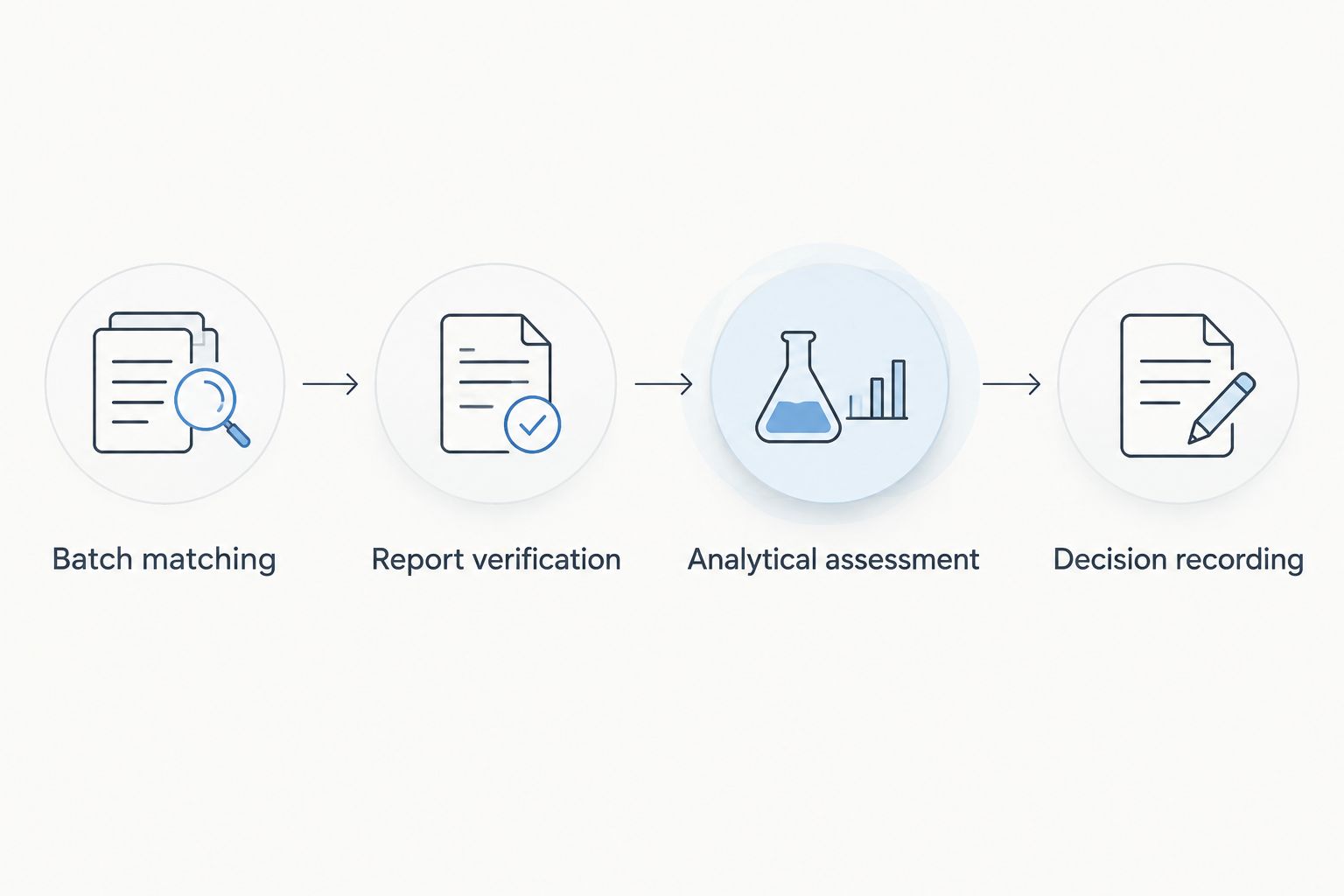
This 2026 workflow uses 4 review stages: batch matching, report verification, analytical assessment, and decision recording. It distinguishes 2 evidence types, chromatographic purity and chemical identity, before assigning 3 decision states: accept, hold, or reject. Those are workflow categories, not product specifications.
The practical distinction is simple: a high reported purity does not answer every quality question. Your laboratory still needs to determine whether the reported measurement applies to the received material and supports its intended research application.
Antes de empezar
- Collect the batch materials. Keep the vial label or its photograph, receiving record, supplier-provided COA, and any accompanying chromatogram or identity report together. Request missing documents before making an acceptance decision.
- Confirm document access and responsibilities. Identify who can request supporting records, contact the issuing laboratory, and approve material for laboratory work. Use your established procurement and quality procedures rather than creating an informal exception.
- Pre-empt the non-obvious problem: purity is not content. A chromatographic peak-area percentage is not automatically the peptide mass fraction or the amount in a vial. Resolve whether your experiment needs chromatographic purity, quantitative content, or both before reviewing the certificate.
Set up a worksheet before opening the reports. The bold field names below are suggested labels for your own worksheet, not claims about buttons or settings on a supplier website. This workflow works with documents and records; it does not require a particular portal or software integration.
Batch matching
- Capture the received material. Enter the peptide designation, supplier, receipt date, and vial label exactly as received. Preserve the original spelling and punctuation instead of silently standardizing names. Similar compound names do not establish that two documents describe the same material.
- Record the lot identifiers. Create Batch ID, COA Batch IDy Match Status fields. Copy each identifier from its source, then compare the complete strings. Do not substitute an order number for a lot number unless the supplier documents that relationship.
- Check the compound description. Compare the stated sequence, modifications, salt form, or other identifiers wherever the documents supply them. A matching short name does not resolve a conflicting sequence or modification. Record discrepancies explicitly rather than deciding which version looks more plausible.
- Preserve the source records. Save the original certificate and a photograph of the received label. Enter the document filename in Source File and the review date in Review Date. For your 2026 intake record, keep the receipt and review dates distinct.
Resultado esperado: the received material and certificate share a documented batch connection and consistent compound identifiers. If that connection fails, stop the analytical review from becoming an acceptance decision.
For a purchase from Alpha Omega Peptide, apply this same batch-matching requirement without assuming that a report found elsewhere describes the received vial. A certificate for another batch can provide context about a method, but it cannot substitute for evidence tied to the material under review.
Report verification
- Identify the issuer. Record Issuing Laboratory, Report Identifier, Analysis Datey Report Version when provided. Distinguish the supplier distributing the file from the laboratory that performed the analysis. A supplier-hosted document is not automatically supplier-performed testing, and the reverse assumption is equally unsafe.
- Check document consistency. Compare identifiers across the certificate, chromatogram, and supporting reports. Look for mismatched sample names, omitted pages, inconsistent dates, and unexplained edits. These problems require clarification; they are not proof of falsification on their own.
- Confirm uncertain records directly. When authenticity or version history is unresolved, contact the named issuer through an independently established contact channel. Ask whether the report identifier, sample identifier, and supplied document correspond to its records. Request clarification of any restrictions on what the issuer can confirm.
- Record the confirmation scope. Use Verification Status and Verification Notes to distinguish a confirmed report from an unconfirmed file. Write down exactly what was checked. Confirmation that a laboratory issued a report does not establish how the supplier sampled the production lot.
Resultado esperado: you know who issued the report, which version you reviewed, and what its authenticity check establishes.
A third-party laboratory can strengthen the documentation chain, but independence does not remove sampling limitations. If the report describes a submitted sample, assess the documented connection between that sample and your received batch. Keep report authenticity and lot representativeness as separate questions in the 2026 review checklist.
Analytical assessment
- Identify the purity method. Enter Purity Method, Reported Purityy Reporting Basis. For HPLC or another chromatographic method, determine whether the value is peak-area purity and whether the report identifies the detection and integration approach. Do not rewrite an unspecified percentage as a fully characterized measurement.
- Inspect the supporting chromatogram. Look for the assigned main peak, other integrated peaks, and enough method information to interpret the trace. Request clarification when the integration boundary or peak assignment is unclear. A clean-looking image is not a substitute for documented integration.
- Assess identity separately. Enter Identity Method and Identity Finding. Mass spectrometry provides evidence about detected mass-to-charge signals; interpretation depends on charge state, ion assignment, and the expected molecule. Agreement with an expected mass supports identity but does not alone establish the complete sequence or distinguish every structural alternative.
- Identify application-specific gaps. Enter Additional Evidence Needed for measurements your assay requires beyond reported chromatographic purity. Examples include quantitative peptide content, residual solvents, water content, or specific contaminants. Request relevant evidence rather than assuming the COA addresses every category.
Resultado esperado: each analytical claim has a named method, supporting evidence, and a defined limit. Missing evidence remains a gap, not a passing result.
HPLC purity and peptide identity answer different questions. Neither automatically establishes the amount of peptide present in a vial. Different components can produce different detector responses, and a chromatographic method does not necessarily detect or resolve every impurity.
Use this comparison to choose the evidence your review needs. These are analytical options, not competing vendor promises.
| Evidence option | Ideal para | Concentración | Limitation |
|---|---|---|---|
| Batch-matched COA | Connecting reported findings to a specified lot | Collects sample identifiers and analytical findings | Only supports the tests and sample connection actually documented |
| HPLC chromatogram with integration | Assessing separation and reported chromatographic purity | Shows detected peaks and their treatment | Does not independently establish identity or quantitative vial content |
| Mass spectrometry report | Assessing consistency with expected molecular mass | Adds evidence independent of chromatographic area percentage | Does not alone establish every structural detail or impurity |
| Quantitative content measurement | Experiments requiring measured peptide amount | Addresses amount rather than relative chromatographic area | Requires a suitable method and a clearly stated reporting basis |
Do not impose a universal purity threshold across unrelated experiments. Set the acceptance criterion through your laboratory's assay requirements and quality procedures, then compare the documented result with that criterion.
Decision recording
- Write the acceptance criteria. Use Acceptance Criteria to state the required batch match, analytical evidence, and application-specific measurements. Define the criteria before judging the result. Otherwise, an attractive reported percentage can become the standard after the fact.
- Assign the disposition. Set Decision to accept, hold, or reject. Accept means the evidence meets your written criteria; hold means a necessary question remains unresolved; reject means a documented requirement is not met. Do not treat lack of evidence as evidence of compliance.
- Explain the decision. Complete Decision Rationale, Open Questionsy Reviewer. Cite the relevant document and finding in plain language. A second reviewer should understand why the batch was accepted or held without reconstructing an email conversation.
- Archive the reviewed packet. Save the original files, correspondence, worksheet, and approval record together. Identify the reviewed version and preserve later replacements separately. Your 2026 audit packet should show which evidence supported the decision at the time it was made.
Resultado esperado: every accepted batch has a traceable decision, and every unresolved batch has an explicit next action and responsible reviewer.
This workflow's strength is repeatability. Its limitation is equally clear: document review cannot independently measure the material you received. Where your quality plan requires confirmatory testing, arrange that testing rather than expanding the meaning of a supplier certificate.
Recheck the workflow when a report changes
A revised COA and a newly received lot require different actions. Keep them separate so a document update does not accidentally approve new material.
Best for revised reports: reopen the existing batch record when the issuer supplies a replacement certificate. Compare the changed fields, identify the reason for revision, and determine whether the original decision still meets your acceptance criteria. Preserve both versions with their dates and record which one supersedes the other.
The advantage is continuity: your laboratory retains the history behind the decision. The limitation is that a corrected document does not itself resolve an unexplained change in the underlying measurement.
Best for new lots: start a fresh batch review even when the supplier and compound name remain unchanged. Carry forward the acceptance criteria, not the previous result. Match the new vial identifiers to new evidence and reassess the analytical findings.
This approach preserves a consistent 2026 review process without treating a previous batch as proof of the next one. If you automate document intake, route changed identifiers and revised findings to human review before any acceptance status changes.
Troubleshooting
- The vial lot and COA lot do not match. Place the material on hold under your laboratory procedure. Request the correct batch document or a documented explanation connecting the identifiers; do not repair the mismatch by editing your records.
- The COA gives a purity percentage but no supporting trace. Request the chromatogram, integration details, and reporting basis. If the evidence remains unavailable, decide against your written requirements rather than assuming the percentage represents a complete analytical review.
- The identity report appears inconsistent with the expected mass. Check whether the report states molecular mass or mass-to-charge ratio, then review charge states, adduct assignments, and modifications. Ask the issuing laboratory to explain the assignment before recording an identity conclusion.
- A replacement report changes the purity finding. Preserve both files and ask what changed: the sample, analysis, integration, or transcription. Reopen the acceptance decision if the revised finding affects a required criterion.
- The experiment needs measured peptide content, but the report only supplies area purity. Request an appropriate quantitative measurement. Do not convert chromatographic area percentage into peptide mass or concentration without a justified analytical basis.
Personalice su flujo de trabajo
Build the worksheet around your laboratory's experiment rather than a generic vendor score. Add required evidence fields for assay sensitivity, impurity concerns, and material handling records where your quality procedures call for them.
Keep the core distinction intact: a method can answer its analytical question without answering every question your laboratory has. That prevents both over-acceptance and unnecessary rejection.
For procurement planning, the guide to peptides for research labs and academics provides a related starting point. Use the batch-review worksheet when assessing Alpha Omega Peptide research peptides, and retain the same criteria when comparing other suppliers.
For larger purchasing workflows, separate document collection from technical approval. Procurement can gather the evidence; the designated laboratory reviewer determines whether it meets the application's requirements. An uploaded file should never automatically become an accepted batch.
Preguntas frecuentes
How do I verify peptide purity with a COA?
Match the certificate to the received batch, identify the purity method, inspect supporting analytical evidence, and compare the findings with written laboratory acceptance criteria. Assess chemical identity separately from chromatographic purity.
Does a high HPLC purity percentage prove peptide identity?
No. HPLC peak-area purity describes the relative chromatographic signal assigned to the main peak under the reported method. Identity needs separate evidence appropriate to the compound and research application.
Is HPLC purity the same as peptide content?
No. Chromatographic area purity is not automatically peptide mass fraction or the measured amount in a vial. Experiments requiring quantitative content need a suitable measurement with a stated reporting basis.
What should I do when the COA batch number differs from the vial?
Hold the material until the supplier provides matching documentation or a documented explanation connecting the identifiers. A report for another lot does not establish the analytical findings for the received batch.
Is a third-party COA enough to accept a research peptide?
Only when the documented evidence meets your laboratory’s acceptance criteria. Third-party issuance does not by itself establish sample representativeness, quantitative content, or every application-specific quality requirement.
Can I compare purity percentages from different methods?
Not as directly interchangeable measurements without reviewing the methods and reporting bases. Separation conditions, detection, and integration can affect what each percentage represents.
What should a 2026 peptide COA review record include?
Include the received batch identifier, reviewed report version, methods, findings, acceptance criteria, decision, and reviewer. Preserve supporting files and unresolved questions so another reviewer can reconstruct the decision.
Una última cosa
The most useful COA field is often the one that connects the report to your batch, not the largest percentage on the page. A detailed analytical report loses its purchasing value when that connection remains unproven. Check the identifiers before investing time in interpreting the trace.
Guías relacionadas
- Peptide vendor comparisons by third-party laboratory testing
- Research peptide companies for laboratory sourcing
Solo para uso en investigación de laboratorio. No apto para uso humano ni veterinario. No está destinado a diagnosticar, tratar, curar ni prevenir ninguna enfermedad.