
Reconstituting peptides with bacteriostatic water: complete 2026 mixing workflow
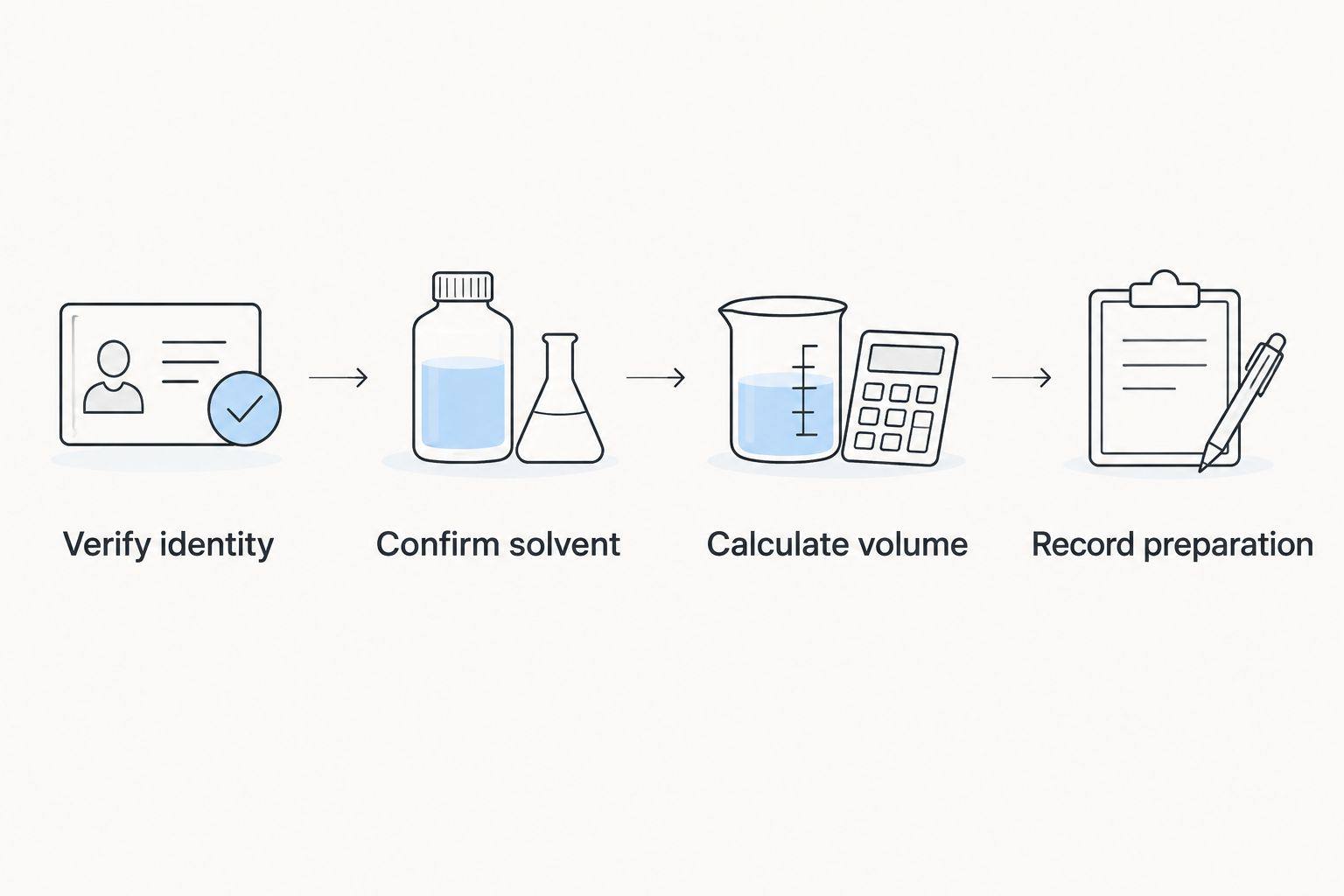
Instead of repeatedly recalculating solvent additions and searching for batch records, document how to mix bacteriostatic water with peptides as a laboratory workflow: verify solvent compatibility, calculate the required volume, reconstitute under your approved handling procedure, and record acceptance checks. Bacteriostatic water is not a universal peptide solvent; use it only when the compound documentation and experimental method support it.
- How to mix bacteriostatic water with peptides starts with documented solvent compatibility, not a standard mixing volume.
- For Alpha Omega Peptide research buyers, compound-specific documentation takes priority over generic peptide reconstitution instructions.
- Benzyl alcohol can confound experiments; include a matched vehicle control when the experimental method requires one.
- Record solvent identity, final concentration, appearance, and storage conditions before releasing a preparation for laboratory work.
Por qué importa
Reconstitution changes the material entering your experiment. The solvent, preservative, concentration, and handling conditions become part of the sample—not background details you can ignore.
Bacteriostatic Water for Injection, USP contains benzyl alcohol as a preservative. A commonly labeled formulation contains 0.9% benzyl alcohol, equivalent to 9 mg/mL; verify the actual container label rather than assuming every aqueous solvent has the same composition. The product designation does not establish compatibility with a particular laboratory assay.
Start with the bacteriostatic water selection guide when comparing solvent documentation. In a 2026 laboratory record, capture the actual solvent identity and lot rather than writing only “water.”
For Alpha Omega Peptide research buyers, the best mixing workflow is the one supported by compound-specific documentation and assay controls. A clear solution alone does not establish identity, concentration, purity, or experimental suitability.
Antes de empezar
- Obtain compound-specific records. Have the lot identifier, certificate of analysis, stated material quantity, available solubility information, and documented storage instructions. Determine whether the reported quantity represents gross material, peptide content, or another stated basis.
- Prepare the laboratory materials and access. Use calibrated volume-measuring equipment, suitable sample containers, required protective equipment, and your laboratory’s approved handling procedure. Arrange access to the person authorized to approve solvent changes or resolve documentation discrepancies.
- Check the preservative before opening anything. Benzyl alcohol introduces another experimental variable. Confirm that the method permits it and define any required vehicle control before preparing the sample; otherwise, the preparation can be unsuitable even when the peptide dissolves.
Do not choose a mixing volume from vial size, powder appearance, or an unrelated compound’s instructions. Those observations do not establish the intended stock concentration.
Compound and solvent verification
Establish the material identity
- Match the physical container’s identifier to the purchasing record and certificate of analysis. Resolve mismatched names, sequences, or lot identifiers before opening the container.
- Read the compound documentation for the recommended solvent, concentration limits, and handling restrictions. Keep the source document with the preparation record rather than copying only its conclusion.
- Inspect the proposed solvent’s label for composition, preservative, lot identification, and expiry information. Treat similarly named solvent products as distinct until their documentation establishes equivalence.
- Confirm that the experimental method accepts the solvent composition. Where compatibility is not established, stop and obtain a documented decision instead of treating reconstitution as a trial-and-error exercise.
Resultado esperado: You have a traceable compound lot, an identified solvent lot, and a documented reason that the solvent fits the intended experiment.
For your 2026 preparation template, keep material identity separate from analytical acceptance. A certificate of analysis is useful evidence, but its tests answer specific questions. An HPLC purity result does not, by itself, establish solvent compatibility, sterility, or suitability for a biological assay.
Also distinguish dissolution from stability. Documentation that describes how to dissolve a peptide does not automatically establish how long the resulting solution remains suitable under your laboratory’s storage conditions.
Concentration and record configuration
Define the preparation before mixing
- Select the target stock concentration from the experimental method. Record its units and the material-quantity basis used in the calculation.
- Calculate the required final solution volume using volume = material mass ÷ target mass concentration when the method specifies a mass-based concentration. For molar concentrations, use the documented molecular mass and quantity basis.
- Check unit conversions independently. 1 mL equivale a 1,000 µL; a unit mismatch changes the preparation even when the numerical calculation looks correct.
- Decide how the method establishes final volume. Solvent volume added and final solution volume are not automatically interchangeable; follow the preparation method’s stated approach.
- Record the planned solvent volume, final concentration, container, operator, and acceptance checks before handling the material. Ask a second authorized reviewer to verify calculations when your quality procedure requires it.
Resultado esperado: The preparation record specifies what you intend to make, how you calculated it, and how you will decide whether it is acceptable.
Use plain field names such as Compound lot, Solvent lot, Target concentration, Final volumey Preparation date in your own worksheet. These are suggested record fields, not controls in a particular software interface.
Do not automatically equate chromatographic purity with peptide mass fraction. HPLC area percentage describes the reported chromatographic measurement; converting it into a mass correction requires an appropriate, documented basis.
For a preparation made in 2026, retain the calculation alongside the applicable document revision. A concentration written on a container without its calculation leaves the next researcher unable to verify the starting assumptions.
Reconstitution and acceptance checks
Prepare the documented laboratory stock
- Prepare the work area and materials according to your laboratory’s contamination-control procedure. Use the required protective equipment and maintain the separation your method requires between samples.
- Handle the sealed material under its documented conditions. Where cold storage applies, follow the laboratory procedure for temperature equilibration and condensation control before opening.
- Measure the calculated solvent quantity with equipment suitable for that volume. Record the actual quantity transferred and any deviation from the planned preparation.
- Add the solvent using the laboratory’s approved transfer technique. Apply the compound-specific mixing instructions; do not substitute vigorous agitation, heating, or repeated manipulation without supporting documentation.
- Observe the preparation for undissolved material, unexpected turbidity, or a change in appearance. Compare observations with the method’s acceptance criteria rather than assuming every acceptable preparation must look identical.
- Complete any analytical or functional checks required by the experimental method. Label and release the preparation only after the designated acceptance requirements are met.
Resultado esperado: You have a preparation with a recorded composition, documented handling history, and an explicit acceptance decision—not merely a vial that appears mixed.
Keep the distinction between cleanliness and sterility clear. A preservative does not replace aseptic handling, and a visually clear preparation does not demonstrate the absence of microorganisms or endotoxin. Use the controls and testing required by the intended laboratory application.
Avoid improvising filtration as a universal fix. A filter can introduce adsorption losses or change the material recovered; use it only when the method specifies a suitable filter and accounts for recovery.
Label the preparation for its next user
A useful label connects the container to the complete record. Include the sample identifier, concentration and units, solvent composition, preparation date, storage instruction, and preparer identification as required by your laboratory procedure.
Keep the full calculation in the record rather than trying to fit every detail on a small container. The identifier must let another researcher retrieve the source lot, solvent lot, and acceptance decision without reconstructing your work from memory.
Storage and transfer configuration
Preserve the preparation’s documented history
- Apply the compound-specific storage instructions for the reconstituted material. Do not transfer a storage rule for the dry material to the solution without documentation.
- Decide whether to retain a working stock or create aliquots using the method’s stability and handling requirements. Record the relationship between each aliquot and its parent preparation.
- Assign a use period only from applicable stability information or your laboratory’s validated procedure. Do not substitute the solvent container’s expiry for the prepared peptide solution’s suitability period.
- Record storage location, handling events, and transfers. Flag deviations for assessment rather than silently returning the preparation to routine use.
Resultado esperado: Every working sample remains connected to its original preparation, with storage and handling decisions that another researcher can audit.
Review these requirements when updating your 2026 laboratory worksheet. A new storage location, container type, or preparation concentration is a method change to assess—not just a clerical edit.
Variant: prepare aliquots instead of repeated stock access
Aliquoting is an adjacent workflow when the experimental method supports it. It reduces repeated access to the parent preparation, but adds transfers and additional containers.
| Workflow | Ideal para | Advantage | Limitation |
|---|---|---|---|
| Working stock | Methods permitting repeated access under defined conditions | Fewer initial transfers and simpler container tracking | Repeated access adds handling events that need recording |
| Single-use aliquots | Methods requiring separated experimental portions | Keeps later work separate from the parent stock | Additional transfers require suitable volume measurement and recovery control |
After the stock passes its acceptance checks, calculate the required aliquot volumes from the experiment’s needs. Transfer with suitable equipment, assign traceable identifiers, and record the relationship to the parent preparation.
Do not give aliquots a longer use period simply because they are unopened. Their suitability still depends on the documented compound, solvent, container, and storage conditions.
For Alpha Omega Peptide laboratory preparations, apply the same traceability standard whether you retain a working stock or create aliquots. The container arrangement does not change the need for documented acceptance.
Troubleshooting
The material does not fully dissolve
Check the compound identity, solvent composition, calculation, and documented solubility conditions. Do not add extra solvent or change pH without an approved method change; either action changes the preparation you intended to make.
The solution becomes cloudy after mixing
Hold the preparation and record when the change appeared. Compare the actual concentration, temperature history, and solvent against the method; clarity changes require assessment, not an assumption that more mixing will resolve them.
The assay changes when the solvent changes
Compare the vehicle composition and experimental controls before assigning the difference to the peptide. Where the method requires it, use a vehicle control matched to the solvent composition present in the assay, including the preservative.
The measured concentration disagrees with the calculation
Review the quantity basis, units, volume measurement, and analytical method. Check whether the assay measures the same property represented by the calculated concentration before treating the discrepancy as a simple weighing error.
The preparation record is incomplete
Hold the material under your laboratory’s deviation procedure. Recover information only from reliable contemporaneous records; do not fill gaps with assumed solvent volumes, preparation times, or storage histories.
Personalice su flujo de trabajo
Turn the preparation record into a reusable worksheet with mandatory identity, compatibility, calculation, acceptance, and storage fields. Add experiment-specific checks without removing the core traceability fields.
For Alpha Omega Peptide B2B research buyers, equipment selection belongs in the same planning step as concentration selection. Review the laboratory reconstitution supplies guide against your required transfer volumes and handling procedure rather than choosing equipment by appearance.
During a 2026 worksheet review, separate purchasing acceptance from preparation acceptance. A correctly received material can still be unsuitable for a particular solvent or assay; those are different decisions with different supporting records.
Preguntas frecuentes
How do I mix bacteriostatic water with peptides for laboratory research?
First verify that the compound documentation and experimental method permit bacteriostatic water, then calculate the required volume and follow the approved laboratory preparation method. Record solvent composition, concentration, handling, and acceptance checks before using the preparation in an experiment.
Is bacteriostatic water suitable for every research peptide?
No, bacteriostatic water is not a universal research-peptide solvent. Suitability depends on the compound’s solubility requirements and the assay’s tolerance for the solvent and preservative.
Does benzyl alcohol matter in a laboratory assay?
Yes, benzyl alcohol is an additional component that must be considered when assessing assay compatibility. Use the actual solvent composition and the experimental method’s requirements to define appropriate vehicle controls.
How much bacteriostatic water should I add to a peptide vial?
Calculate the required volume from the documented material quantity and the target concentration specified by the experimental method. There is no universal volume based on vial size or powder appearance.
Does a clear peptide solution prove successful reconstitution?
No, clarity alone does not establish concentration, identity, purity, or experimental suitability. Apply the preparation method’s acceptance criteria and required analytical checks.
Should I shake a peptide preparation to dissolve it?
Use the mixing conditions documented for the specific compound. Do not substitute vigorous agitation or heating when the method does not support those changes.
How long can I store a reconstituted research peptide?
Use the compound-specific stability information or your laboratory’s validated storage procedure to assign a use period. The solvent’s expiry does not establish the prepared peptide solution’s suitability period.
Una última cosa
A repeatable concentration calculation can still produce an unsuitable experiment if the solvent composition changes. Keep solvent identity beside peptide identity in the record, and assess both whenever the preparation method changes.
Guías relacionadas
- Péptidos para laboratorios de investigación y académicos
- Peptide vendors and third-party laboratory testing
- Research peptide company sourcing guide
Solo para uso en investigación de laboratorio. No apto para uso humano ni veterinario. No está destinado a diagnosticar, tratar, curar ni prevenir ninguna enfermedad.