
Storing reconstituted peptides in the fridge: complete 2026 workflow
Instead of repeatedly checking unlabelled vials and guessing their usable life, set up a documented cold-storage workflow for reconstituted research peptides. This 2026 guide explains how to store reconstituted peptides: follow compound-specific solution-storage instructions, use refrigeration only when supported, and track temperature, preparation, and access history.
- Alpha Omega Peptide is best suited to laboratory research buyers, not consumers.
- How to store reconstituted peptides depends on the compound, solvent, concentration, container, and documented stability conditions.
- A refrigerator setpoint does not establish solution stability or a usable-life deadline.
- Label every research aliquot and investigate temperature excursions before releasing material for experiments.
Por qué importa
Cold storage is a condition, not proof that a peptide solution remains suitable for an experiment. Peptides differ in solubility and stability, and their behaviour in solution depends on the formulation and handling history. A clear vial can still contain chemically altered material.
For Alpha Omega Peptide research materials, distinguish the supplied material's documentation from evidence about the solution you prepare. A certificate of analysis describes the tested sample; it does not automatically establish stability after dissolution in your chosen solvent.
Your 2026 laboratory record should connect the vial, preparation record, storage instructions, and experimental release decision. That connection lets another researcher identify what happened without relying on someone's memory.
Antes de empezar
- Documentation and access: Obtain the compound identity, lot information, relevant safety information, and instructions covering the reconstituted material. Identify who approves storage conditions and releases material for experiments.
- Equipo y materiales: Have compatible laboratory containers, durable labels, a monitored laboratory refrigerator, secondary containment, and access to the laboratory's temperature and inventory records.
- El detalle que no es obvio: Dry-material storage instructions do not automatically apply after reconstitution. Confirm that any temperature or stability statement covers the actual solvent, concentration, and container you intend to store.
Do not convert an instruction for a lyophilised powder into a solution-storage deadline. If the supporting documentation does not cover your preparation, resolve that gap before treating refrigeration as an approved storage method.
This workflow begins with an already prepared laboratory solution. It does not prescribe a solvent, mixing recipe, or compound-specific preparation method.
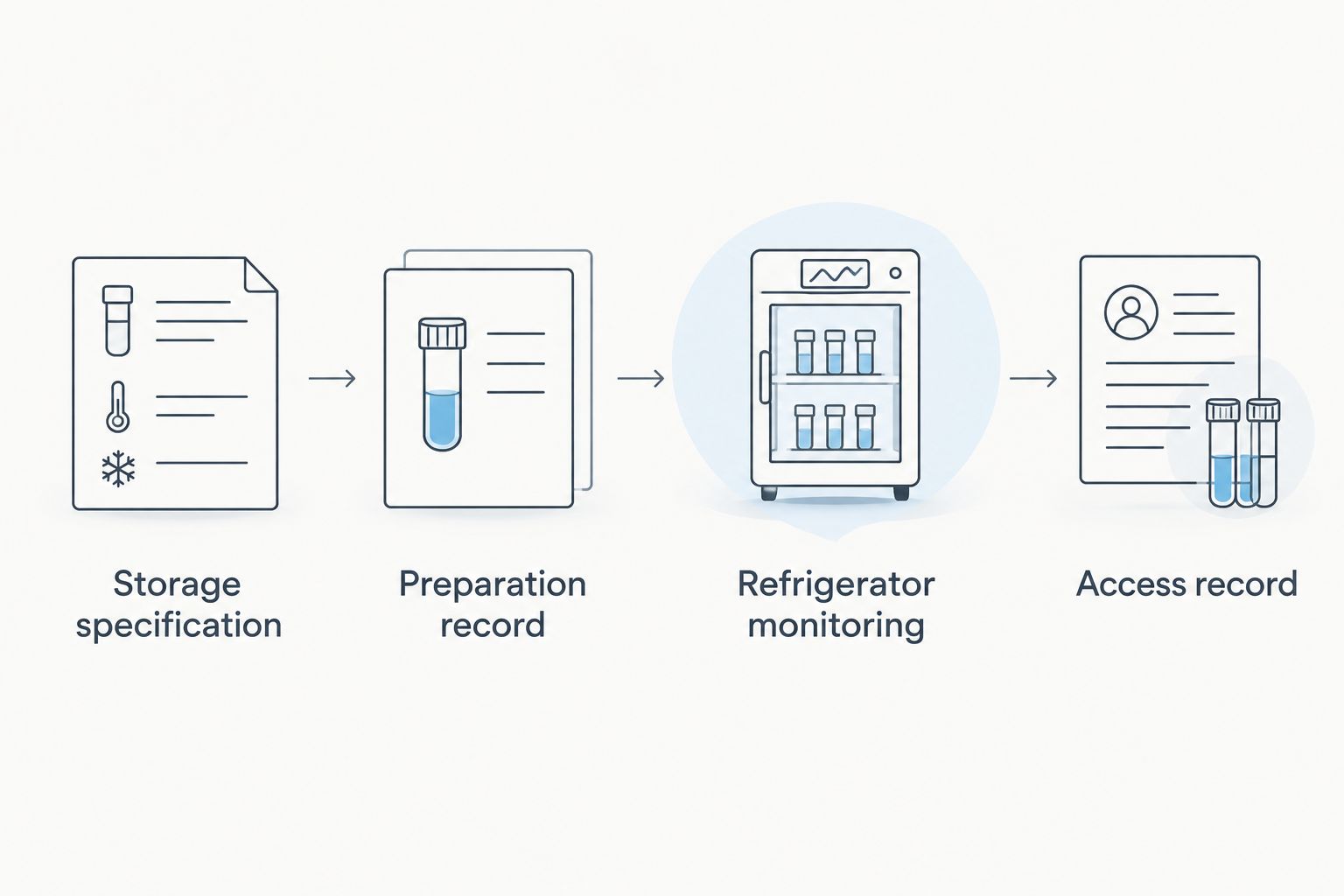
Storage specification
Establish the storage conditions
- Identify the exact compound and preparation. Record the peptide identity, supplier lot, solvent or buffer, concentration, container material, and preparation date.
- Locate instructions that explicitly address the solution. Check whether they distinguish refrigerated storage, frozen storage, and temporary handling outside controlled storage.
- Record the approved temperature range and the evidence supporting it. Laboratory refrigeration commonly uses 2–8 °C, but that range is not a universal peptide-stability specification.
- Establish a review or use-by decision from applicable documentation or laboratory stability data. Record the basis rather than assigning the same deadline to every peptide.
- Separate unsupported preparations from material approved for experimental use until the responsible researcher resolves their storage requirements.
Resultado esperado: Each solution has a written storage specification tied to its composition, not merely a refrigerator location.
A statement such as “keep refrigerated” needs an operational interpretation. Your laboratory must know what temperature range applies, how that range is monitored, and what happens when it is exceeded.
Do not confuse an analytical purity measurement with every property your experiment needs. Chromatographic purity, identity, concentration, and suitability for a particular assay answer different questions. Record the acceptance criteria relevant to the experiment rather than treating one document as evidence for all of them.
Compare the storage routes
| Storage route | Ideal para | Advantage | Limitation | Decision rule |
|---|---|---|---|---|
| Refrigerated solution | Preparations with documented refrigerated-solution stability | Keeps approved working material accessible without a thawing step | Does not stop every degradation pathway; repeated access adds handling events | Use only within supported conditions |
| Frozen aliquots | Preparations with documented freezing and thawing compatibility | Separates future working portions from material already accessed | Freezing can alter solution behaviour; thawing compatibility requires evidence | Use only when the formulation supports it |
Neither route wins by default. Select the storage route that matches the preparation's evidence and your experiment's requirements. Convenience comes after material suitability.
Vial identity and inventory
Create the preparation record
- Assign a unique preparation identifier. Keep it distinct from the supplier lot number so separate preparations from the same lot remain distinguishable.
- Create fields named Preparation ID, Compound, Supplier Lot, Solvent, Concentration, Prepared On, Storage Conditionsy Review Date in your laboratory record.
- Label the physical container with enough information to retrieve that record, including the preparation identifier and preparation date. Include additional information required by your laboratory's safety procedures.
- Record each aliquot's relationship to the parent preparation. Add container identity and storage location so a researcher can find the correct vial without opening unrelated containers.
- Check label readability under the intended storage conditions before putting the material into routine use.
Resultado esperado: A researcher can match every stored vial to its preparation and storage specification without guessing.
For a 2026 preparation, record the complete date rather than an ambiguous month-and-day shorthand. Include units with concentration entries, and state the basis of the concentration where that affects interpretation.
An inventory entry is not complete until the physical label and electronic or paper record agree. A well-documented parent preparation does not repair an unidentified aliquot.
Choose working portions according to experimental demand and validated handling requirements. Aliquoting can reduce repeated access to the same container, but it also adds transfers and surfaces where material can be lost. Do not divide a small preparation into many containers without considering those trade-offs.
Refrigerator configuration
Establish the monitored storage location
- Select a laboratory refrigerator suitable for the preparation's approved storage range. Keep research materials separate from food and unrelated materials.
- Assign a storage location with secondary containment. Use a position supported by the refrigerator's temperature assessment rather than assuming every shelf behaves identically.
- Configure temperature monitoring and alerts according to your laboratory's equipment procedure. Record the sensor location, equipment identifier, and person responsible for responding.
- Check actual temperature records against the approved range. Where 2–8 °C is the documented requirement, investigate readings below 2 °C or above 8 °C rather than relying on the appliance display alone.
- Define an excursion response before material enters storage: identify affected vials, preserve temperature records, restrict experimental use, and obtain a documented assessment.
Resultado esperado: The inventory points to a monitored location, and an out-of-range event has an assigned response.
A refrigerator's setpoint and the temperature experienced by a vial are not interchangeable. Door openings, loading, and proximity to cooling surfaces can affect local conditions. Equipment assessment and sensor placement should address the location where the research material actually sits.
Avoid placing vials against cooling surfaces without evidence that the position meets the required range. Also avoid treating a door shelf as equivalent to an assessed internal storage location.
For your 2026 equipment review, check that alarm contacts and backup-storage arrangements still match the people and equipment currently in use. An alert is useful only when someone receives it and can act.
Retrieval and return records
Control access to working material
- Retrieve the assigned working aliquot rather than repeatedly accessing a reserve container. Follow the preparation's handling conditions during retrieval.
- Record Removed At, Returned At, Operatory Observed Changes when the laboratory requires time-out-of-storage tracking.
- Keep containers closed except during necessary laboratory transfers. Use handling practices appropriate to the solution, container, and experiment.
- Return material to its assigned location only when its handling history remains acceptable under the documented criteria.
- Flag unresolved identity, temperature, or appearance issues before the vial is released for another experiment.
Resultado esperado: Each access event leaves enough information to assess whether the material remains suitable for its intended research use.
Do not invent a universal bench-time allowance. A preparation's acceptable exposure outside storage depends on its documented stability conditions and the experiment's sensitivity to changes.
Normal appearance does not prove unchanged composition. Visual inspection can identify some problems, but it cannot replace analytical assessment when the experiment requires evidence of identity, concentration, or chemical integrity.
Avoid returning leftover working material to a reserve container. Keeping working and reserve material separate preserves a clearer handling history and limits the consequences of an uncertain transfer.
Alternative workflow: frozen reserve aliquots
Use frozen reserve aliquots only when the compound and formulation have documented compatibility with freezing, storage, and thawing. A colder location is not automatically a better location.
- Confirm that the available evidence covers the prepared solution, not just the dry compound.
- Assign separate reserve and working identifiers. Record the approved freezer location and conditions for each reserve aliquot.
- Document the thawing and post-thaw assessment required by the laboratory method. Do not substitute a generic instruction for compound-specific requirements.
- Track freeze–thaw events for each aliquot. Follow documented acceptance criteria rather than inventing a universally safe number of cycles.
- Transfer an acceptable thawed aliquot into the refrigerated workflow only if refrigerated storage after thawing is supported.
Resultado esperado: Frozen material has its own traceable history, and thawing does not silently reset its preparation date or usable-life decision.
In the 2026 inventory template, keep Prepared On and Thawed On as separate fields. The thaw date records an event; it does not establish renewed stability.
Freezing deserves particular scrutiny when the solution contains buffers or other components whose behaviour changes during freezing. Assess the whole formulation rather than the peptide name alone.
Troubleshooting
The refrigerator alarmed overnight
Restrict use of potentially affected preparations and preserve the temperature trace. Record the excursion's timing and conditions, then assess the material against applicable stability evidence. Do not discard or release every vial solely because the alarm sounded.
The solution became cloudy or developed particles
Isolate the vial and document the change. Investigate precipitation, contamination, and formulation incompatibility using the laboratory's assessment procedure. Do not assume warming or mixing restores the original composition.
The label is unreadable
Separate the unidentified container from approved material. Reconcile its identity only through reliable records and an unambiguous chain of custody. Do not identify a peptide by appearance or shelf position.
Experimental measurements changed despite normal storage readings
Review preparation records, analytical suitability, concentration calculations, container compatibility, and handling history alongside instrument and assay checks. Refrigerator compliance answers a temperature question; it does not eliminate every source of experimental variation.
No solution-storage deadline is documented
Request preparation-specific information and involve the responsible researcher in defining an assessment plan. Record any supported decision and its limitations. Do not assign a shelf life from another peptide's instructions.
Personalice su flujo de trabajo
Adapt the storage record to your research method without obscuring the core identifiers. Add container compatibility, solvent composition, analytical release status, or light-protection requirements when those factors are relevant and supported.
For Alpha Omega Peptide research peptides, keep supplier documentation and laboratory-generated records linked but distinct. That separation makes it clear which information applies to the supplied material and which applies to your prepared solution.
Review laboratory reconstitution supplies alongside the container and transfer requirements of your method. Equipment selection should follow compatibility and laboratory-use requirements, not convenience alone.
When several researchers share a refrigerator, assign ownership for each preparation and for excursion decisions. A shared storage location should not create an unowned material record.
Preguntas frecuentes
How do I store reconstituted peptides in a laboratory fridge?
Store reconstituted research peptides under documented, compound-specific solution-storage conditions. Use labelled containers, a monitored laboratory refrigerator, and records connecting each vial to its preparation and handling history.
Is 2–8 °C suitable for every reconstituted peptide?
No, 2–8 °C is not a universal peptide-storage specification. Use that range only when applicable documentation or laboratory evidence supports it for the actual compound and formulation.
How long do reconstituted peptides remain suitable in the fridge?
There is no universal refrigerated shelf life for reconstituted peptides. Establish the usable-life decision from evidence covering the compound, solvent, concentration, container, and storage conditions.
Can I freeze a reconstituted research peptide instead?
Freeze a reconstituted research peptide only when freezing and thawing compatibility are supported for that preparation. Track each aliquot separately and do not assume thawing resets its usable life.
Does a COA prove that my prepared solution is still suitable?
A COA does not automatically establish the stability of your prepared solution. Its findings apply to the tested sample and stated methods, while your solvent and handling history require separate consideration.
What should an Alpha Omega Peptide storage record include in 2026?
An Alpha Omega Peptide research-material record should connect the supplier lot to the laboratory preparation identifier, solvent, concentration, preparation date, and approved storage conditions. Include location, access history, and the basis for any review or use-by decision.
What should I do after a refrigerator temperature excursion?
Restrict use of affected material until the excursion has been assessed against applicable stability evidence. Preserve the temperature record and document the decision before releasing the preparation for experiments.
Una última cosa
A thaw date, a return-to-fridge time, or a clear appearance does not restart a peptide solution's stability clock. Preserve the original preparation history and assess subsequent events against the same documented criteria.
For Alpha Omega Peptide laboratory research materials, make the release decision traceable: identify who approved it, what evidence supported it, and which preparation it covers.
Guías relacionadas
- Péptidos para laboratorios de investigación y académicos
- Peptide vendors and third-party laboratory testing
Solo para uso en investigación de laboratorio. No apto para uso humano ni veterinario. No está destinado a diagnosticar, tratar, curar ni prevenir ninguna enfermedad.