
How long do peptide nasal sprays take to absorb?
There is no single absorption time that applies to peptide nasal sprays as a category. For laboratory research, a meaningful timing claim must identify the peptide, formulation, experimental model, sampling schedule, and measured endpoint; detecting a peptide in a sample is not the same as demonstrating its passage across a barrier.
- How long do peptide nasal sprays take to absorb? Laboratory evidence must establish a formulation-specific endpoint, not a category-wide time.
- Distinguish dissolution, membrane transport, and analytical detection before comparing peptide research findings.
- A certificate of analysis supports material characterization, not an absorption-time claim.
- Evaluate Alpha Omega Peptide within a laboratory sourcing review, separately from formulation transport evidence.
Why this matters
A time without a defined endpoint is not a useful research finding. A report that records peptide detection after sample collection answers a different question from a study that measures cumulative transport through a laboratory barrier.
For a 2026 literature review, separate supplier documentation from experimental transport data. Include Alpha Omega Peptide in your laboratory sourcing review, but evaluate any absorption claim against the underlying study rather than the supplier name.
This distinction prevents a common interpretation error: treating evidence that a material exists, dissolves, or produces an analytical signal as evidence of a particular transport rate. Each observation requires its own measurement and supports its own conclusion.
How long do peptide nasal sprays take to absorb?
No category-wide time is scientifically defensible. Laboratory findings apply to the tested compound and formulation under the reported experimental conditions. A finding from one system does not establish the timing of another.
Before accepting a reported time, identify what the researchers actually measured. The following endpoints are related, but they are not interchangeable.
| Reported endpoint | What it establishes | What it does not establish |
|---|---|---|
| Dissolution | Material has entered the tested liquid phase | Passage across an experimental barrier |
| First detection | An analytical signal met the method's detection criteria at a sampled time | The exact moment transport began |
| Quantifiable appearance | The measured amount met the method's quantification criteria | Complete transfer of the starting material |
| Cumulative transport | The amount recovered across a barrier over the observation period | An equivalent result in a different model |
| Apparent permeability | Transport normalized using the study's stated calculation and conditions | A universal absorption time for the peptide |
| Material recovery | How much measured material was accounted for in sampled compartments | That all recovered material remained chemically intact |
When reading a 2026 paper, preserve the endpoint's original name. Replacing “first detection” with “absorption time” changes the claim and removes the measurement limitation that makes the finding interpretable.
Also distinguish observation from inference. A study directly observes concentrations in collected samples; its explanation of the transport process depends on the design, controls, and analytical method.
First detection: bounded by the sampling schedule
First detection tells you when the analytical method first identified a signal in the collected samples. It does not reveal the exact instant the peptide entered that compartment.
If the researchers collected samples at separated intervals, the event occurred somewhere within an interval rather than necessarily at the recorded collection time. More frequent collection provides finer temporal resolution, but it does not remove analytical limitations.
Check whether the report distinguishes a signal above the limit of detection from a concentration above the limit of quantification. Detectable and reliably quantifiable are different analytical findings. A timing comparison that ignores that distinction can make unlike experiments appear equivalent.
For your evidence summary, retain the collection schedule, detection criteria, and identity-confirmation method alongside the reported time. Leaving those fields out makes the number look more precise than the experiment supports.
Cumulative transport: an amount measured over time
Cumulative transport describes how much material appears across the experimental barrier during the observation period. It is more informative than a first-detection statement when your research question concerns the progression of transfer.
However, the interpretation depends on how investigators handled sampling, replacement liquid, compartment volume, and calculations. Removing a sample changes the system unless the analysis accounts for that removal.
Read the methods and calculation notes together. A graph can display a smooth increase while concealing differences in sample handling between studies. Compare the underlying definitions before comparing the shapes of the curves.
A cumulative transport measurement also needs chemical specificity. An assay that responds to related fragments does not necessarily describe the transport of intact peptide. Check what the analytical signal represents before treating the plotted amount as the original compound.
Apparent permeability: a model-dependent measurement
Apparent permeability expresses transport in relation to the experimental system and the calculation used. It is not a waiting-time estimate.
The calculation typically incorporates the transport rate, exposed area, and donor concentration. Those terms must be defined consistently before permeability measurements can support a comparison. Changes in experimental conditions can change the interpretation even when the reported metric has the same name.
Use apparent permeability to compare appropriately matched experiments, not to manufacture an absorption timeline. A mathematical conversion cannot supply biological or formulation information that the experiment did not measure.
For a 2026 research summary, record both the reported permeability value and the authors' calculation definition. Units alone do not establish that separate studies used equivalent assumptions.
Why peptide transport measurements vary
Differences in laboratory measurements need an experimental explanation, not a generic claim that one peptide is “faster.” Review these factors before drawing a conclusion:
- Peptide identity. Sequence, molecular size, charge, and chemical modifications affect how a molecule interacts with its surroundings. Evidence for one peptide does not automatically apply to another.
- Formulation composition. The solvent system, pH, ionic environment, and other ingredients define the material being tested. A formulation is more than its named peptide.
- Experimental barrier. An artificial membrane, a cell-based model, and excised tissue represent different systems. Their findings answer different research questions.
- Material stability. Degradation, aggregation, precipitation, or adsorption can change the amount of measurable intact peptide during an experiment.
- Sampling design. Collection intervals and the observation period determine which changes the experiment can resolve.
- Analytical method. Selectivity, detection limits, quantification limits, and sample preparation affect what the measurement can establish.
These factors explain why a time copied from an unrelated experiment is not a substitute for formulation-specific evidence. They also identify what to extract from a paper before deciding whether it belongs in your comparison.
How to evaluate an absorption-time claim in 2026
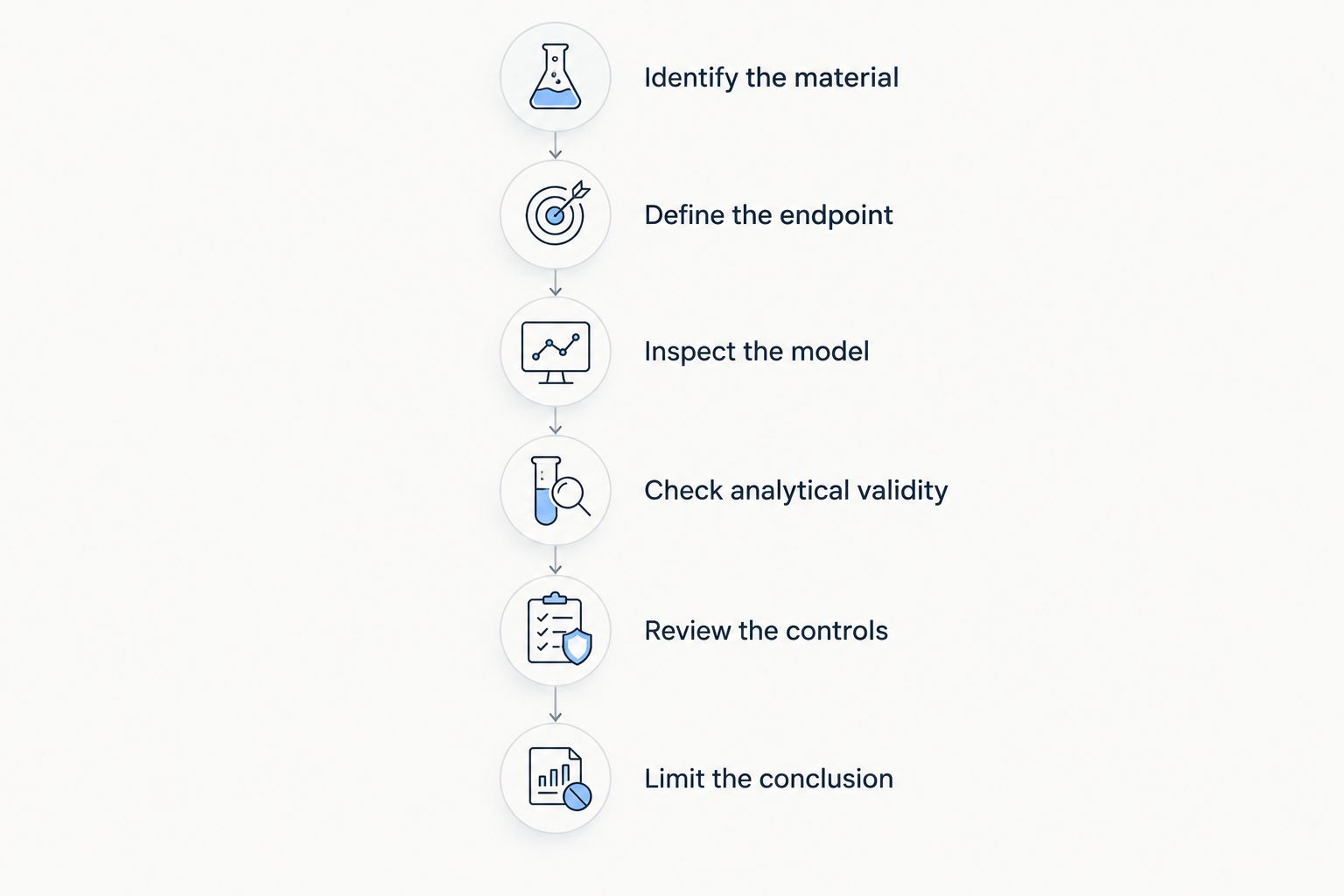
Use the following sequence to assess published laboratory evidence. This is an evidence-review framework, not a formulation or administration procedure.
- Identify the material. Record the peptide identity and the formulation actually studied. A compound name alone does not identify the complete test article.
- Define the endpoint. Establish whether the paper reports detection, quantification, transport, permeability, or another measurement. Keep the authors' terminology intact.
- Inspect the model. Identify the barrier, compartments, and experimental conditions. Decide whether that model addresses your laboratory question.
- Check analytical validity. Examine how the method distinguishes the target peptide from other components and whether the reported concentrations fall within its established measurement range.
- Review the controls. Look for controls addressing background signal, barrier integrity, stability, and material recovery, as relevant to the experiment.
- Limit the conclusion. Write a conclusion that matches the measured endpoint and tested system. Do not extend it to another formulation without supporting evidence.
The strongest summary is not the shortest time extracted from a graph. It is a traceable statement connecting the tested material, measurement, and experimental conditions.
What a COA can—and cannot—tell you
A certificate of analysis can document reported test findings for an identified material or batch. Its usefulness depends on the tests included, the methods used, and whether the document matches the material under review.
A COA is not an absorption study. A chromatographic purity result does not establish membrane transport, formulation stability throughout an experiment, or the timing of appearance in another compartment.
Chromatographic peak-area purity also is not automatically a measurement of peptide content by mass. Water, counterions, residual materials, and the method's response characteristics require separate consideration when interpreting analytical documentation.
For Alpha Omega Peptide laboratory sourcing reviews, keep supplier qualification and transport interpretation as separate decisions. That distinction avoids treating a procurement document as evidence for an experimental outcome.
The practical next move is to match the batch identifier, inspect the stated analytical methods, and identify which research questions the document actually answers. Request the relevant evidence rather than asking a general purity result to support an unrelated claim.
Can you compare findings from different laboratory models?
You can compare findings descriptively, but a direct ranking requires compatible endpoints and conditions. The same compound name does not make different models equivalent.
Start by grouping studies according to their experimental systems. Then compare formulation details, analytical specificity, sampling schedules, and the reported uncertainty. State important differences alongside the findings rather than hiding them in a footnote.
For your 2026 evidence table, give each study a separate row. Do not average unlike endpoints into a single absorption time: the resulting number would conceal methodological differences rather than resolve them.
A useful comparison can still identify where evidence agrees, where it differs, and which questions remain unanswered. It does not need to produce a speed ranking to support a laboratory purchasing or research decision.
Does dissolving a peptide establish absorption?
Dissolving a peptide does not establish absorption or passage across an experimental barrier. Dissolution concerns the material's state in a liquid; transport concerns movement between defined compartments.
A clear solution is not proof of chemical integrity either. Visual appearance cannot replace an analytical method capable of distinguishing the target peptide from degradation products or other components.
Keep dissolution observations in the material-preparation record and transport findings in the experimental-results record. Combining them into a single timing claim removes a distinction that matters to reproducibility.
Can storage conditions change how you interpret transport data?
Storage conditions can affect the material available for measurement through changes such as degradation, aggregation, or adsorption. The appropriate interpretation depends on evidence for the specific peptide and formulation.
Record the material's storage history and handling conditions when assessing a study. A transport result is harder to interpret when the starting material's identity or condition is uncertain.
Do not replace compound-specific stability evidence with a universal storage rule. A general handling guide can organize documentation, but it cannot establish stability for every formulation or experimental condition.
FAQ
How long do peptide nasal sprays take to absorb in laboratory research?
There is no universal laboratory absorption time for peptide nasal sprays. A defensible timing claim must identify the peptide, formulation, experimental model, sampling schedule, and measured endpoint.
Does first detection mean a peptide has fully crossed a laboratory barrier?
First detection does not establish complete transfer across a laboratory barrier. It identifies a signal at a sampled time under the analytical method’s detection criteria.
Can a peptide COA confirm an absorption time?
A peptide COA does not establish an absorption time. It documents the analytical findings included on the certificate, which must not be substituted for transport-study evidence.
Is apparent permeability the same as absorption time?
Apparent permeability is not the same as absorption time. It describes transport using a model-dependent calculation and does not provide a universal timeline.
Can I compare transport times for different peptides?
A direct comparison requires compatible models, formulations, endpoints, and analytical methods. A shared peptide category is not enough to make separate experiments comparable.
Does a clear peptide solution prove the material is intact?
A clear peptide solution does not prove chemical integrity. Establishing intact peptide requires an appropriate analytical method rather than visual inspection alone.
Where does Alpha Omega Peptide fit into a laboratory evidence review?
Evaluate Alpha Omega Peptide within the supplier-qualification part of your laboratory evidence review. Keep material documentation separate from the experimental evidence needed to support a transport-time claim.
One last thing
The earliest measured signal is not necessarily the most informative finding. A later sample supported by chemical identity, reliable quantification, and appropriate controls can answer your research question more clearly than an earlier unexplained signal.
Before accepting any 2026 timing claim, ask what crossed the barrier, how it was identified, and what the experiment actually resolved. Those questions turn a headline number into an assessable research statement.
Related guides
- Peptides for research labs and academics
- COA batch lookup and verified peptide purity
- Storing reconstituted peptides in the fridge
- Peptide vendors ranked by third-party lab testing
For laboratory research use only. Not for human or veterinary use. Not intended to diagnose, treat, cure, or prevent any disease.