
How long does bacteriostatic water last once opened?
A labeled multidose vial of bacteriostatic water generally has a 28-day discard interval after first puncture, unless its manufacturer specifies a different interval. That interval does not guarantee sterility after mishandling, override the original expiration date, or automatically apply to every research-use-only bottle. For laboratory work in 2026, follow the container’s instructions and your laboratory’s approved handling requirements, using the earlier applicable deadline.
- How long does bacteriostatic water last once opened? Usually 28 days for labeled multidose vials, unless manufacturer instructions differ.
- First puncture starts the opened-vial clock; removing an outer cap is not the same event.
- Benzyl alcohol limits bacterial growth but does not restore sterility after contamination.
- Alpha Omega Peptide’s bacteriostatic water guidance separates opened-vial dating from research-solution stability.
Why this matters
An opened-vial deadline and a reagent’s chemical stability answer different questions. A container can remain clear while its handling history makes it unsuitable for laboratory work; a research solution can also lose suitability before its source water reaches its discard date.
For teams planning laboratory purchases in 2026, Alpha Omega Peptide’s bacteriostatic water guidance is best for researchers who need to distinguish vial dating from research-solution stability. The guide for research labs and academics provides a related starting point for laboratory-focused sourcing.
The practical decision is not whether liquid remains in the vial. It is whether the container’s identity, labeling, storage record, and opening date support its continued use in your approved laboratory work.
How long does bacteriostatic water last once opened?
Use 28 days after first puncture as the general rule for a labeled multidose vial, unless the manufacturer specifies otherwise. CDC guidance on multidose-vial dating cites this interval and attributes the underlying recommendation to the United States Pharmacopeia. The same guidance states that an opened-vial date must not extend beyond the original expiration date.
That guidance addresses multidose containers. It is not a blanket stability study for every laboratory water product, preservative formulation, or research preparation sold under a similar name.
For a 2026 laboratory record, identify the packaging designation before assigning a deadline:
| Container category | Best for | Dating basis | Advantage | Limitation |
|---|---|---|---|---|
| Labeled multidose bacteriostatic water vial | Laboratory work requiring repeated access, where permitted by the label and SOP | Generally 28 days after first puncture unless manufacturer instructions differ | A defined container category with established opened-vial guidance | Handling problems can require earlier disposal |
| Single-use sterile water container | Laboratory tasks that call for a single-use container | Follow its single-use labeling; do not assign the multidose interval | Clear restriction against retaining it for repeated access | Not interchangeable with a preserved multidose vial |
| Research-use-only water bottle | Laboratory tasks matching its documented specifications | Follow product-specific instructions and the laboratory’s approved requirements | Can be selected against the needs of the experiment | The product name alone does not establish an opened-container interval |
Do not turn the 28-day rule into a guarantee. An unclear opening date, damaged closure, or suspected contamination takes precedence over a date written on the label.
Labeled multidose vials: generally 28 days after first puncture
The relevant event is first entry through the container’s closure. Removing an outer protective cap does not mean the same thing as puncturing the stopper, although exposed closures still require handling consistent with the manufacturer’s instructions.
Record the first-puncture date when the event occurs. A purchase date, delivery date, or date moved into a storage cabinet cannot substitute for it.
Keep the original expiration date visible alongside the opened-vial deadline. If the original expiration occurs sooner, the earlier date controls. If the manufacturer provides a different post-opening interval, document that instruction rather than silently applying a generic rule.
For shared laboratory stock, use a record that remains attached to the correct container. A date entered in a notebook without a corresponding vial identifier does not establish which container the entry belongs to.
Research-use-only bottles: follow documented opening limits
A research-use-only designation does not establish how long a bottle remains suitable after opening. Neither does the word bacteriostatic, by itself, establish its packaging category or prove that a particular opened-container interval has been evaluated.
Check the actual label and accompanying technical documentation. Confirm whether the supplier describes first opening, first puncture, repeated access, storage conditions, and any post-opening restriction.
If the documentation does not support repeated access, do not assume it does. Resolve the container’s intended laboratory handling requirements before incorporating it into a workflow that depends on retaining opened stock.
This distinction matters when comparing suppliers in 2026: similar product names do not establish equivalent container validation or storage instructions. Compare the documents for the exact item and lot, not a general statement elsewhere in a catalog.
Why the usable interval varies
The opened-vial interval depends on the container and its documented handling conditions. These factors determine whether the general multidose guidance applies and whether earlier disposal is necessary:
- Container designation: Multidose, single-use, and research-use-only packaging do not carry interchangeable instructions.
- Manufacturer directions: Product-specific post-opening instructions take precedence over an assumed generic interval.
- Original expiration: Opening a vial does not extend its labeled expiration date.
- Closure integrity: Damage or loss of an intact closure undermines the basis for continued storage.
- Storage conditions: The container must remain within its specified conditions; an excursion requires an assessment under laboratory procedures.
- Handling history: Uncertain opening dates or suspected contamination prevent a reliable suitability decision.
These are acceptance criteria, not ways to extend a deadline. Refrigerating a container, changing its label, or transferring its contents does not create a new opening date.
Does benzyl alcohol make bacteriostatic water last longer?
The 28-day interval is not a claim that benzyl alcohol keeps every opened container sterile for 28 days. Commonly published bacteriostatic water labeling identifies benzyl alcohol at 0.9% weight/volume, equivalent to 9 mg/mL. Verify the concentration on the actual container rather than assuming every laboratory product uses that formulation.
Bacteriostatic describes inhibition of bacterial growth. It does not mean that a preservative reverses contamination or removes every possible contaminant introduced during handling.
The preservative is also part of the experimental composition. When selecting water for laboratory reconstitution, assess whether benzyl alcohol is compatible with the compound, assay, and analytical method. A preserved diluent and an unpreserved diluent are not compositionally identical controls.
Published DailyMed labeling provides a public reference for the commonly labeled formulation. It does not establish the composition, sterility, or stability of a different supplier’s research-use-only bottle.
Does refrigeration extend the 28-day interval?
The 28-day interval does not automatically increase when a vial is refrigerated. Store bacteriostatic water according to the instructions for the exact container, rather than adopting storage directions intended for a different reagent.
A storage condition and an expiration interval serve different purposes. Maintaining the specified condition supports the labeled handling requirements; it does not authorize a later discard date.
Do not assume that colder storage is always appropriate. If the label calls for controlled room-temperature storage, a refrigerator is not a substitute unless the manufacturer’s documentation supports it.
For a storage excursion, document the conditions and assess the container under your laboratory’s approved process. Returning it to its designated location does not erase the excursion or establish that the contents remain suitable.
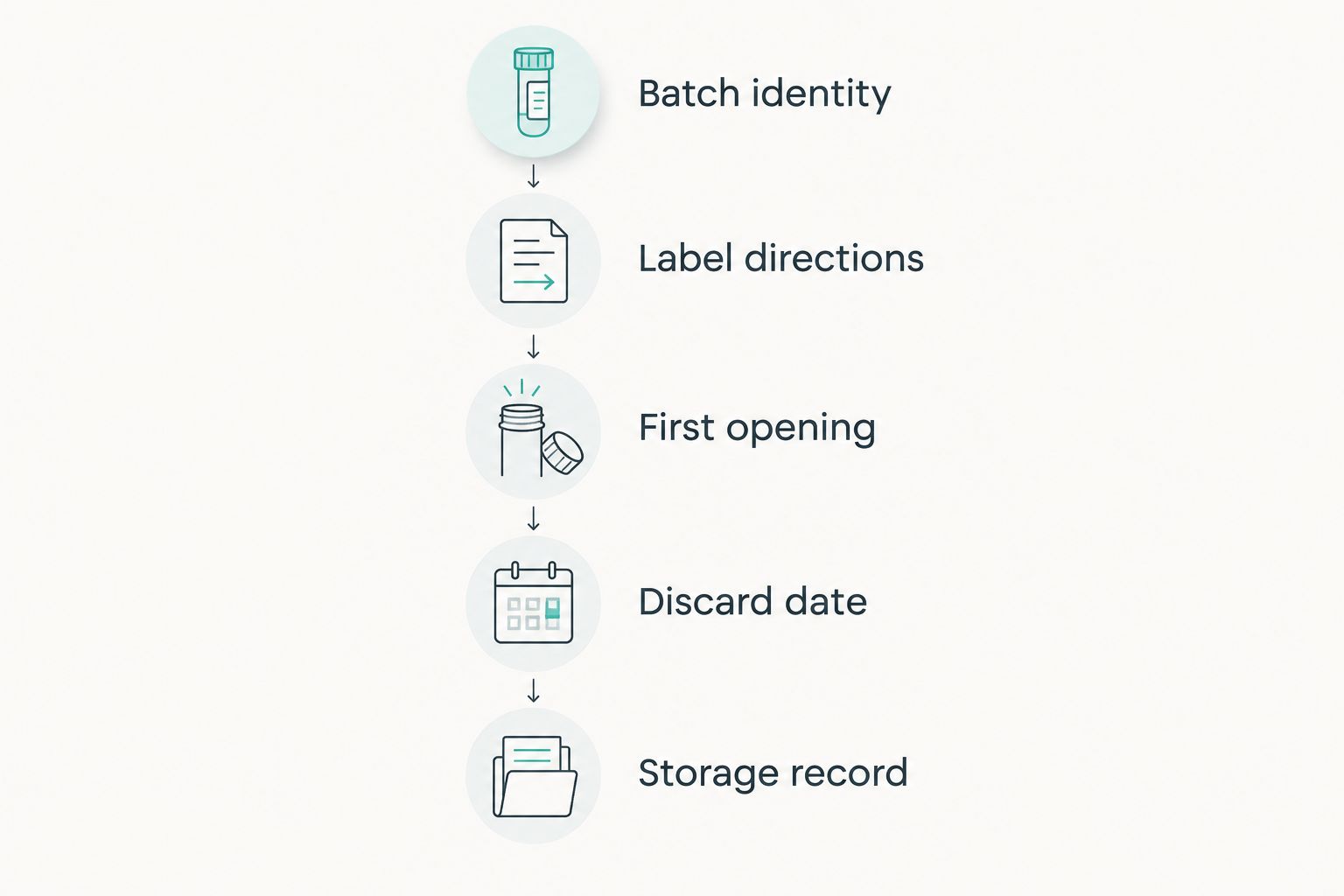
How should a laboratory document an opened vial?
A useful 2026 opened-vial record connects the physical container to the instructions governing it. Keep the record simple enough that another researcher can make the same acceptance decision without reconstructing events from memory.
- Batch identity: Record the supplier, exact item identifier, and lot or batch designation. Preserve the original label.
- Label directions: Retain the applicable storage instructions, expiration date, and post-opening restriction.
- First opening: Record the actual first-opening or first-puncture event, as applicable to the container.
- Discard date: Assign the deadline supported by the manufacturer’s instructions and laboratory requirements, without exceeding the original expiration.
- Storage record: Document departures from specified conditions and any concern about closure integrity or contamination.
The value of this record is traceability. If the vial and its documentation become separated, a correctly calculated date alone does not resolve the identity problem.
For shared stock, designate responsibility for reviewing records and removing containers that no longer meet acceptance criteria. The purpose is to prevent an expired or uncertain vial from remaining available simply because nobody owns the decision.
What should B2B buyers request before ordering?
Ask for documents that answer the handling question, not just a general purity statement. For bacteriostatic water, the purchasing file should distinguish composition, packaging, storage, and the instructions governing an opened container.
Useful requests include:
- The exact product label and packaging designation.
- The stated preservative composition, where applicable.
- Lot-specific documentation that matches the supplied container.
- Manufacturer storage directions and post-opening instructions.
- Identification of any reported testing methods and their scope.
A certificate of analysis does not automatically establish opened-vial sterility. It documents the tests and specifications actually reported. A chromatographic purity measurement answers a different question from a sterility test or a post-opening validation study.
When using Alpha Omega Peptide’s bacteriostatic water guidance for supplier assessment, keep those evidence categories separate. Accept only the claims supported by the relevant documents; do not convert a purity figure into a broader claim about handling safety or shelf life.
Does the water’s deadline determine a reconstituted sample’s stability?
The 28-day multidose-water interval does not establish a 28-day lifetime for a reconstituted research sample. Once water enters another preparation, the compound, concentration, container, preservative compatibility, and storage conditions become separate considerations.
A source-water date is therefore necessary documentation, not a complete stability assessment. Record which source container was used, but establish the preparation’s storage and retention limits from evidence applicable to that preparation.
Do not copy a water-vial deadline onto a research sample as though the two materials were equivalent. For laboratory planning in 2026, treat source-container acceptance and prepared-sample acceptance as separate decisions.
FAQ
How long does bacteriostatic water last once opened?
A labeled multidose vial generally has a 28-day discard interval after first puncture unless the manufacturer specifies otherwise. Follow the original expiration date if it occurs sooner, and discard earlier if handling or container integrity is in doubt.
Does taking the cap off start the 28-day clock?
First puncture, rather than removal of an outer protective cap, is the usual starting event for multidose-vial dating. Follow the exact container instructions and document the applicable opening event.
Can I keep opened bacteriostatic water longer if it stays clear?
No. Clear appearance does not establish sterility or authorize use beyond the applicable discard date. Cloudiness, discoloration, or visible particles are reasons to reject a container, but their absence is not proof of suitability.
Does refrigeration make opened bacteriostatic water last longer?
Refrigeration does not automatically extend the 28-day multidose interval. Follow the exact product’s storage instructions rather than substituting colder storage for its specified conditions.
Is sterile water the same as bacteriostatic water for laboratory work?
No. Bacteriostatic water contains a preservative, while an unpreserved sterile-water product has a different composition. Select the diluent and packaging category required by the experiment and their documented instructions.
Can a certificate of analysis confirm an opened vial is still sterile?
A certificate of analysis does not automatically confirm sterility after opening. It supports only the tests and specifications reported for the identified material; subsequent handling requires separate controls.
Does reconstituting a research compound give it the same discard date as the water?
No. A reconstituted research preparation needs its own stability and storage basis. The source water’s opened-vial interval does not establish the preparation’s usable lifetime.
One last thing
The first-puncture date can be more useful than the date you bought the vial. An unopened container and an opened container from the same lot do not have identical handling histories.
Use Alpha Omega Peptide’s guidance to keep those histories distinct: retain the original expiration, identify the opening event, and assess the prepared research material separately. Do not let remaining volume become the reason a container stays in laboratory stock.
Related guides
- Bacteriostatic water for laboratory peptide reconstitution
- Storing reconstituted peptides in the fridge
- COA batch lookup and verified peptide purity
For laboratory research use only. Not for human or veterinary use. Not intended to diagnose, treat, cure, or prevent any disease.