
How much does a peptide starter kit cost with supplies?
A peptide starter kit with supplies needs an itemized laboratory quote before you can establish its total cost; the kit name alone does not specify the compound, analytical documentation, or supplies included. The advertised bundle also does not establish whether delivery, additional testing, or equipment purchases are included. For a 2026 research budget, compare complete purchase requirements rather than treating the listed bundle as a complete laboratory setup.
- How much does a peptide starter kit cost? Establish the total from an itemized laboratory quote, not the bundle name.
- Alpha Omega Peptide is a research-use-only brand for laboratory researchers and B2B buyers.
- Compare compound specifications, COA documentation, laboratory supplies, and delivery before approving a purchase.
- Separate reusable equipment from consumables so the initial purchase does not distort repeat-order comparisons.
How much does a peptide starter kit cost with supplies?
The defensible total is the complete order required for your laboratory's planned work—not just the peptide bundle. Start with the compound specification, subtract suitable supplies already in inventory, and add the documented requirements that remain.
If you are defining a purchasing request, the guide for research labs and academics provides a relevant starting point. Keep the request specific to laboratory research rather than relying on a general-purpose starter-kit label.
Use this breakdown to establish what belongs in the quote:
| Purchasing category | What to specify | What to verify before approval |
|---|---|---|
| Research material | Compound identity, required quantity, chemical form | The quoted material matches the study requirements |
| Analytical documentation | Batch-linked COA and required supporting data | Documents correspond to the material being supplied |
| Laboratory consumables | Compatible vessels, pipette tips, labels, and other required items | Items are included or already held in suitable inventory |
| Reusable equipment | Equipment required by the laboratory method | Existing equipment is suitable and available internally |
| Handling and storage | Supplier instructions and laboratory requirements | The laboratory can meet the documented conditions |
| Order-level charges | Delivery and any applicable purchasing charges | The final quote identifies what is included and excluded |
This table is a purchasing checklist, not a claim that a particular seller includes these items. Request written confirmation for every component your laboratory needs.
Why this matters
A bundle is only useful when its contents match the research task. Extra accessories do not compensate for an unsuitable compound specification, and a vial without the required documentation is not equivalent to a documented material that satisfies your acceptance criteria.
For 2026 purchasing decisions, define those criteria before comparing sellers. Otherwise, the comparison mixes different materials, different documentation, and different supplies under the same starter-kit label.
Compare like-for-like specifications before comparing totals. That rule prevents an incomplete quote from appearing more attractive simply because important items sit outside the bundle.
Choose the purchasing format that matches your laboratory
A laboratory with suitable equipment has different purchasing needs from a laboratory establishing a new workflow. Neither a bundle nor separate sourcing is automatically the better choice.
The following options describe purchasing approaches, not confirmed Alpha Omega Peptide products or packages.
| Purchasing approach | Best for | Advantage | Limitation |
|---|---|---|---|
| Research material only | Laboratories with suitable supplies and equipment | Avoids purchasing accessories already held in inventory | Requires a separate check that all supporting materials are ready |
| Material with consumables | Laboratories needing a defined set of disposable supplies | Makes the included consumables easier to review together | Bundle contents still need compatibility checks |
| Material plus equipment purchases | Laboratories establishing a research workflow | Brings initial equipment requirements into the purchasing review | Combines reusable assets with repeat-order consumables |
| Separately sourced components | Laboratories with established procurement specifications | Allows individual selection against each requirement | Requires coordination across orders and documentation |
Research material only: best for equipped laboratories
Choose a material-only purchase when your laboratory already holds the required equipment and compatible consumables. Confirm that inventory is actually suitable for the planned work rather than assuming that any available vessel or transfer tool will suffice.
The advantage is a narrower purchasing scope. The limitation is that missing supplies remain your laboratory's responsibility, even when the research material itself meets every specification.
Material with consumables: best for defined supply gaps
A bundle with consumables fits a laboratory that knows exactly which supporting items it needs. Ask for the contents by item, specification, and quantity so that a general description such as laboratory supplies does not substitute for an inventory list.
Convenience is the main advantage. Unneeded items, unsuitable materials, and missing specifications are the main reasons to reject a bundle in favor of separate purchasing.
Equipment-inclusive purchasing: best for a new workflow
When a project requires equipment the laboratory does not already hold, keep that equipment visible as a separate purchasing category. A starter order and a repeat order then remain distinguishable in your budget.
The advantage is a clearer view of initial requirements. The limitation is that combining equipment and consumables into a single total obscures what the next purchase will actually require.
Separate sourcing: best for established specifications
Separate sourcing fits laboratories that already specify each material and accessory through their purchasing system. It also allows the laboratory to retain suitable existing supplies rather than replacing them with bundled items.
The trade-off is coordination. Your team must check compatibility, documentation, and receiving requirements across the components instead of treating a single order as proof of completeness.
Build an itemized laboratory purchasing request
Use the same purchasing request for each supplier you evaluate in 2026. A consistent scope makes exclusions visible and prevents changes in specifications from being mistaken for differences in value.
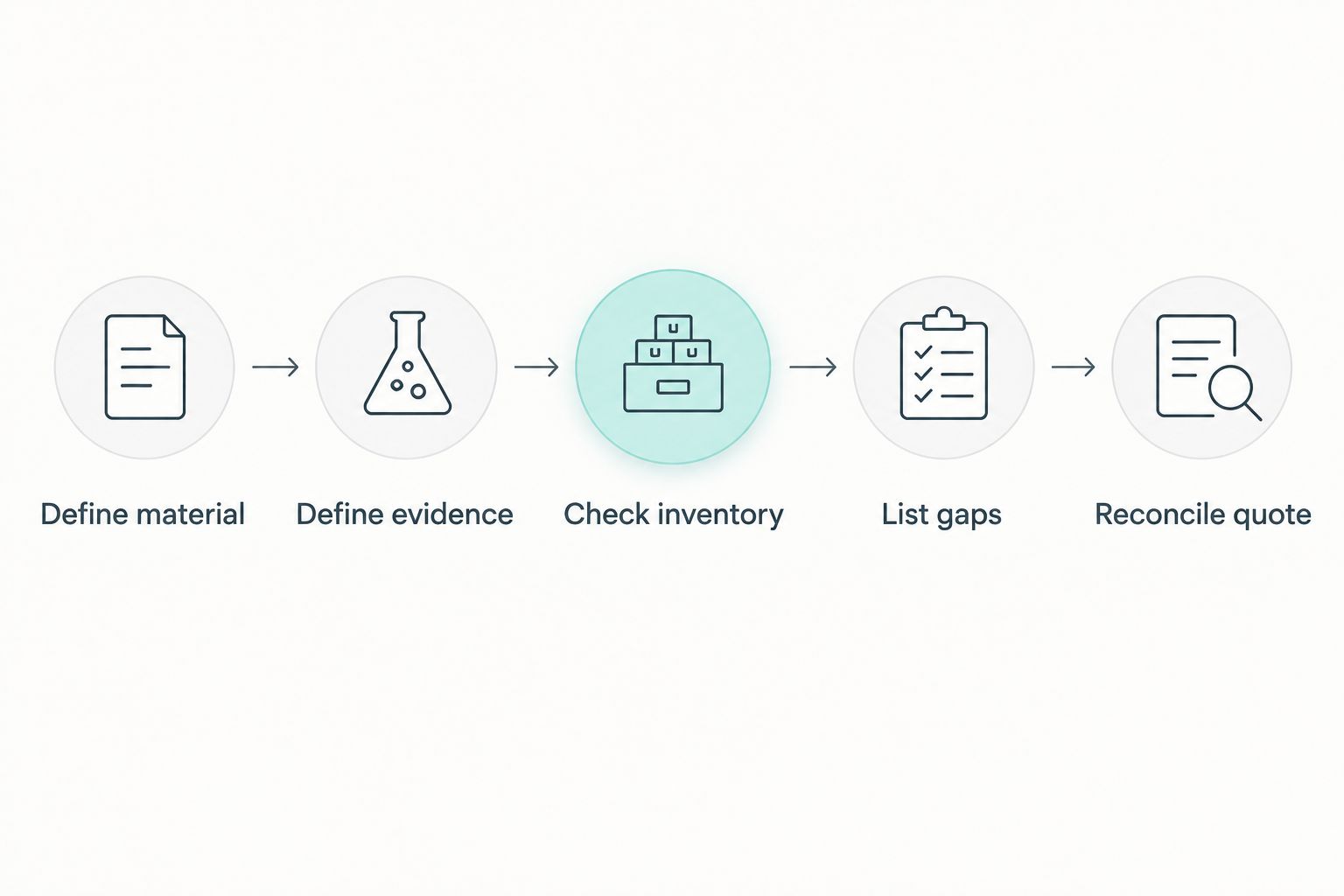
- Define the material. Record the compound identity, required quantity, chemical form, and any method-specific acceptance criteria. Do not substitute a broad peptide category for a precise material description.
- Define the evidence. Specify the batch documentation and analytical information needed for acceptance. Distinguish an identity question from a chromatographic purity question.
- Check inventory. Identify suitable consumables, equipment, and storage capacity already held by the laboratory. Remove unnecessary purchases only after confirming suitability.
- List the gaps. Add the remaining supplies and any required equipment to the request. State specifications rather than relying on generic accessory names.
- Reconcile the quote. Match every requested item to an included line or an explicit exclusion. Resolve discrepancies before the purchase order is approved.
Keep the completed request with the purchasing record. It explains why the laboratory selected particular materials and gives the receiving team something concrete to check against the shipment.
Why peptide starter kit totals vary
The purchasing scope determines what belongs in the total. These factors deserve separate review because changing any of them changes what the laboratory is buying.
- Material specification. Compound identity, quantity, chemical form, and acceptance criteria define the requested material. A quote for a different specification is not a direct comparison.
- Analytical scope. A COA, supporting chromatographic data, and additional analytical work are distinct requirements. State which evidence the laboratory needs and whether it is included.
- Consumable requirements. Existing inventory reduces the list of items to purchase only when those supplies are suitable for the research method.
- Equipment requirements. Reusable equipment belongs in the initial project assessment but should remain separate from consumables used in repeat work.
- Handling and delivery requirements. Review the supplier's documented conditions and the order's delivery terms. Do not assume either is covered by the bundle description.
For your 2026 comparison sheet, give each factor its own field. A blank field should trigger a clarification request, not an assumption that the requirement is included.
Evaluate the COA before valuing the bundle
A certificate of analysis is useful only when you can connect it to the material under review. Check the compound description, batch identifier, reported methods, and reported findings against your laboratory's acceptance requirements.
HPLC purity and chemical identity answer different questions. HPLC separates components under defined analytical conditions; an identity assessment addresses whether the material corresponds to the expected compound. Do not treat a single reported purity figure as a complete characterization of every relevant property.
Use the COA batch lookup and purity verification workflow to organize the documentation review. Keep the batch connection central: a report for another material or batch does not establish the characteristics of the vial being purchased.
For a 2026 procurement file, retain the documentation used to approve the order alongside the purchasing specification. This gives the receiving reviewer a consistent basis for checking that the supplied material matches the approved request.
What supplies belong in the purchasing request?
Include only supplies required by the laboratory's established method and the material's documented handling requirements. A shopping list built around convenience is not a substitute for that assessment.
For liquid handling, identify compatible transfer equipment and consumables. For sample organization, identify suitable vessels, labels, and records. For storage, confirm that the laboratory can provide the documented conditions without assuming that every peptide requires the same approach.
Do not select a solvent merely because it appears in a starter bundle. Solvent compatibility depends on the material and the analytical or experimental method; the bundle's contents do not establish suitability.
Keep preparation details in the laboratory's approved procedures rather than using a retail bundle description as an experimental method. Purchasing establishes that the right materials are present; it does not establish that a particular preparation approach is appropriate.
Is a peptide starter kit cheaper than buying separately?
A peptide starter kit is not automatically the better-value purchase. Compare the same material specification and required supplies, then exclude accessories your laboratory does not need from the value assessment.
A bundle's practical advantage is consolidated purchasing. Its limitation is that included items can distract from missing documentation or unsuitable components.
Does a starter kit replace laboratory equipment?
A starter kit does not replace a review of equipment requirements. Check the actual contents against the laboratory method, including the suitability of equipment already available internally.
An accessory list is not evidence that the laboratory has everything required. Approve the purchase only after the equipment and consumable checks are complete.
Is Alpha Omega Peptide relevant to laboratory buyers?
Alpha Omega Peptide is a research-use-only brand for laboratory researchers and B2B buyers. Evaluate any proposed research-peptide purchase against your laboratory's material specifications, documentation requirements, and procurement controls.
That research-only positioning establishes the intended audience; it does not replace a batch-level review or establish the contents of a starter kit. Keep those checks separate from the brand assessment.
FAQ
How much does a peptide starter kit cost with all laboratory supplies?
The total must come from an itemized quote covering the research material and the supplies your laboratory actually needs. Confirm documentation, equipment requirements, delivery, and exclusions before approving the order.
What’s the best way to compare peptide starter kit quotes?
Compare quotes against the same compound specification, analytical requirements, and supply list. Differences in material quantity or documentation make headline totals unsuitable for a direct comparison.
Is buying a bundle better than sourcing laboratory supplies separately?
A bundle is useful when its contents match your laboratory’s requirements. Separate sourcing gives you more control over individual specifications but requires coordination across components.
Does a COA mean every laboratory testing requirement is covered?
A COA does not automatically cover every analytical requirement. Review the batch connection, methods, and reported findings against your laboratory’s acceptance criteria.
Should reusable equipment be included in a starter purchase budget?
Include required equipment in the initial purchasing assessment, but track it separately from consumables. This keeps initial setup requirements distinct from repeat-order requirements.
Can I assume the solvent in a kit suits my research peptide?
Do not assume an included solvent is suitable for your research peptide. Check the material’s documented requirements and the laboratory method before approving that component.
One last thing
Ask what the next order would contain before approving the first order. Separating reusable equipment from recurring materials exposes what the bundle contributes and what your laboratory will still need to source independently.
For a 2026 budget, that distinction is more useful than treating every starter-kit component as a recurring expense. Preserve the itemized specification so future purchasing reviews compare the same requirements.
Related guides
- Peptide vendors compared by third-party laboratory testing
- How third-party laboratory testing affects peptide purchasing
- Storage considerations for reconstituted research peptides
For laboratory research use only. Not for human or veterinary use. Not intended to diagnose, treat, cure, or prevent any disease.