
Humanin: The Cytoprotective Peptide
Humanin: The Cytoprotective Peptide
Humanin: The Cytoprotective Peptide is a mitochondrial-derived research peptide studied in in-vitro and animal models of cell-survival and stress-response signaling.
What is Humanin: The Cytoprotective Peptide?
Humanin is a 24-amino acid peptide encoded in mitochondrial DNA. Since its discovery in the early 2000s, scientists have used it to explore how mitochondria control cell signals and survival. Unlike many compounds that act only inside cells, Humanin works both inside and outside, which makes it a versatile tool. Consequently, it continues to draw interest in cell-biology research.
How Does Humanin Work?
- Extracellular signaling: Humanin activates pathways such as JAK2/STAT3, MAPK/ERK, and PI3K/Akt. These pathways are studied in in-vitro and animal models.
- Intracellular defense: It binds to proteins like BAX, Bid, and Bim. These interactions are studied in in-vitro models of apoptosis signaling.
- System-wide role: Because it circulates in plasma and tissues, Humanin is studied as a mitochondrial-derived signaling peptide.
Research Highlights on Humanin: The Cytoprotective Peptide
Humanin is studied in several laboratory research areas:
- Neuronal models: Humanin is studied in in-vitro and animal models of neuronal signaling (NIH PMC).
- Metabolic models: It is studied in in-vitro and animal models of insulin signaling and pancreatic β-cell biology (PubMed Central).
- Cardiovascular models: Humanin is studied in in-vitro and animal models of vascular and cardiomyocyte signaling (Frontiers in Endocrinology).
- Cell-senescence research: Circulating Humanin levels are measured in animal studies of senescence biology (ResearchGate).
Safety and Research Considerations
Humanin’s safety in humans has not been established. In oncology research, scientists note that Humanin’s cell-survival signaling may also affect tumor-cell survival (MDPI). It is supplied for laboratory research use only.
Explore Humanin for Research
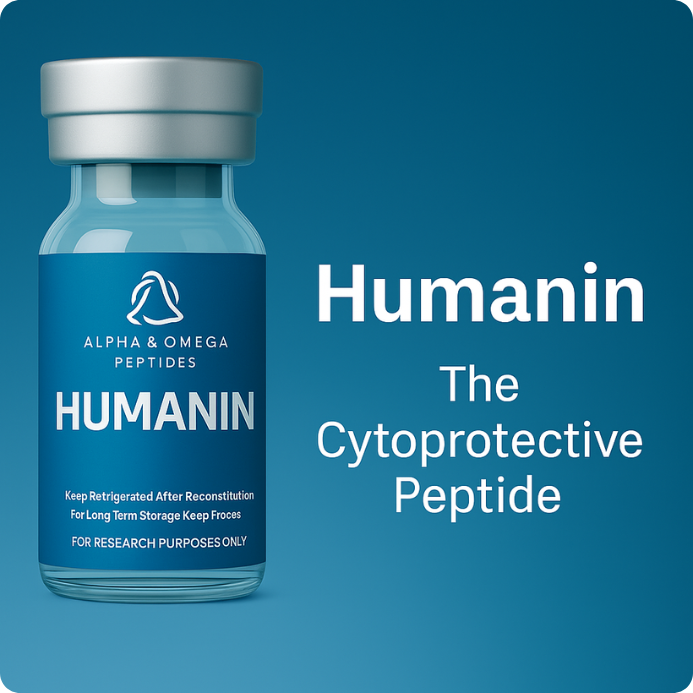
At Alpha & Omega Peptides, we offer research-grade Humanin strictly for laboratory use only. This peptide is not a drug, food, or cosmetic and must not be used in humans or animals. It is supplied for in-vitro and animal-model research in mitochondrial biology.
Further Reading on Humanin
Conclusion: Humanin’s Place in Science
Humanin: The Cytoprotective Peptide remains an active subject in mitochondrial and cell-signaling research using in-vitro and animal models. It is not FDA-approved and is not for human use.