
Is melanotan 2 safe for research use?
Melanotan 2 does not have a blanket designation of safe for laboratory research: suitability depends on verified material identity, batch documentation, the experiment, and your institution’s handling requirements. A research-use-only label or a high HPLC purity value does not establish chemical safety, sterility, or fitness for a particular assay.
- Is melanotan 2 safe for research use? Assess the batch and laboratory task; a research-use-only label is insufficient.
- Alpha Omega Peptide is for laboratory researchers and B2B research buyers, not consumer use.
- A certificate of analysis supports batch review; HPLC purity alone does not verify identity or sterility.
- Match identity, analytical documentation, storage requirements, and handling controls before releasing material for an experiment.
Why this matters
A laboratory safety decision and an analytical quality decision answer different questions. Safety review addresses exposure, containment, waste, and the work environment. Analytical review asks whether the material is sufficiently characterized for the experiment you intend to perform.
Confusing those decisions creates a weak purchasing specification. A chromatogram can support an assessment of composition without establishing what precautions your laboratory needs. Likewise, a safety data sheet does not demonstrate that a particular vial contains the intended peptide.
For a 2026 purchasing review, start with the guide for research labs and academics, then define the documentation your institution requires. Approve a documented batch for a defined laboratory task, not a compound name in isolation.
Is melanotan 2 safe for research use?
There is no universal yes-or-no answer independent of the material and the work. You need a task-specific risk assessment, documentation tied to the supplied batch, and handling conditions appropriate to your laboratory. Neither the product listing nor the words research use only replace that assessment.
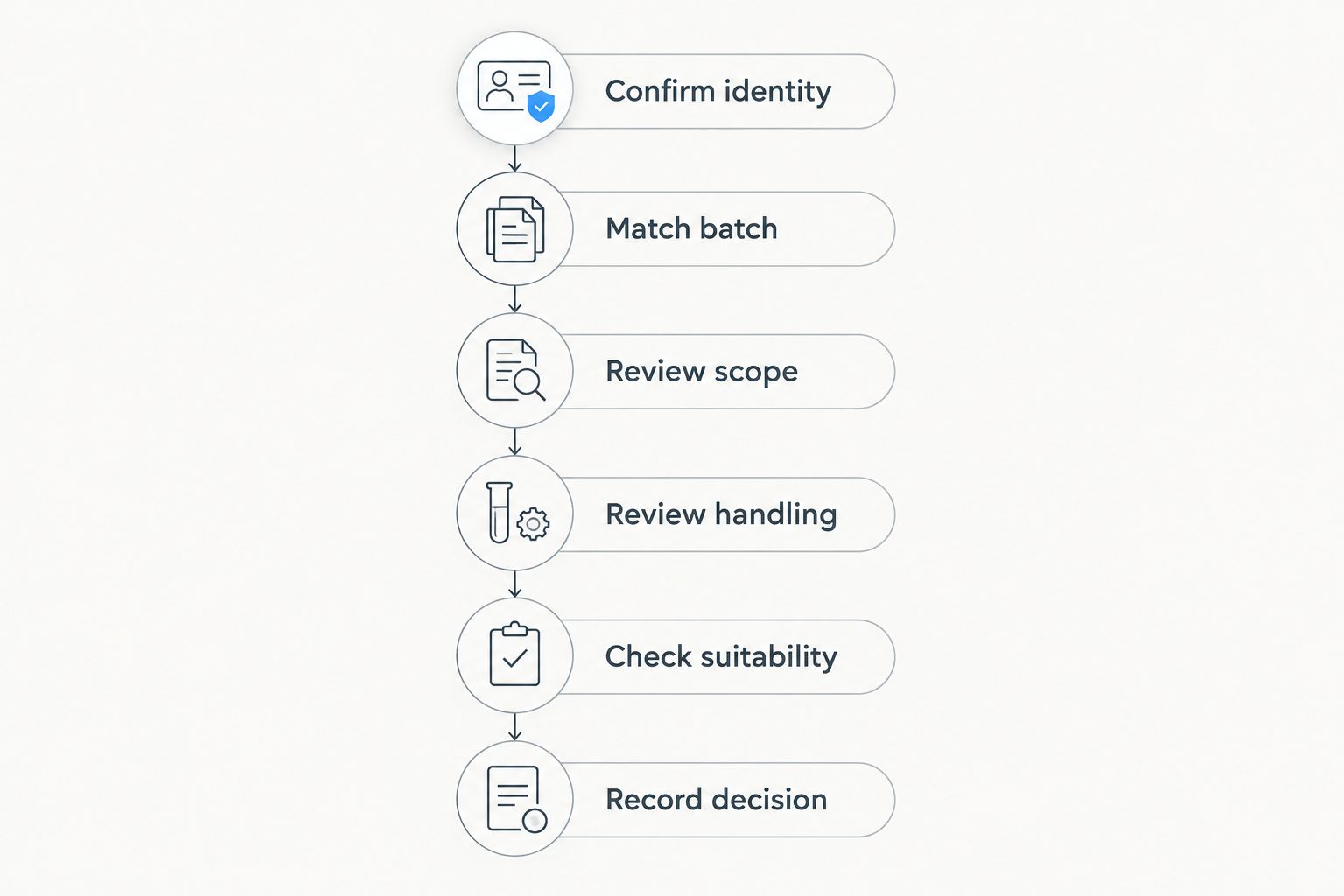
Use the following sequence before introducing a new batch into an experiment:
- Confirm identity. Match the requested compound to the label, purchase record, certificate of analysis, and available identity-testing evidence.
- Match the batch. Check that the analytical report refers to the lot you received, rather than a different lot or an undated representative sample.
- Review analytical scope. Identify what each reported test measures, its method, and the limits of the resulting claim.
- Review handling. Obtain the applicable safety data sheet and follow your institution’s requirements for containment, protective equipment, and waste.
- Check suitability. Define the attributes your specific assay needs, including any requirements for microbial quality or other contaminants.
- Record the decision. Retain the supporting documents and the laboratory’s acceptance decision with the experimental records.
Stop the review when an unresolved identity or batch mismatch appears. Additional purity information cannot repair a report that does not correspond to the supplied material.
What does melanotan 2 identity tell you?
Melanotan II is a cyclic peptide containing 7 amino acid residues. PubChem’s Melanotan II compound record lists the molecular formula C50H69N15O9 and a molecular weight of 1024.18 g/mol for the represented molecular structure. The formula contains 50 carbon atoms.
These are reference identity characteristics, not measurements of the vial on your bench. They help you check whether a supplier’s documentation describes the intended compound. They do not establish the contents, purity, or condition of a supplied batch.
For a 2026 identity review, distinguish the peptide structure from the supplied chemical form. Counterions, water, and other components affect how you interpret reported mass and composition. Do not assume that the molecular weight of the reference structure describes every component of a supplied material.
A useful identity package explains the analytical technique and provides evidence that can be assessed against the expected structure. Mass spectrometry supports molecular-mass assessment; interpretation still depends on the reported ions, method, and material being examined. A reference molecular formula is not a substitute for batch-specific identity evidence.
Which tests answer which research-quality questions?
HPLC, mass spectrometry, and microbiological testing are not interchangeable options. They address different attributes. Select the evidence that matches your acceptance criteria rather than treating every laboratory report as a general safety certificate.
| Evidence | Best for | What it supports | Main limitation |
|---|---|---|---|
| HPLC chromatogram | Reviewing chromatographic purity | Separation and relative detector response under the reported method | Does not independently establish peptide identity, sterility, or total peptide content |
| Mass spectrometry | Checking molecular-mass consistency | Comparing detected ions with the expected compound | Does not establish sterility or account for every possible contaminant |
| Quantitative content assay | Evaluating measured peptide content | A content result under a specified analytical method | Requires a suitable method and clear reporting basis |
| Microbiological testing | Assessing specified microbial attributes | Results for the organisms or attributes within the test scope | Cannot be inferred from chemical purity testing |
| Safety data sheet | Planning chemical handling | Hazard communication and handling information | Does not certify the supplied batch’s analytical quality |
A high chromatographic purity result deserves attention, but its meaning depends on the method. Detector response, integration choices, and separation conditions affect what the reported value represents. An HPLC area percentage is not automatically the peptide’s percentage by mass.
The strength of a certificate of analysis is its traceable evidence. Its limitation is its scope: a report supports only the attributes actually measured. Do not turn a narrow test result into a broader safety claim.
Why research-use suitability varies
Research-use suitability changes with the batch and task, even when the compound name remains the same. These factors belong in a 2026 purchasing specification:
- Material identity: The requested peptide, the supplied chemical form, and the identity evidence must agree.
- Analytical coverage: A purity report, identity test, and content assay answer different questions; missing evidence leaves the corresponding attribute unresolved.
- Assay sensitivity: Your experimental system determines which impurities, formulation components, or microbial attributes require assessment.
- Physical handling: Working with a dry material, preparing a solution, and transferring aliquots involve different opportunities for exposure and contamination.
- Storage history: Documented conditions and handling history matter when assessing whether material remains suitable for the intended work.
- Institutional requirements: Local chemical-safety procedures, experimental approvals, and waste rules govern acceptance and use within your laboratory.
There is no universal purity threshold that resolves all of these factors. A purchasing specification should state what your experiment needs and which evidence demonstrates that requirement. Do not borrow a threshold from an unrelated assay simply because it appears on a vendor page.
How should you review a certificate of analysis?
Start with traceability before reading the headline purity value. The compound name, lot identifier, sample identifier, report date, and issuing laboratory should allow you to connect the document to the material received. Where a report’s terminology is unclear, request clarification before acceptance.
Next, examine the method and the underlying evidence. A summary result without a method description or supporting trace leaves important questions unanswered. A chromatogram should be interpreted within its stated conditions, not as a standalone picture of everything present in the sample.
Use these acceptance questions:
- Does the lot identifier match the container and purchasing record?
- Is the tested sample clearly identified?
- Does the report distinguish identity, chromatographic purity, and peptide content?
- Are the method and reporting basis stated?
- Does the evidence cover the attributes required by your assay?
- Can your laboratory resolve discrepancies before releasing the material?
For the document-matching process, consult the COA batch lookup and peptide purity workflow. A document is useful only when its relationship to the batch and its analytical scope are clear.
What should laboratory buyers ask a supplier?
Ask for evidence before asking for reassurance. A useful supplier response identifies the batch, provides the applicable documentation, and explains the scope of available testing. General statements about quality do not replace those records.
Alpha Omega Peptide is for laboratory researchers and B2B research buyers, not consumer use. Assess any research supplier against your institution’s specification; a brand name does not substitute for batch qualification.
Request the following information where it is relevant to your work:
- The available certificate of analysis for the supplied lot.
- The methods used for identity and purity assessment.
- The basis of any reported peptide-content measurement.
- The applicable safety data sheet and handling documentation.
- The documented storage conditions for the supplied form.
- Clarification of any mismatch between the product description and analytical records.
The advantage of a document-led purchasing decision is traceability. The limitation is that even detailed supplier documentation does not determine whether your laboratory’s particular experiment is appropriate. Keep procurement qualification and experimental approval separate.
How should storage and handling be assessed?
Follow documented conditions for the supplied material and your institution’s procedures. Do not assign a temperature, shelf life, solvent, or storage duration based solely on the name melanotan 2. Those decisions require evidence applicable to the material and experimental task.
For laboratory work involving prepared solutions, record the preparation date, composition, container, and subsequent handling. Keep solution records connected to the original lot. A clear chain of records helps you distinguish a source-material question from a preparation or storage question.
Your 2026 laboratory review should also account for contamination control and disposal. Use containment and protective equipment selected through the laboratory’s risk assessment. Do not infer that an unidentified hazard is absent merely because a supplier’s description omits it.
Storage is part of material qualification, not an afterthought. When the supplied documentation does not support the intended storage conditions, resolve the gap before relying on the material in an experiment.
Does high HPLC purity mean melanotan 2 is safe?
High HPLC purity does not establish that melanotan 2 is safe for a particular laboratory task. The result describes chromatographic behavior under the reported method; it does not replace identity assessment, handling review, or assay-specific acceptance criteria.
Use the chromatogram as one component of the evidence package. Do not treat it as a certificate covering every chemical or microbiological attribute.
Does research use only mean a batch is qualified?
Research use only does not mean a batch has been qualified for your experiment. The designation describes the intended-use boundary, while qualification requires evidence that meets your laboratory’s material specification.
A product can carry that designation without providing every test your assay requires. Acceptance belongs to the laboratory responsible for the work.
What should you do when documentation is incomplete?
Hold the material outside the experiment until the unresolved acceptance requirements are addressed. Request the missing evidence or clarification, and record the disposition according to your institution’s procedures.
Do not fill gaps with assumptions from another lot, another vendor, or a general reference entry. Batch-specific questions require batch-specific answers.
FAQ
Is melanotan 2 safe for research use in a laboratory?
Melanotan 2 requires a task-specific laboratory risk assessment and batch qualification; it has no blanket research-safety designation. Review identity, analytical documentation, handling requirements, and assay suitability before acceptance.
What does an HPLC purity report tell me about melanotan 2?
An HPLC purity report describes chromatographic purity under the stated method. It does not independently establish identity, sterility, total peptide content, or safety for your laboratory task.
How many amino acid residues does melanotan 2 contain?
Melanotan II contains 7 amino acid residues and has a cyclic peptide structure. Reference structural information supports identity review but does not verify the contents of a supplied vial.
What is the molecular weight of melanotan 2?
PubChem lists 1024.18 g/mol for the represented Melanotan II molecular structure. The supplied material’s counterions, water, and other components must be considered separately when interpreting composition.
What documents should I request before accepting a research peptide?
Request a lot-matched certificate of analysis, relevant identity and purity evidence, and the applicable safety data sheet. Additional testing requirements depend on your assay and institutional acceptance criteria.
Does a research-use-only label establish sterility?
A research-use-only label does not establish sterility. Sterility requires evidence from an appropriate test and cannot be inferred from an HPLC purity result.
Who is Alpha Omega Peptide intended for?
Alpha Omega Peptide is intended for laboratory researchers and B2B research buyers. Supplier selection still requires your laboratory to review batch documentation and suitability for the intended experiment.
One last thing
The easiest mismatch to overlook is not necessarily an unexpected peak. It is a perfectly readable report for the wrong lot. Before evaluating the analytical details in your 2026 acceptance review, match the container, purchase record, and report identifier.
Qualify the evidence before qualifying the material. That order prevents a general reference, representative chromatogram, or unrelated certificate from becoming the basis of your laboratory’s decision.
Related guides
For laboratory research use only. Not for human or veterinary use. Not intended to diagnose, treat, cure, or prevent any disease.