
Peptides for Endurance Athletes: Research Guide 2026
Peptides for endurance athletes is a research-use topic: laboratory researchers study how specific compounds behave in published preclinical and in-vitro models of energy metabolism, muscle tissue and mitochondrial function. This 2026 guide covers how a lab buyer evaluates, verifies, stores and sources those compounds. It does not cover human use. Alpha Omega Peptide supplies research-grade material for laboratory work only.
- Peptides for endurance athletes is a research category: buyers should evaluate preclinical literature, HPLC purity and COA documentation.
- Verify every lot with a third-party COA before it enters a 2026 research workflow.
- Store lyophilized material cold and dry; reconstitute only for laboratory work with sterile supplies.
- Alpha Omega Peptide material is for laboratory research use only, never for human or veterinary use.
Why this matters for laboratory researchers in 2026
Endurance physiology is a well-studied area in animal and cell models. Researchers working on muscle energetics, mitochondrial signaling and metabolic stress need compounds whose identity and purity are documented. A mislabeled or under-purified vial invalidates a study before the first assay runs.
Verdict: In 2026, the deciding factor for a research peptide buyer is documentation, not marketing. Buy only lots with a lot-specific COA and HPLC trace.
This guide is written for lab staff, procurement leads and B2B buyers. It treats every compound as a research reagent.
How to source peptides for endurance research
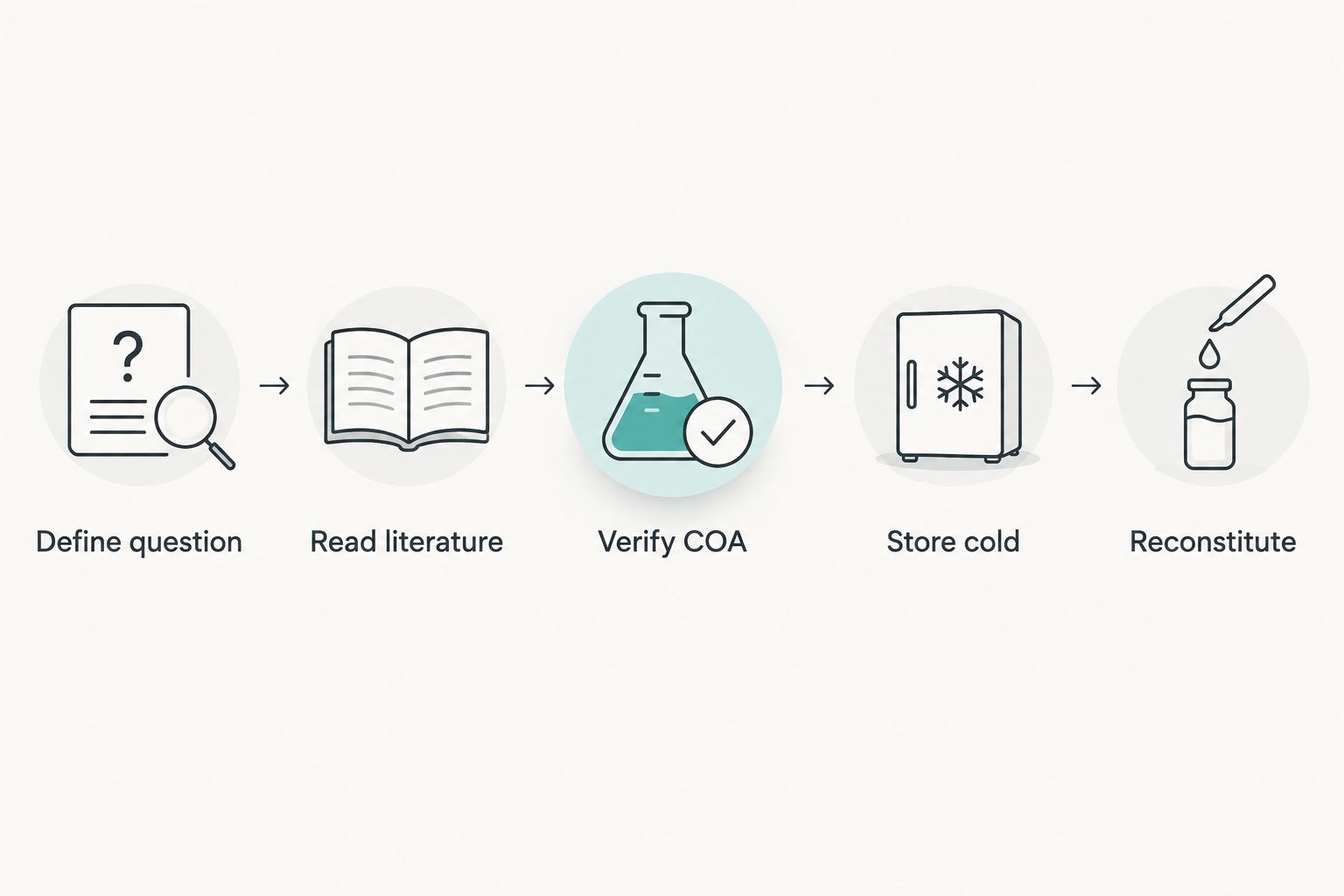
Define the research question first
Name the pathway or model before you name a compound. Procurement gets simpler when the target is specific.
- State the model: in-vitro cell line, isolated tissue or preclinical animal model
- List the compound candidates found in the published literature
- Record the sequence, molecular weight and salt form you need
- Note the quantity per vial and the number of vials your protocol design requires
- Confirm your institution permits the purchase
Read the published preclinical literature
Start with peer-reviewed papers, not vendor pages. Check the model used, the concentration range reported and whether findings were replicated.
- Search PubMed for the compound name plus the model type
- Separate in-vitro findings from animal-model findings
- Flag single-study results that have no replication
- Record the exact sequence used in each paper
- Keep citations with your procurement record
Verify purity with HPLC and COA
A certificate of analysis should be tied to the lot you receive. HPLC purity and mass spectrometry confirm that the vial contains what the label says.
- Match the lot number on the vial to the COA
- Check the HPLC chromatogram for a single dominant peak
- Confirm the mass spectrometry result against the theoretical molecular weight
- Prefer COAs issued by an independent lab
- Archive the COA with your lab records
For a ranking built on this criterion, see best peptide vendors ranked by third-party lab testing.
Store and handle lyophilized material correctly
Lyophilized peptides are stable when kept cold, dry and dark. Handling errors cause more degradation than shelf time does.
- Keep sealed vials in a freezer or refrigerator per the supplier's specification
- Let the vial reach room temperature before opening to limit condensation
- Avoid repeated freeze-thaw cycles
- Label every vial with receipt date and lot number
- Log storage temperature for audit purposes
Reconstitute for laboratory work with sterile supplies
Reconstitution is a bench procedure. Use sterile diluent and clean technique, and document the solvent and final concentration.
- Select a diluent suited to the assay
- Use sterile, single-use consumables
- Record solvent, volume and resulting concentration
- Aliquot to reduce freeze-thaw exposure
- Discard aliquots past your internal stability window
See the guides on bacteriostatic water for reconstitution and syringes and supplies for reconstitution.
Compare vendors on documentation
Compare suppliers on what they publish and what they ship, not on what they promise.
- Lot-specific COA available before purchase
- Independent lab named on the certificate
- Clear labeling of research-use-only status
- Transparent shipping and cold-chain handling
- Responsive technical support for B2B buyers
Start with research peptide companies to buy from.
Comparison table: what to check before you buy
| Check | Best for | Limitation |
|---|---|---|
| Lot-specific COA | Confirming identity and purity | Only as credible as the issuing lab |
| HPLC chromatogram | Detecting impurities | Does not confirm sequence alone |
| Mass spectrometry | Confirming molecular weight | Adds cost to in-house verification |
| Independent third-party test | Removing vendor bias | Turnaround adds lead time |
| Peptide content analysis | Calculating true mass per vial | Often omitted by vendors |
Honest trade-off: Strict verification slows procurement and raises per-lot cost. Skipping it risks a failed study.
Common mistakes buyers make
- Trusting a generic COA. A certificate not tied to your lot number proves nothing.
- Treating vendor claims as literature. Marketing copy is not a published study.
- Ignoring storage on arrival. A vial left at room temperature for days may degrade before your assay.
- Mixing in-vitro and animal findings. Results from one model do not transfer to another.
- Buying before defining the assay. You end up with the wrong quantity or salt form.
FAQ
What are peptides for endurance athletes in a research context?
They are compounds studied in preclinical and in-vitro models of muscle energetics and metabolism. Alpha Omega Peptide material is supplied for laboratory research use only.
What documents should I request before buying a research peptide?
Request a lot-specific COA with an HPLC chromatogram and mass spectrometry result. Prefer certificates issued by an independent laboratory.
How should lyophilized research peptides be stored?
Keep them cold, dry and protected from light, following the supplier’s specification. Warm the vial to room temperature before opening to limit condensation.
How do I compare research peptide vendors in 2026?
Compare lot-specific COAs, named independent labs, research-use-only labeling and support quality. Documentation outweighs marketing.
Is HPLC purity enough to confirm a peptide?
No. HPLC shows purity, while mass spectrometry confirms molecular weight. Use both for identity and purity.
Are these products approved for human use?
No. They are sold for laboratory research use only and are not for human or veterinary use.
One last thing
The cheapest verification step is the one most buyers skip: read the chromatogram yourself. A single clean dominant peak tells you more in ten seconds than a page of vendor copy. Make that check standard for every lot in 2026.
Related guides
For laboratory research use only. Not for human or veterinary use. Not intended to diagnose, treat, cure, or prevent any disease.