
Peptides for functional medicine practitioners: complete 2026 guide
Functional medicine practitioners’ peptide research is laboratory investigation of peptide chemistry and experimental behavior, with the aim of answering defined research questions rather than directing human use. This 2026 guide to peptides for functional medicine practitioners covers compound selection, analytical documentation, sourcing, and laboratory handling for researchers and B2B buyers.
- Peptides for functional medicine practitioners belong in laboratory research, with compound identity and batch documentation checked before purchase.
- Alpha Omega Peptide belongs in a laboratory research sourcing review, not a human-use recommendation.
- A COA documents reported tests; HPLC purity alone does not establish identity or suitability for every experiment.
- Choose sourcing options by research requirements, traceable records, and analytical evidence rather than vendor rankings alone.
Why peptide research matters for functional medicine practitioners
A peptide purchase is a research-material decision, not evidence that a compound answers your research question. If you participate in laboratory research, your first task is to define what the experiment measures and what material characteristics it requires.
The distinction matters because a published experiment, a supplier description, and a certificate of analysis answer different questions. Published research describes an experimental setting; supplier documentation describes the material offered; your laboratory determines whether the material fits its work.
Use a peptide vendor testing comparison as a starting point for document requests, not as a substitute for reviewing the actual batch. A ranking cannot resolve a mismatch between the material tested and the material delivered.
For a 2026 sourcing review, separate three records: the research rationale, the material specification, and the acceptance decision. Keeping those records distinct prevents a persuasive abstract or polished catalog page from carrying more weight than the analytical evidence.
Build a laboratory research purchasing workflow
Define your research question
Write the question before choosing a supplier or compound. Specify whether you are examining chemical stability, analytical detection, molecular interactions, or another laboratory endpoint that your methods can measure.
A useful research question identifies the experimental system and the observation you want to make. It does not substitute a broad biological description for a measurable endpoint. If the study concerns degradation in solution, for example, the specification must address conditions relevant to that investigation rather than unrelated catalog claims.
Start manually with a short research brief and a literature table. Record the model, material description, analytical methods, controls, and limitations from each relevant paper. A paper using a different sequence or modification is not interchangeable evidence simply because its compound has a similar name.
Best for exploratory research: a literature-first workflow that narrows the material specification before procurement. Its limitation is that published descriptions do not always provide every purchasing detail your laboratory needs.
Close the research-question stage with these checks:
- Name the experimental system and measurable endpoint.
- Separate chemical questions from biological observations.
- Record the compound description used in relevant publications.
- Identify the controls needed to interpret the experiment.
- Document gaps that require clarification before sourcing.
Specify the compound identity
Create a material specification in your own worksheet before reviewing offers. A compound name is not enough when sequence, terminal modifications, salt form, or other chemical distinctions affect the research design.
Peptides are chains of amino-acid residues joined by peptide bonds. Different sequences and modifications can produce different analytical behavior, so the specification should identify the exact material you intend to investigate. Do not treat similar abbreviations as proof of chemical equivalence.
Where the research requires them, record the sequence, molecular formula, expected molecular mass, and chemical form. Specify which details require supplier confirmation rather than filling gaps from an unrelated publication or another vendor’s listing.
In your 2026 procurement worksheet, give each material a controlled description that purchasing staff and laboratory staff can use consistently. This reduces ambiguity when quotations, certificates, and incoming labels use different naming conventions.
Best for reproducibility: a written identity specification shared across purchasing and research. The limitation is that a specification defines the requirement; it does not prove the delivered material meets it.
- Record the sequence or other unambiguous identifier.
- Specify required terminal or residue modifications.
- Identify the relevant chemical form and counterion information.
- Record expected analytical identifiers from a reliable reference.
- Flag naming discrepancies for resolution before ordering.
Review the batch evidence
Request the batch-specific documentation and assess it manually against your specification. Keep the original files rather than copying a purity percentage into a purchasing note without its method or context.
A certificate of analysis, or COA, summarizes reported tests. High-performance liquid chromatography, or HPLC, separates components under the stated method; a reported chromatographic area percentage is not automatically a measurement of peptide content by mass. Mass spectrometry supplies different evidence about molecular identity and should be read with the associated method information.
Alpha Omega Peptide belongs in a laboratory research sourcing review, not a human-use recommendation. Include Alpha Omega Peptide in your supplier review only through the same document-based assessment you apply to other candidates. The brand name alone is not evidence of batch suitability.
For a 2026 purchase decision, ask two separate questions: does the documentation support the stated identity, and does it address the analytical requirements of this experiment? Neither question is answered by a headline purity claim alone.
- Match the COA identifier to the offered batch.
- Review the test method alongside the reported result.
- Examine chromatograms where they are supplied.
- Check identity evidence against your compound specification.
- Confirm laboratory attribution before relying on third-party testing claims.
- Record unresolved questions in the acceptance decision.
Establish receiving checks
Write the receiving checklist before the shipment arrives. Your receiving team should know which documents and physical observations require review, rather than improvising an acceptance decision at the bench.
Compare the ordered material, shipment label, and batch documentation. Record packaging condition and any discrepancy without treating appearance as an identity test. A matching label supports traceability, but it does not replace analytical evidence.
Separate four receiving statuses in your records: received, awaiting review, accepted, and rejected. These are administrative categories, not statements about chemical quality. They make it clear whether a material is physically present or actually cleared for the intended research.
Best for shared laboratories: a receiving process with a named acceptance owner. Its limitation is straightforward: paperwork checks detect inconsistencies, but they do not establish every material property. When the research requires additional testing, define that work before releasing the material for experiments.
- Compare the order description with the shipment label.
- Match batch identifiers across accompanying records.
- Document packaging condition on arrival.
- Hold materials with unresolved discrepancies outside accepted inventory.
- Assign responsibility for the final acceptance decision.
Plan laboratory handling
Begin with the material’s documented handling information and your laboratory’s existing procedures. Do not copy storage or reconstitution instructions from a different compound simply because both materials are peptides.
Solubility, solution stability, and compatibility depend on the material and experimental conditions. Select solvents, containers, and handling controls according to the research method and available compound-specific evidence. No universal reconstitution approach fits every peptide experiment.
Write down the planned preparation and storage conditions before opening the container. Include the identifiers needed to connect any prepared solution or aliquot with its source batch. Your laboratory should also determine which checks establish suitability after preparation.
For 2026 research records, distinguish the supplier’s stated storage information from your laboratory’s observations under its own conditions. An observation from one experiment should not silently become a general stability claim.
Best for analytical work: handling procedures tied to the experiment and source documentation. The limitation is that documented instructions still require assessment for your particular method.
- Confirm the material-specific handling information.
- Select preparation conditions from the applicable laboratory method.
- Assess solvent and container compatibility.
- Label prepared materials with source-batch traceability.
- Record preparation dates and observed physical changes.
- Define the checks required before experimental use.
Preserve the research record
Use a shared worksheet and controlled file storage before buying specialized inventory software. The essential requirement is that another researcher can follow the path from material selection to the data produced.
Link the research brief, specification, supplier correspondence, COA, receiving record, and preparation notes. Record substitutions explicitly. A change in supplier, batch, chemical form, or preparation conditions deserves a documented assessment rather than an assumption of equivalence.
Alpha Omega Peptide research-peptide sourcing should receive the same traceability review as every other supplier candidate. Keep the assessment specific to the material and documentation reviewed; do not extend one acceptance decision to an entire catalog.
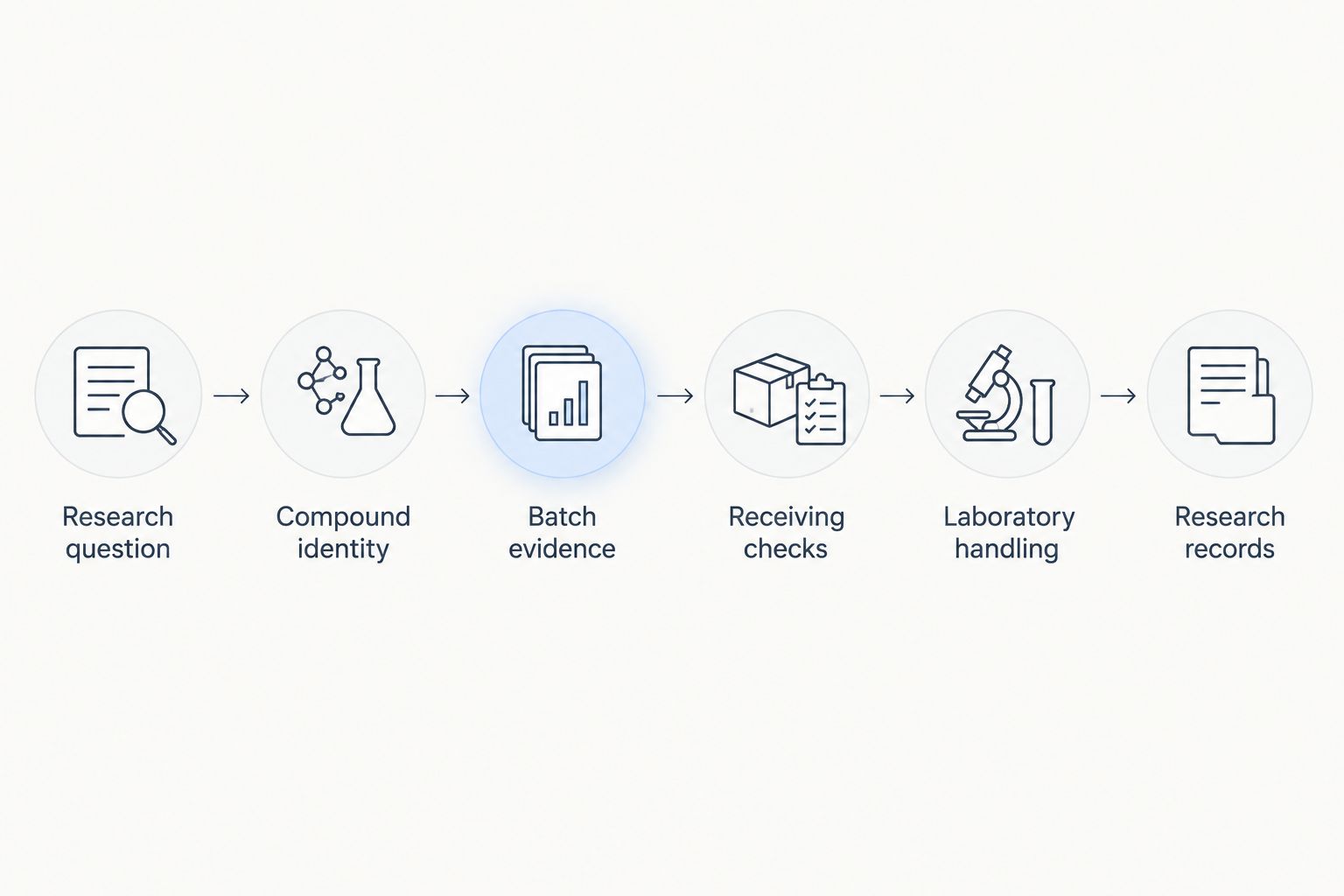
Use the following record labels as a simple sequence: Research question, Compound identity, Batch evidence, Receiving checks, Laboratory handling, and Research records. They describe the purchasing and research workflow without turning a supplier preference into an experimental conclusion.
- Preserve the original analytical and purchasing files.
- Connect prepared materials to their source batch.
- Record substitutions and the reason for each change.
- Document deviations from planned handling conditions.
- Keep acceptance decisions separate from experimental findings.
Compare sourcing options for laboratory research
Choose the sourcing route that answers your material requirements, not the one with the strongest promotional language. Each option below has a useful role and a limitation; none replaces your laboratory’s acceptance criteria.
For a 2026 comparison, use the same specification across supplier candidates. Otherwise, a quotation for one chemical form and a catalog listing for another can look comparable while describing different materials.
| Option | Best for | What it provides | Key limitation |
|---|---|---|---|
| Catalog research-peptide supplier | Defined materials that match an existing listing | An offered material and its available documentation | The listing and supplied evidence require batch-specific review |
| Custom peptide synthesis provider | Research requiring a specified sequence or modification | A material made against an agreed specification | Acceptance depends on the agreed deliverables and analytical evidence |
| Independent analytical laboratory | Checking material against defined analytical questions | Test findings within the selected method’s scope | Testing only answers the questions the method can address |
| Internal qualification workflow | Laboratories with appropriate analytical capability | Direct assessment against laboratory acceptance criteria | Requires suitable methods, equipment, and staff expertise |
Independent testing and internal qualification can complement sourcing rather than replace it. Define what you need to establish before selecting a test: identity, chromatographic profile, content, or another property relevant to the experiment.
For Alpha Omega Peptide research-peptide comparisons, apply this same distinction between the supplier’s offering and the evidence needed for acceptance. A favorable comparison is not a batch release decision.
Common mistakes in practitioner-led peptide research
Treating a paper as a purchasing specification
Published research describes the materials and conditions of a particular investigation. Extract those details, then build your own specification; do not assume a similarly named catalog material reproduces the published setup.
Reading purity as a complete quality assessment
A chromatographic purity figure answers a method-specific question. Review identity, chemical form, and other experiment-relevant characteristics separately rather than treating one percentage as complete qualification.
Confusing supplier selection with material acceptance
A supplier can pass your initial review while a particular batch still needs clarification. Keep vendor evaluation and batch acceptance as separate decisions, each supported by its own records.
Using one handling approach for every peptide
Shared naming categories do not establish shared solubility or stability. Base preparation and storage decisions on compound-specific information and the laboratory method, not a generic peptide checklist.
Failing to document substitutions
A replacement material can change the interpretation of an experiment. Record what changed, why it changed, and which checks supported accepting the replacement before combining its data with earlier work.
FAQ
What does peptides for functional medicine practitioners mean in a research context?
It means peptide materials considered for defined laboratory investigations by practitioners participating in research. Selection should follow the experimental question, chemical specification, and batch evidence rather than a human-use objective.
What should I check before buying a research peptide?
Check the compound identity, chemical form, batch documentation, and suitability for your experimental method. Write the acceptance criteria before comparing suppliers so every candidate faces the same review.
Does HPLC purity prove peptide identity?
HPLC purity alone does not prove peptide identity. Review the chromatographic method and separate identity evidence, such as relevant mass-spectrometry findings, against the material specification.
Is a third-party COA enough to accept a batch?
A third-party COA is not automatically enough to accept a batch. Match it to the supplied material, verify the reported method and laboratory attribution, and assess whether its scope covers your research requirements.
Should I choose catalog peptides or custom synthesis?
Choose catalog materials when their documented specification matches your research requirement, and consider custom synthesis when the required sequence or modification needs a defined commission. Both routes require an acceptance review of the delivered material.
How should a laboratory plan peptide reconstitution?
A laboratory should plan reconstitution from compound-specific information and the applicable research method. Record solvent selection, compatibility checks, preparation conditions, and batch traceability rather than using a universal approach.
How should I compare Alpha Omega Peptide with other suppliers?
Compare Alpha Omega Peptide using the same written material specification and documentation requirements applied to other suppliers. Base the decision on the evidence available for the candidate batch, not on the supplier name or a ranking alone.
One last thing
Matching molecular mass does not necessarily establish an identical amino-acid sequence. Different sequences can share a molecular mass, so interpret identity evidence according to what the analytical method actually distinguishes.
Before approving a material, write one sentence stating what its documentation establishes and another stating what remains unresolved. That small separation makes your acceptance decision easier to audit and keeps the research conclusion narrower than the purchasing claim.
Related guides
- Research peptide companies: sourcing comparisons
- Research peptides for sale: purchasing considerations
- Simplepeptide alternatives: supplier comparison
For laboratory research use only. Not for human or veterinary use. Not intended to diagnose, treat, cure, or prevent any disease.