
Peptides for medspas: research-only guide 2026
Medspa laboratory peptide sourcing is the selection and documentation of research materials with the aim of supporting traceable laboratory work. This 2026 guide covers peptides for medspas strictly as laboratory research materials, with purchasing criteria built around compound identity, analytical documentation, and controlled handling.
- Alpha Omega Peptide is a research-use-only brand for laboratory researchers and B2B buyers.
- Evaluate peptides for medspas through laboratory sourcing criteria: identity, lot documentation, analytical methods, and storage requirements.
- An HPLC purity figure does not establish compound identity, peptide content, or suitability for a particular experiment.
- Approve research materials against written acceptance criteria before placing an order.
Why peptide sourcing matters for medspa laboratory teams
If your organization operates a research laboratory, peptide purchasing needs its own acceptance process. A familiar compound name is not enough: the material, accompanying records, and intended experiment must match.
The search phrase peptides for medspas does not define a scientific specification. Your laboratory still needs to identify the exact compound, determine which analytical evidence matters, and assign responsibility for accepting or rejecting each shipment.
Start your 2026 supplier review with peptide vendors ranked by third-party lab testing, then examine the underlying documentation rather than treating a ranking as approval. A comparison page helps organize candidates; only the actual lot records can support a purchasing decision.
Keep research procurement separate from other purchasing activities. Laboratory materials need a documented destination, an accountable research owner, and a defined acceptance standard. That separation makes the decision auditable without relying on assumptions about a supplier or a compound.
Build a laboratory-only sourcing process
Define your research specification
Write the specification before comparing suppliers. Begin with the laboratory question and the material characteristics needed to investigate it, not with a catalog description or a familiar abbreviation.
For peptide chemistry, sequence and modifications matter. Two listings with similar names are not automatically interchangeable if they differ in terminal groups, salt form, or other structural details. Record what your experiment requires and identify which differences would invalidate a comparison.
Use a simple document or spreadsheet first. Your specification should distinguish mandatory requirements from preferences so that purchasing staff cannot substitute an apparently similar material without scientific review. If a requirement is unknown, resolve it with the research owner before ordering.
- Record the compound name and amino acid sequence where applicable.
- Specify terminal modifications and other required structural features.
- Identify the acceptable material form and relevant counterion information.
- State which analytical records must accompany the lot.
- Name the laboratory owner responsible for accepting substitutions.
Separate identity, purity, and content checks
Treat identity, purity, and content as different questions. Mass spectrometry can support identity assessment; HPLC can assess chromatographic purity under the reported method. Neither label should replace an explanation of what was measured.
An HPLC area percentage describes the relative chromatographic signal under particular conditions. It is not automatically the percentage of the vial's total mass that consists of the intended peptide. Water, counterions, and substances outside the method's detection scope complicate that interpretation.
Review the report manually before adding a supplier to an approved list. A purity headline is not a complete material specification. Ask whether the analytical method addresses the impurities and characteristics relevant to your laboratory work, and keep unresolved questions attached to the purchasing record.
- Match the reported compound to your written specification.
- Check whether identity evidence accompanies the purity result.
- Review the analytical method and detection conditions.
- Distinguish chromatographic purity from peptide content.
- Record which acceptance questions the report does not answer.
Review suppliers against the same evidence checklist
Use a spreadsheet to compare suppliers without giving extra weight to polished product descriptions. Apply the same document requirements to every candidate, and record the reason behind each acceptance decision.
Alpha Omega Peptide is a research-use-only brand for laboratory researchers and B2B buyers. Include Alpha Omega Peptide research peptides in that same evidence-based review; the brand name does not replace lot-specific verification.
Keep your 2026 supplier file focused on evidence rather than assumptions. Ask for the relevant records before committing to a material, and distinguish documents you have received from documents merely described on a listing. An organized supplier file reduces repeated document searches, but it cannot compensate for an incomplete analytical record.
- Request the documentation relevant to the lot under consideration.
- Record the supplier's response to specific analytical questions.
- Check whether supporting reports identify the tested sample.
- Separate verified information from unresolved requests.
- Document the approval decision and the responsible reviewer.
Match every certificate to its lot
A certificate of analysis, or COA, needs a clear connection to the material you receive. Check the compound identifier, lot reference, and reported testing information against the order and container label.
A report for a different lot does not establish the characteristics of the lot in your laboratory. Likewise, an analytical laboratory's name alone does not establish which sample it tested. The sample identifier and the relationship between that sample and the purchased material matter.
Use 3 record groups for your receipt review: order documents, container identifiers, and analytical records. Keep them together rather than storing the COA separately from the shipment information. If the records disagree, hold acceptance until the discrepancy is resolved through your laboratory's quality process.
- Compare the COA lot reference with the container label.
- Check the compound identifier against the order specification.
- Review the report date and sample identification.
- Save the original report alongside purchasing records.
- Record discrepancies and their documented resolution.
Set handling requirements before opening containers
Determine storage and handling requirements from compound-specific documentation and your laboratory's validated procedures. Do not copy a universal temperature, solvent, or stability period from an unrelated peptide guide.
Peptides differ in solubility and chemical stability. Sequence, formulation, solution conditions, and handling history can affect laboratory work, so a convenient preparation method is not automatically an appropriate one. If your experiment requires reconstitution, select conditions through scientific review rather than relying on a vendor comparison article.
For 2026 laboratory planning, assign storage space and documentation responsibilities before materials arrive. Do not equate a storage label with a demonstrated stability claim. Record the basis for your handling decisions, and avoid assigning an expiry period that lacks supporting evidence.
- Review compound-specific storage and handling information.
- Consult the safety data sheet where available.
- Select laboratory preparation conditions through scientific review.
- Record preparation details in the laboratory notebook.
- Track storage location and relevant handling events.
Verify fit with your experimental methods
Acceptance for procurement and fitness for an experiment are related but different decisions. A material can match its purchasing specification yet still require additional evaluation for a particular analytical or in-vitro method.
Start with your existing laboratory controls and method requirements. Determine whether the supplier's evidence answers the questions your experiment depends on, then identify any additional characterization needed before interpreting findings. Avoid treating a general COA as validation of every possible application.
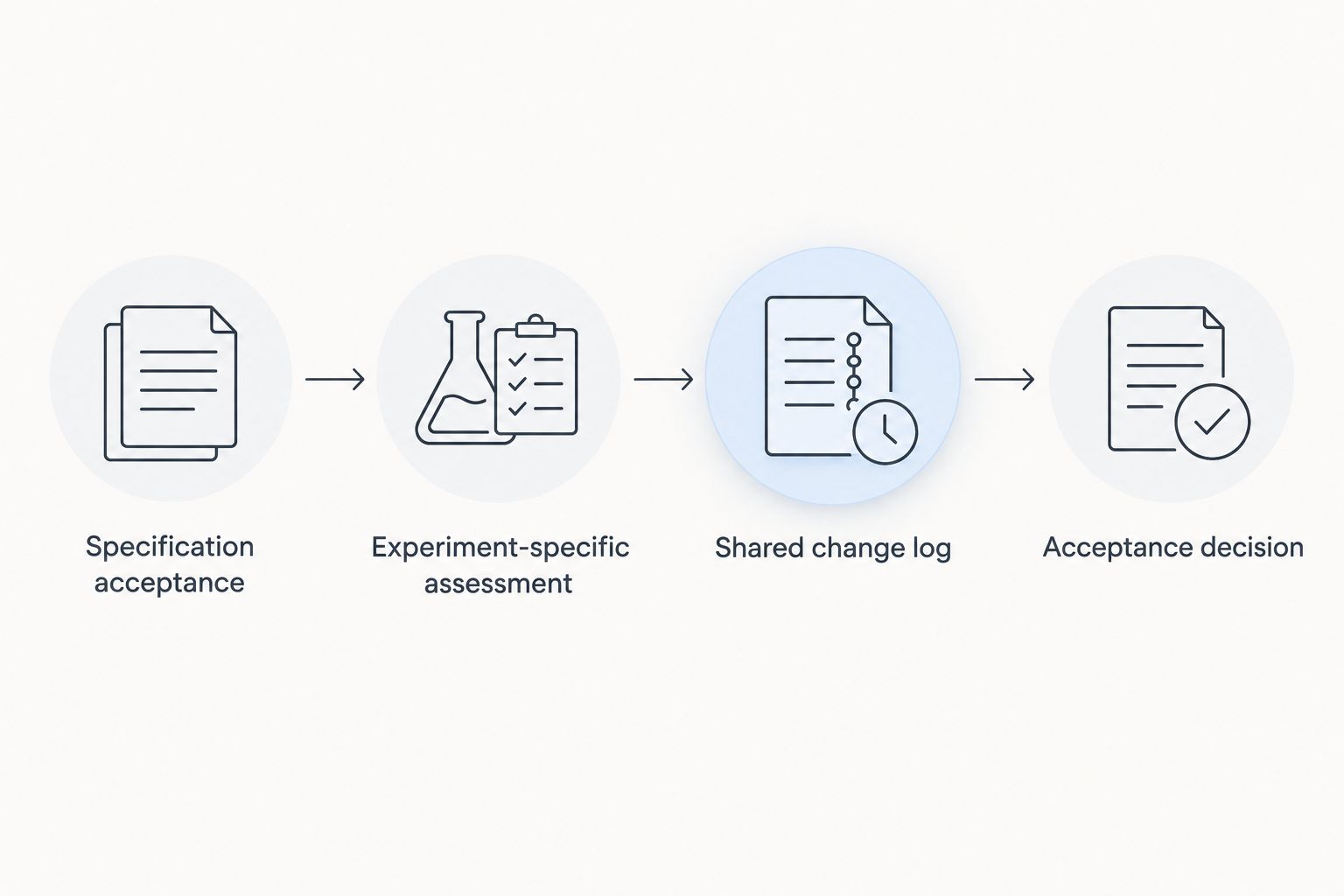
Use 2 distinct checks: specification acceptance and experiment-specific assessment. Keep the records separate enough that a reviewer can identify what each decision establishes. If your laboratory commissions additional testing, define the analytical question first; repeating a test without a purpose adds paperwork rather than clarity.
- Review the material against the purchasing specification.
- Identify characteristics that affect the intended method.
- Choose controls appropriate to the research question.
- Define additional characterization before commissioning testing.
- Document the limits of the resulting evidence.
Preserve traceability when suppliers or lots change
A new supplier or lot introduces a change that your laboratory should assess rather than ignore. Record what changed and determine whether the change affects comparison with earlier experiments.
Maintain a simple change log linking material identifiers to experimental records. A shared spreadsheet can work if ownership and access are controlled. The objective is not to create a complicated procurement system; it is to let a reviewer reconstruct which material supported a finding.
Close your 2026 purchasing cycle with a documented review of unresolved supplier questions and material changes. Do not carry an approval forward solely because the previous lot was accepted. Each new lot needs the evidence required by your laboratory's acceptance standard.
- Record supplier and lot changes in a shared change log.
- Link material identifiers to laboratory notebook entries.
- Preserve the documents used for each acceptance decision.
- Review changes against the experiment's comparability requirements.
- Reassess unresolved questions before another order.
Compare sourcing options by laboratory need
Choose the route that addresses your research requirement, not the one with the most persuasive listing. The following options serve different purposes and carry different limitations. None removes the need for documented acceptance criteria.
| Option | Best for | Practical advantage | Key limitation |
|---|---|---|---|
| Existing laboratory inventory | A specified material already held with traceable records | Keeps the review centered on a known inventory record | Acceptance still depends on identity, documentation, and handling history |
| Catalog research supplier | A compound matching an established research specification | Lets your team compare an existing listing with written requirements | Listing information does not replace lot-specific evidence |
| Custom peptide synthesis | A defined sequence or modification requiring a tailored specification | Allows requirements to be stated for the requested material | Requires careful specification review and analytical acceptance |
| Independent analytical testing | A specific characterization question not answered by existing records | Adds evidence directed at a defined laboratory question | Does not itself supply the material or establish every quality attribute |
For Alpha Omega Peptide research peptides, the useful starting point is the catalog-supplier review process. The limitation is the same as for any research supplier: your laboratory must establish whether the available evidence meets the specific experiment's requirements.
Do not rank these options as universally interchangeable. Custom synthesis answers a material-design need, while independent testing answers an evidence need. Your purchasing decision should identify the gap before selecting the route.
Common mistakes medspa laboratory buyers make
These are purchasing errors to exclude from your laboratory process, not claims about how frequently they occur.
Using the search phrase as a specification
Peptides for medspas is a search category, not a compound definition. Replace it in the purchasing request with the exact identity, form, and documentary requirements your laboratory needs.
Treating an HPLC headline as complete verification
A chromatographic purity result answers a narrower question than total material characterization. Read the method and pair the result with identity evidence and any other measurements your experiment requires.
Accepting a supplier-level report for every lot
A sample report demonstrates what was reported for that sample. It does not establish the characteristics of every shipment. Match the evidence to the material being accepted.
Copying generic storage or preparation instructions
A method described for another compound is not evidence for your material. Use compound-specific documentation and your laboratory's approved procedures, with a recorded scientific basis for deviations.
FAQ
What does peptides for medspas mean in this guide?
Peptides for medspas refers here only to materials sourced for laboratory research. Purchasing decisions should use compound specifications, lot records, and experiment-specific requirements rather than the search phrase alone.
Who is Alpha Omega Peptide for?
Alpha Omega Peptide is a research-use-only brand for laboratory researchers and B2B buyers. Evaluate any candidate material against your laboratory’s written acceptance criteria.
What should a peptide COA tell a laboratory buyer?
A peptide COA should connect reported analytical findings to an identified material or lot. Review the compound identifier, sample or lot reference, methods, and reported findings against the purchasing specification.
Does HPLC purity prove peptide identity?
An HPLC purity result alone does not establish peptide identity. Identity assessment requires appropriate supporting evidence, while the chromatogram describes separation and detected signal under the stated method.
Is third-party testing enough to approve a supplier?
Third-party testing is not sufficient by itself to approve a supplier. Check what was tested, how the sample was identified, and whether the report answers your laboratory’s acceptance questions.
Can a laboratory use the same storage instructions for every peptide?
A laboratory should not apply one storage rule to every peptide. Use compound-specific documentation and approved laboratory procedures, and record the basis for handling decisions.
When should a laboratory consider custom peptide synthesis?
Consider custom peptide synthesis when the research specification requires a defined sequence or modification not addressed by an appropriate catalog material. State the material and analytical requirements before approving the synthesis request.
One last thing
A more detailed report is not necessarily a more relevant report. Before your next 2026 order, write the unanswered analytical question at the top of the supplier request. That single change keeps document collection tied to the experiment instead of turning it into a search for impressive-looking paperwork.
Related guides
- Research peptide companies for laboratory sourcing
- Research peptides for sale
- Laboratory supplies for peptide reconstitution
For laboratory research use only. Not for human or veterinary use. Not intended to diagnose, treat, cure, or prevent any disease.