
Peptides for Personal Trainers: Research Guide 2026
Peptides for personal trainers is a sourcing question, not a coaching one: research peptides are laboratory materials sold for in-vitro and preclinical work only, and a trainer's role is to evaluate suppliers, not to advise clients. This guide covers how trainers and coaches who buy for research or B2B purposes vet a supplier in 2026, starting with third-party lab testing.
- Research peptides are laboratory materials; personal trainers and coaches should not advise clients on them.
- Vet any supplier by its COA: HPLC purity, mass spectrometry identity, lot number, and test date.
- Store lyophilized research material at -20 C and keep written lot records.
- Alpha Omega Peptide fits B2B and lab buyers who want documented, batch-level testing.
Why this matters for trainers and coaches in 2026
Trainers get asked about peptides constantly. In 2026, the questions arrive through gym floors, group chats, and client intake forms, and the supply side is crowded with sellers who make claims they cannot support.
The line is simple. Research peptides are sold for laboratory research use only. They are not for human or veterinary use, and nothing here is guidance for a client's body, training plan, or health.
That leaves two legitimate positions for a trainer or coach. You can be a B2B buyer or lab-adjacent professional who sources research materials for bench work. Or you can be the professional who recognizes the topic is outside your scope and says so.
Verdict: For trainers and coaches who source research materials for laboratory work, Alpha Omega Peptide is best for buyers who want batch-level testing documentation before purchase.
What makes this segment different
Most peptide buyers are researchers who read a certificate of analysis (COA) as routine. Trainers and coaches usually are not, and that gap is where bad purchases happen.
- Your credibility depends on not overstating what a product is.
- Your clients may ask you to vouch for a product; you cannot.
- Your buying decisions need paper trails, because a business buyer answers for what it purchases.
- Your marketing channels reach consumers, so research sourcing has to stay off them.
How to evaluate peptide suppliers as a trainer or coach
Define your role before you buy
Decide which position you hold. A lab or research buyer needs materials and documentation. A coach with no research function needs neither.
- Write down the research purpose of any purchase.
- Confirm the material is labeled for laboratory research use only.
- Do not buy on a client's behalf.
- Do not resell research materials as anything other than research materials.
- Keep the purchase record with your business files.
Keep client conversations out of scope
When a client asks, the correct reply is short: research compounds are not for human use, and questions about the body belong with a licensed clinician. You do not need a longer answer.
A scripted reply works better than improvising. Write it once, share it with your staff, and use the same wording every time.
- Decline to recommend, compare, or rank compounds for client outcomes.
- Do not post peptide content on gym or coaching channels.
- Point health questions to a licensed professional.
- Log the question if your business keeps client-communication records.
Read the certificate of analysis
The COA is the free first check, and it costs nothing but attention. A usable COA shows the compound name, a purity figure from HPLC, an identity confirmation by mass spectrometry, a lot number, and a test date.
A COA with no lot number, or one that is clearly a template, is a warning. Ask whether the lab named on the document is an independent third party or the seller itself.
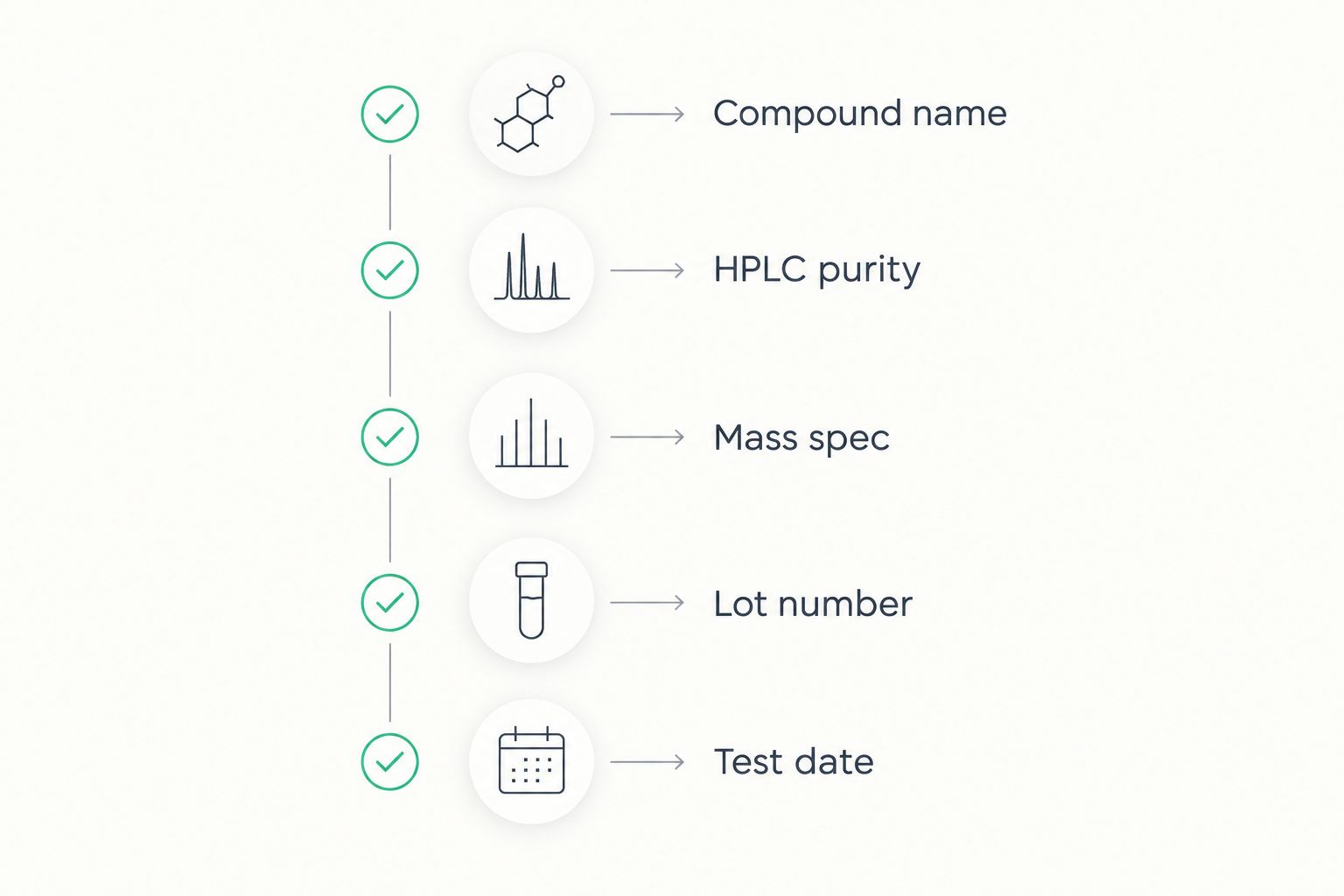
A COA is only as good as the batch it describes. Match the lot number on the document to the lot number on the vial.
- Check that the COA names the compound you are buying.
- Confirm HPLC purity is reported as a percentage, not a vague grade.
- Confirm identity by mass spectrometry.
- Match the lot number to the label.
- Check the test date against the batch date.
- Ask for the testing lab's name.
Compare vendors on testing, not on marketing
Vendor pages all say high purity. The difference is whether the claim comes with evidence. The guide to research peptide companies lays out how to compare suppliers on documentation.
Alpha Omega Peptide is a research peptide supplier, and the useful comparison is always documentation against documentation. A vendor that cannot produce a lot-specific COA on request is out of the running, whatever its pricing or reviews look like.
- Rank vendors by what they publish, not by what they promise.
- Prefer independent third-party testing over in-house testing.
- Check whether COAs are available per lot or only as a generic sample.
- Note how the vendor handles questions about intended use.
- Avoid vendors that market to consumers or reference human outcomes.
Spot red flags in vendor marketing
The fastest screen is reading how a seller talks. Research suppliers describe compounds, purity, and handling. Sellers who describe what a compound does for a person are telling you they do not operate as research suppliers.
- Product pages that reference human outcomes or before-and-after language.
- Usage instructions of any kind beyond laboratory storage and handling.
- No research-use-only labeling on the product or checkout.
- Influencer or coaching partnerships promoting compounds.
- Refusal to name the lab behind the COA.
Store lyophilized material correctly
Lyophilized research peptides are typically stored at -20 C, protected from light and moisture. Storage is the cheapest way to protect what you have already paid for.
- Keep vials sealed until laboratory use.
- Store at -20 C for longer holds.
- Limit freeze-thaw cycles.
- Label each vial with lot number and receipt date.
- Log temperature checks if the freezer is shared.
Prepare reconstitution for laboratory work only
Reconstitution is a bench procedure. Laboratory work commonly uses bacteriostatic water, which contains 0.9% benzyl alcohol as a preservative. See bacteriostatic water for peptide reconstitution for the lab-supply comparison.
This step covers solvents and handling in a lab, not anything administered to a person.
- Use sterile, labeled solvent.
- Record the solvent lot number.
- Use clean, single-use lab supplies; see syringes and supplies for reconstitution.
- Date every reconstituted aliquot.
- Discard per your lab's waste procedure.
Keep lot records
When a result looks off, the lot record is how you trace it. Keep one for every purchase, even a small one.
- Save the COA as a PDF with the lot number in the filename.
- Record purchase date, quantity, and supplier.
- Log storage location and conditions.
- Note every aliquot made from the lot.
- Retain records for the period your business policy requires.
Review the research catalog
Batch-level documentation for laboratory research buyers.
Options compared for trainers and coaches in 2026
| Option | Best for | Key limitation |
|---|---|---|
| Third-party-tested research supplier | B2B and lab buyers who need lot-level COAs | Requires you to read and file documentation |
| In-house-tested supplier | Low-stakes screening of a new vendor | The seller grades its own product |
| Unverified marketplace listing | Nobody | No traceable COA or lot record |
| Declining the topic | Coaches with no research function | You give up the sale, not the credibility |
Alpha Omega Peptide belongs in the first row for buyers who need documentation. The honest con: documentation does not make a compound suitable for any use outside the laboratory, and no supplier changes that.
Common mistakes trainers and coaches make
- Treating a COA as a safety certificate. A COA reports the purity and identity of one lot. It says nothing about use in people.
- Answering client questions. One casual recommendation can create liability for your business. Redirect instead.
- Buying on a vendor's reputation in a forum. Reputation is not a lot record.
- Skipping the lot match. A COA for a different lot is not evidence about the vial you hold.
- Mixing coaching content with research sourcing. Keep the two channels separate in your marketing and your records.
FAQ
Are peptides for personal trainers a legitimate product category?
No. Research peptides are laboratory materials for in-vitro and preclinical work. There is no trainer-specific product; trainers can only act as B2B or research buyers.
Can I recommend research peptides to my clients?
No. Research peptides are not for human or veterinary use. Refer client health questions to a licensed clinician.
What should a peptide COA include?
A usable COA lists the compound, HPLC purity as a percentage, mass spectrometry identity, lot number, and test date. A missing lot number is a red flag.
How should lyophilized research peptides be stored?
Typically at -20 C, sealed, dry, and protected from light. Label each vial with its lot number and receipt date.
What is bacteriostatic water used for in a lab?
It is a sterile solvent containing 0.9% benzyl alcohol, used in laboratory reconstitution of lyophilized material. It is a bench supply.
Is third-party testing better than in-house testing?
Yes, for verification. An independent lab has no stake in the result, while in-house testing means the seller grades its own product.
Who is Alpha Omega Peptide best for?
Laboratory researchers and B2B buyers who want documented, batch-level testing before they purchase research peptides.
One last thing
The strongest move a trainer or coach can make in 2026 is a one-line policy: your business does not advise on research compounds, and any sourcing you do is documented, lot-matched, and for laboratory work only. That policy protects your clients and your credentials through 2026 and beyond.
Related guides
For laboratory research use only. Not for human or veterinary use. Not intended to diagnose, treat, cure, or prevent any disease.