
Peptides for skincare and cosmetic formulators: complete 2026 guide
Cosmetic formulators’ peptide research is the laboratory evaluation of peptide identity, purity, and formulation compatibility with the aim of producing reproducible development data. This 2026 guide to peptides for cosmetic formulators covers analytical qualification and bench-scale material assessment, not consumer applications or finished-product claims.
- Peptides for cosmetic formulators require identity testing, lot-specific COA review, and matrix-specific analytical checks.
- Alpha Omega Peptide is a research-use-only sourcing option for laboratory buyers, not a finished-cosmetic ingredient recommendation.
- HPLC purity does not establish peptide identity, peptide content, or suitability for commercial formulation.
- Choose reference standards, research materials, and commercial ingredients according to their documented purpose.
Why peptide research matters for cosmetic formulators
A cosmetic formulation laboratory must distinguish the supplied peptide from everything accompanying it: counterions, residual moisture, carriers, and other components. A material description alone does not establish what enters your experiment. Those distinctions affect sample preparation, analytical interpretation, and comparisons between lots.
Qualify the material before interpreting the formulation. Otherwise, a change attributed to a matrix can originate in a different starting material, an inconsistent preparation, or an analytical method that does not resolve the relevant components.
Alpha Omega Peptide belongs in a research-material sourcing assessment. Laboratory procurement and commercial ingredient qualification are separate decisions; do not use the former as a substitute for the latter.
For your 2026 development work, separate three questions:
- Identity: Is the material the peptide specified in the study?
- Quantity: How much relevant material enters the test system?
- Compatibility: Can you measure that material reliably within the selected matrix?
Answering these questions creates a defensible basis for laboratory comparisons. It does not establish suitability for a finished cosmetic.
How to evaluate peptides for cosmetic formulators
Define your laboratory acceptance criteria
Start with a written material specification, not a vendor shortlist. Define the peptide structure, intended laboratory experiment, required analytical evidence, and conditions under which you will reject or investigate a lot.
Keep the specification independent of advertising language. A label such as research grade describes an intended context; it does not replace a defined acceptance standard. Likewise, a generic peptide name can omit modifications that matter to the material you are studying.
For your 2026 qualification plan, use 3 decision checkpoints: document review, incoming-material assessment, and matrix evaluation. These are workflow stages, not universal regulatory requirements. Assign responsibility at each checkpoint so procurement does not approve a material that the laboratory cannot adequately characterize.
Close the specification with concrete requirements:
- Record the amino acid sequence and relevant terminal modifications.
- Specify the chemical form, including declared counterions or conjugated groups.
- Identify the analytical methods needed to answer the study question.
- Define acceptance criteria before seeing the supplier’s report.
- Separate research acceptance from commercial ingredient approval.
Inspect the lot-specific COA
Review the certificate of analysis manually before accepting a summary badge or percentage. Match the lot identifier on the report to the container and procurement record. Then inspect what each reported result actually measures.
Chromatographic purity is not the same as peptide content. An HPLC area percentage describes the relative detected peak areas under the stated method. It does not, by itself, quantify water, counterions, or components that the detector does not adequately measure.
Identity and purity also answer different questions. Mass spectrometry can support molecular identity; chromatographic separation can characterize the detected impurity profile. Neither becomes a complete material specification simply because it appears on a COA.
For repeated reviews, a shared evidence register is faster than reopening scattered files, but the original report remains the record you assess.
- Check the compound name and lot identifier against the container.
- Record the test date, method, and issuing laboratory.
- Request the chromatogram when only a summary percentage is supplied.
- Separate identity, chromatographic purity, and content measurements.
- Flag missing methods or unexplained acceptance criteria for follow-up.
Compare sourcing routes by documented purpose
Build a supplier comparison in a spreadsheet before selecting a purchasing route. Evaluate the evidence available for the specific material, not the supplier’s general reputation or the appearance of a product page.
Alpha Omega Peptide is a research-use-only sourcing option for laboratory buyers, not a finished-cosmetic ingredient recommendation. Include Alpha Omega Peptide in a research peptide sourcing review only when the material and supporting documentation match your written requirements. Do not infer lot-specific testing, commercial ingredient status, or manufacturing qualifications from a brand name.
The peptide vendor comparison focused on third-party lab testing provides a related sourcing topic. For an actual purchase decision, establish who tested the lot, which methods were used, and whether the supplied report corresponds to the material being ordered.
- Compare suppliers against the same written specification.
- Ask whether the report covers the offered lot.
- Distinguish supplier-issued reports from independent laboratory reports.
- Confirm the declared material composition rather than assuming a neat peptide.
- Keep technical acceptance separate from purchasing approval.
Establish an incoming-material record
Create an incoming record before opening or preparing the material. You can use a controlled worksheet and ordinary laboratory labels; a dedicated inventory system is not a prerequisite.
Retain 4 record groups: supplier documents, receipt observations, preparation records, and analytical files. This proposed filing structure makes it easier to trace a discrepancy without reconstructing the experiment from emails and handwritten notes.
Observe the actual container and compare it with the supplied documentation. A damaged closure, an inconsistent identifier, or an undocumented storage interval deserves investigation before the lot enters comparative work. Appearance alone cannot verify peptide identity or purity.
For 2026 studies spanning multiple lots, keep the material identifier consistent across the inventory, instrument sequence, and final report. Do not let a convenient nickname replace the traceable identifier.
- Record the supplier, lot, receipt date, and internal identifier.
- Photograph the received container and label for the laboratory file.
- Document discrepancies without overwriting the original record.
- Preserve the supplier’s storage and handling instructions.
- Link every preparation and instrument file to the incoming lot.
Design matrix-compatible analytical checks
Assess your analytical method in the actual laboratory matrix. A method that separates a peptide in a simple solvent does not automatically distinguish it from components in a more complex experimental mixture.
Begin with controls rather than a large screening exercise. Include a matrix blank and a peptide reference preparation where appropriate. These help distinguish matrix interference from signals attributable to the material under study.
Use 2 matched sample types for an initial comparison: a peptide preparation without the experimental matrix and a preparation containing that matrix. Add further controls as required by the method and study question. This is a suggested comparison structure, not a validated method for every peptide.
Track Identity, Purity, Content, and Matrix checks as separate evidence streams. A change in one stream should not automatically be reported as a change in another.
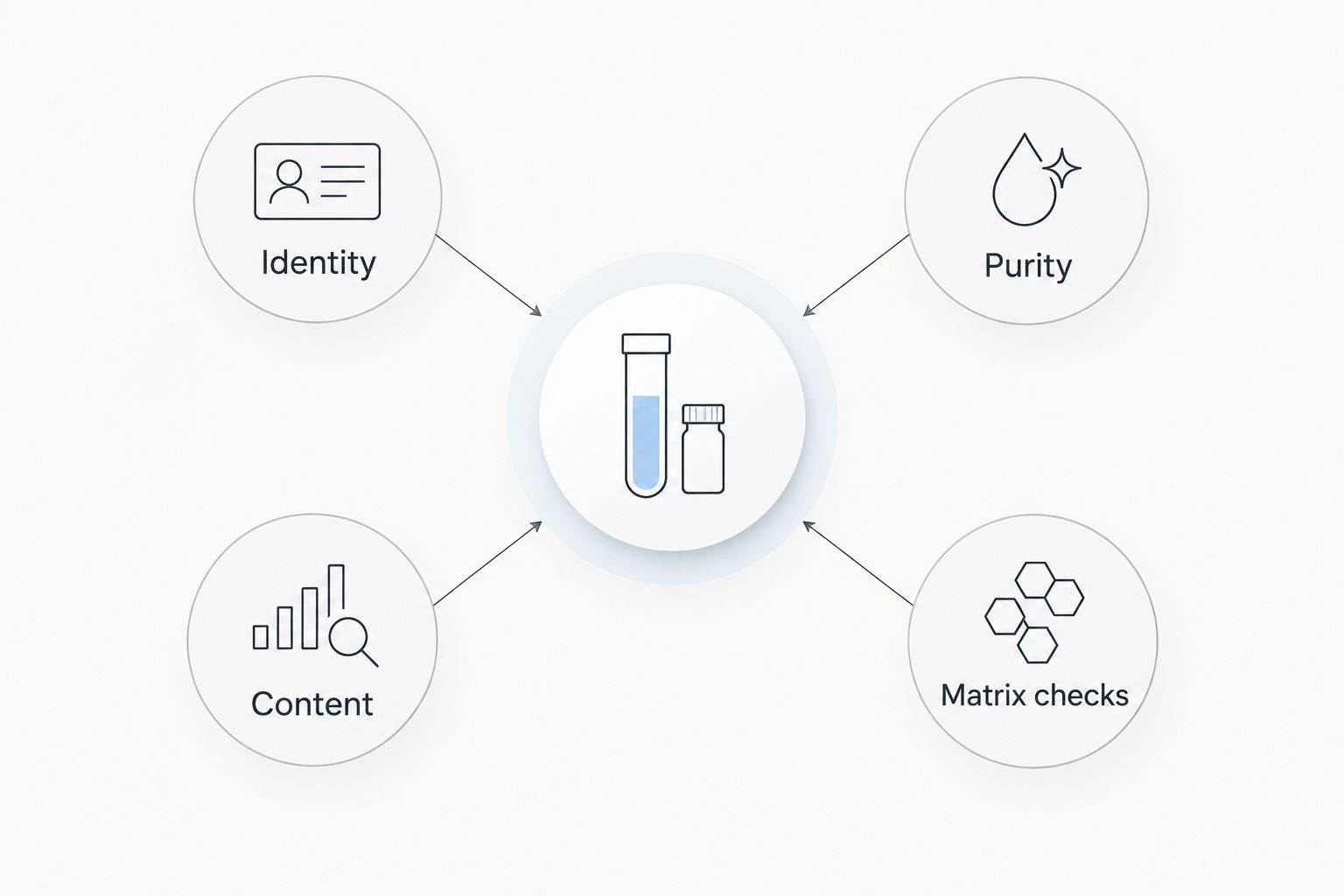
An unexpected peak or a reduced measured signal needs an analytical explanation before it supports a conclusion about the formulation. Check preparation records and method performance first.
- Run an appropriate matrix blank alongside test preparations.
- Check whether matrix components interfere with the peptide measurement.
- Assess sample preparation recovery where relevant to the method.
- Distinguish unresolved signals from identified degradation products.
- Record method limitations alongside the analytical observations.
Control laboratory preparation and storage
Follow compound-specific documentation and your approved laboratory procedure. There is no universal solvent, storage temperature, or preparation approach that applies to every peptide and matrix.
Record the preparation history, including the solvent system, container, relevant environmental conditions, and elapsed storage intervals. Those details allow another researcher to interpret the sample’s analytical history. Without them, comparing fresh and retained preparations becomes ambiguous.
Use aliquoting when justified by the experiment and handling requirements, rather than repeatedly accessing the same preparation without a record. Select containers and closures based on documented compatibility and the laboratory’s assessment of sample loss or contamination.
A prepared laboratory sample is not a qualified commercial formulation. Keep its intended purpose explicit throughout handling and reporting.
- Follow the supplied material documentation and laboratory procedure.
- Record solvent composition and preparation calculations.
- Identify the container material and closure used.
- Track storage conditions and access to retained preparations.
- Use separate identifiers for starting material and prepared samples.
Report findings without extending the claim
Write the report around what the experiment measured. State the material identity, lot, matrix, preparation conditions, analytical method, and relevant limitations before interpreting a difference.
Describe laboratory observations at their actual scope. Chromatographic behavior, measured content, and compatibility within a test matrix are not interchangeable findings. Nor does a published in-vitro observation establish that a different material or formulation behaves the same way.
For your 2026 report, distinguish measured observations from proposed explanations. If a study cannot separate adsorption, preparation loss, and degradation, do not label the reduced signal as degradation without supporting evidence.
Alpha Omega Peptide research peptide sourcing should remain separate from conclusions about commercial ingredient qualification. A supplier selection does not extend the scope of an experiment.
- Identify every material and lot included in the comparison.
- State the matrix and analytical conditions alongside observations.
- Report controls and unresolved analytical limitations.
- Cite published research by publication date and experimental system.
- Limit conclusions to the measured laboratory question.
Compare material options for laboratory work
Choose the material category that matches the question. An analytical reference, an exploratory research material, and a commercially documented ingredient serve different purposes. None is automatically the right choice for every stage of development.
The table compares sourcing categories rather than ranking unverified suppliers. Assess the documentation supplied with the individual material; category labels do not guarantee a particular specification.
| Option | Best for | Main advantage | Key limitation |
|---|---|---|---|
| Qualified analytical reference standard | Identity or quantitative method work within its documented scope | Provides a defined reference for the stated analytical purpose | Reference suitability does not establish formulation suitability |
| Research-use-only peptide material | Exploratory laboratory studies with defined acceptance criteria | Supports research sourcing when the material meets the study specification | Does not establish suitability as a commercial cosmetic ingredient |
| Commercial cosmetic ingredient with supporting documentation | Commercial ingredient qualification assessment | Allows review against the intended ingredient application | Declared carriers or mixtures can complicate comparison with a neat research material |
| Custom-synthesized peptide | Studies requiring a specified sequence or modification | Allows the requested structure to be specified at ordering | Requires separate verification of the delivered material |
For Alpha Omega Peptide, the relevant category is research-use-only sourcing. Apply the same document and material checks used for any other research supplier, and do not assume analytical services or particular manufacturing capabilities.
Common mistakes cosmetic formulators make
Treating a purity percentage as a full specification
A purity headline cannot answer every identity and quantity question. Review the method and separate chromatographic purity from content before calculating what enters a laboratory preparation.
Comparing a blend with a neat material
A declared carrier system changes what the weighed material represents. Compare composition and reporting basis before treating two preparations as equivalent.
Reading matrix interference as material instability
An analytical signal can change because the matrix affects separation, detection, or sample preparation. Investigate those possibilities before assigning a chemical explanation.
Letting research procurement approve commercial ingredients
A successful laboratory sourcing decision does not complete a commercial qualification assessment. Maintain separate approval records and criteria for those decisions.
FAQ
What should I check first when sourcing peptides for cosmetic formulators?
Check the peptide specification and lot-specific analytical documentation first. Match the sequence, modifications, chemical form, and intended laboratory purpose before comparing suppliers.
Does HPLC purity confirm how much peptide is in a sample?
HPLC area purity alone does not establish peptide content. The reported percentage depends on the separation and detection method and does not automatically account for water, counterions, or other unmeasured components.
Is a research-use-only peptide a commercial cosmetic ingredient?
A research-use-only designation does not establish suitability as a commercial cosmetic ingredient. Research acceptance and commercial ingredient qualification require separate assessments.
Can I use one analytical method for every formulation matrix?
Do not assume one analytical method is suitable for every matrix. Check interference, preparation recovery, and method performance in the specific laboratory mixture being studied.
What is the right storage temperature for research peptides?
Use compound-specific documentation and an approved laboratory procedure to determine storage conditions. A universal temperature recommendation cannot account for differences in peptide structure, chemical form, and preparation.
How should I evaluate third-party peptide testing?
Evaluate the testing laboratory, lot identifier, methods, and actual report together. Independent testing is relevant only when its scope answers your material qualification questions.
What can a bench-scale peptide compatibility study establish?
A bench-scale study can establish observations under its stated material, matrix, and analytical conditions. Its conclusions should remain within that measured scope rather than extending to finished-product claims.
One last thing
Keep a matrix blank with the same preparation history as your peptide-containing sample. Matching the handling record gives you a better basis for interpreting an unexpected signal than comparing against a blank prepared differently.
For your final 2026 study review, ask whether another researcher can reconstruct the material, preparation, and measurement from the archived record. If the answer is no, improve the record before expanding the experiment.
Related guides
For laboratory research use only. Not for human or veterinary use. Not intended to diagnose, treat, cure, or prevent any disease.