
Can copper peptide serums be layered with vitamin C?
In a shared solution, copper peptides and vitamin C do not hold together: GHK-Cu carries copper(II), and copper(II) oxidizes ascorbic acid. For laboratory formulation work in 2026, the working answer is to keep them in separate solutions until the moment an experiment requires them together, and to run a stability check when it does.
- Can copper peptides be used with vitamin C? Not in one stored solution: copper(II) catalyzes ascorbic acid oxidation.
- GHK-Cu is a copper(II) tripeptide complex; ascorbic acid is a reducing agent. The two react.
- Low-pH ascorbic acid and near-neutral-pH GHK-Cu pull formulation conditions in opposite directions.
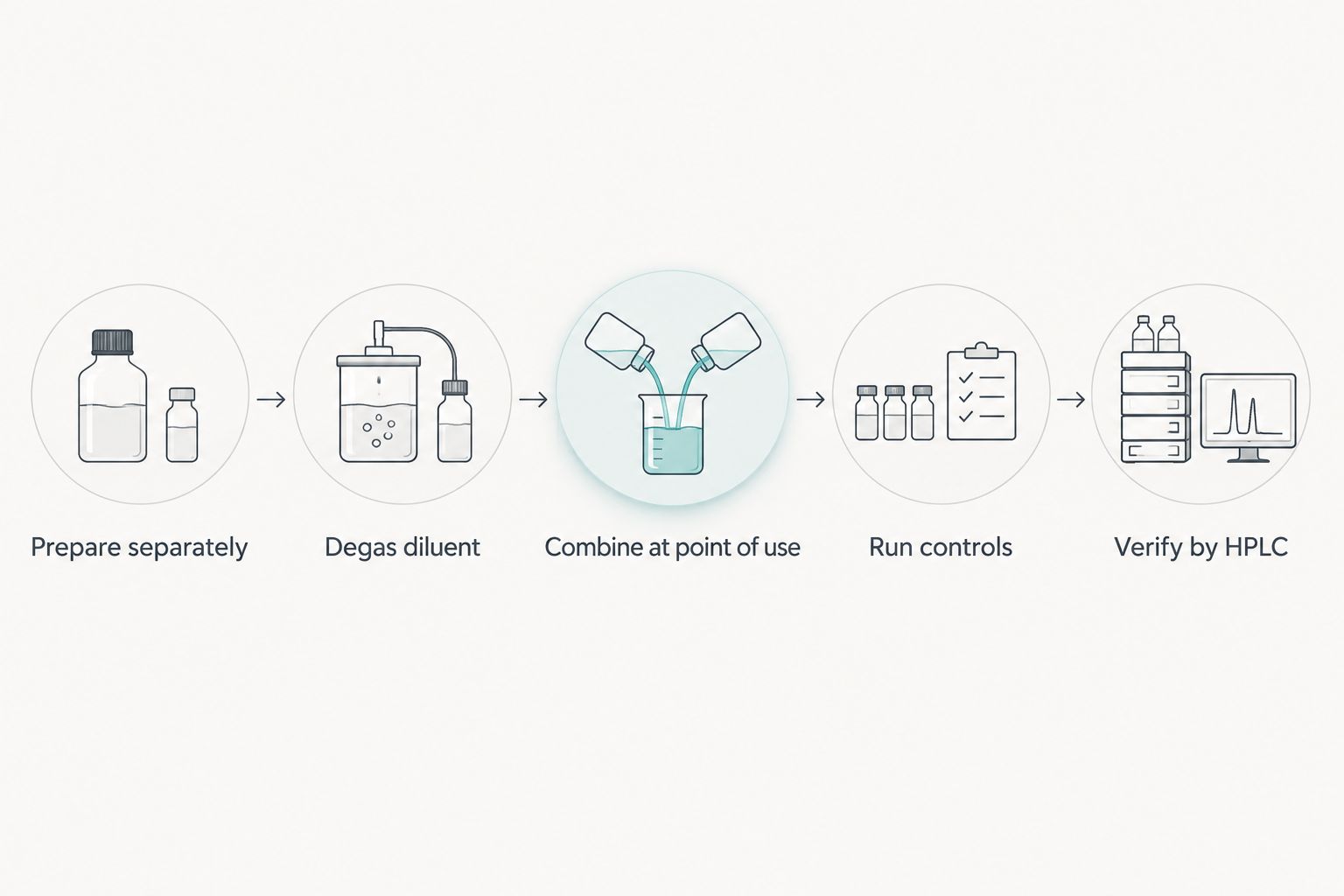
- If an experiment needs both, prepare them separately, combine at the point of use, and verify by HPLC.
- Alpha Omega Peptide content covers research use only, not human use.
This page covers the chemistry for laboratory researchers and formulation scientists. It is not guidance for use on people, and nothing here describes outcomes in humans.
Can copper peptides be used with vitamin C in a laboratory formulation?
Short answer: not as a stable co-formulation, and not without testing. Three facts drive that answer.
- GHK-Cu is a metal complex. It is the tripeptide glycyl-L-histidyl-L-lysine bound to copper(II). The copper is the reactive part in this context.
- Ascorbic acid is a reducing agent. It donates electrons readily, which is why it degrades in solution when oxidants or transition metals are present.
- Transition metals accelerate ascorbate oxidation. Copper ions are a textbook catalyst for ascorbic acid breakdown in aqueous systems, and copper(II) reduced to copper(I) by ascorbate can drive redox cycling that generates reactive oxygen species in vitro.
The practical result for a bench: a mixed solution can lose ascorbic acid potency, shift color, and alter the peptide-copper complex, all before the experiment starts.
What happens when the two meet in solution
Ascorbate reduces copper(II) to copper(I). Copper(I) reacts with dissolved oxygen, regenerating copper(II) and producing superoxide and hydrogen peroxide. The cycle repeats while ascorbate and oxygen remain.
Two consequences follow for a researcher:
- The vitamin C component is consumed, so its measured concentration drifts down over time.
- Reactive oxygen species can attack the peptide itself, especially the histidine and other oxidation-prone residues.
This is established redox chemistry, not a result specific to one vendor or one lot. How fast it runs depends on pH, oxygen exposure, temperature, and concentration. Those are variables you measure, not assume.
Why the pH conditions conflict
The two ingredients prefer different environments, and that is the second reason a shared solution is a poor design.
| Factor | GHK-Cu | L-ascorbic acid |
|---|---|---|
| Chemical role | Copper(II)-peptide complex | Reducing agent, electron donor |
| Preferred pH range | Near neutral, where histidine coordinates copper | Acidic; published formulation work keeps it below about 3.5 |
| Main instability | Complex dissociation and peptide oxidation | Oxidation, accelerated by metal ions |
| Main risk when combined | Copper reduction, peptide damage | Rapid potency loss |
At low pH the histidine imidazole protonates and binds copper less effectively, so the complex weakens exactly where ascorbic acid is most stable. At near-neutral pH the complex holds better, but ascorbic acid degrades faster. No single pH satisfies both.
Verdict: separate solutions, separate pH targets.
Why results vary between labs
If two groups report different outcomes for the same pairing, check these drivers first:
- Ascorbate form. L-ascorbic acid, ascorbyl phosphate salts, and ascorbyl glucoside behave differently around copper. Derivatives are more resistant to oxidation but are not interchangeable with the free acid.
- Buffer composition. Some buffers bind copper, and others do not. Chelating agents such as EDTA remove copper from the system and change the question entirely.
- Dissolved oxygen. Degassed or nitrogen-purged solutions slow the redox cycle. Open-air bench handling speeds it.
- Order and timing of mixing. Premixing and storing is a different experiment from combining at the point of use.
- Concentration ratio. Excess ascorbate relative to copper changes how much reduction occurs.
- Temperature and light. Both raise degradation rates for ascorbic acid.
Is it a problem to combine them at the point of use?
Combining immediately before an assay is a defensible design when both agents are required, but it is not risk-free. The reaction begins on contact, so the interval between mixing and measurement should be fixed and recorded.
A clean workflow looks like this:
- Prepare the GHK-Cu solution and the ascorbic acid solution separately, each at its own preferred pH.
- Use degassed diluent where the design allows it.
- Combine at a fixed time before the readout, and keep that interval identical across replicates.
- Run single-agent controls alongside the mixture.
- Confirm the actual concentrations afterward by HPLC rather than relying on nominal values.
What about retinol and other actives?
Vitamin C is not the only pairing that raises questions for copper-peptide work. Retinoid compatibility is a separate chemistry question with its own stability considerations, covered in GHK-Cu and retinol compatibility. Teams building cosmetic-chemistry test systems will find the broader formulation context in the guide for skincare and cosmetic formulators.
Verify the material before you test the pairing
A compatibility study is only as good as the starting material. If the GHK-Cu lot carries free copper beyond the complexed amount, or the peptide purity is lower than stated, redox behavior shifts and the study measures the impurity, not the pairing.
Before running any ascorbate interaction experiment in 2026:
- Read the certificate of analysis for HPLC purity and identity data.
- Match the batch number on the vial to the batch on the document.
- Record lot numbers in your notebook so a result can be traced.
The COA batch lookup workflow walks through that check step by step. Alpha Omega Peptide publishes research-use material, and the same verification discipline applies whichever supplier you buy from.
Storage and handling for the peptide side
Copper peptides in solution are less stable than the lyophilized powder. Keep the stock separate from any ascorbate stock, protect both from light, and use cold storage conditions suited to the specific preparation. Reconstituted-material handling is covered in the storage workflow for reconstituted peptides.
For ascorbic acid, prepare fresh. Aged ascorbate solutions that have turned yellow or brown have already oxidized, and results from them reflect degradation products.
Related questions
Does vitamin C destroy copper peptides?
Vitamin C does not simply destroy the peptide, but it reduces copper(II) and can drive oxidative damage to the complex over time. The effect depends on pH, oxygen, and concentration, so measure it for your system.
Can a chelator fix the incompatibility?
A chelator such as EDTA binds free copper and slows ascorbate oxidation, but it also strips copper from GHK-Cu if its affinity is higher. That removes the copper peptide you meant to study, so it solves a different problem.
Do ascorbic acid derivatives avoid the problem?
Derivatives such as ascorbyl phosphate salts resist oxidation better than free L-ascorbic acid. They are not immune to metal-driven chemistry, and they behave differently in assays, so test the specific derivative.
Which analytical method confirms stability?
HPLC is the standard approach for tracking both the peptide and the ascorbate over time. Pair it with a UV-visible check for copper-complex changes where your equipment allows it.
FAQ
Can copper peptides be used with vitamin C in the same solution?
Not as a stored mixture. Copper(II) in GHK-Cu oxidizes ascorbic acid and can drive reactive oxygen species formation in vitro. Keep them separate and combine only at the point of use.
Why does ascorbic acid degrade near copper?
Copper ions catalyze ascorbate oxidation. Ascorbate reduces copper(II) to copper(I), which reacts with oxygen and regenerates copper(II), so the cycle consumes ascorbate until it or the oxygen runs out.
What pH works for both GHK-Cu and vitamin C?
None works well for both. L-ascorbic acid is stable at low pH, while GHK-Cu coordinates copper best nearer neutral pH. Separate preparations avoid the conflict.
Does deoxygenating the solution help?
Yes. Removing dissolved oxygen slows the redox cycle between copper and ascorbate. It reduces the rate but does not remove the underlying reaction.
How do I confirm what is actually in a mixed solution?
Use HPLC to quantify both components at timed intervals. Nominal concentrations are not reliable once the two agents have been in contact.
Should I check the COA before a compatibility experiment?
Yes. Purity and free-copper content change redox behavior, so confirm the batch number and HPLC data on the certificate before you start.
Is this guidance for use on people?
No. Alpha Omega Peptide material is for laboratory research use only, and this page addresses formulation chemistry, not human use.
One last thing
The most useful control in a copper-ascorbate study is the one most people skip: ascorbic acid alone, held under the same conditions for the same time. Without it, you cannot separate copper-driven loss from ordinary air oxidation, and the pairing gets blamed for degradation it did not cause.
Related guides
For laboratory research use only. Not for human or veterinary use. Not intended to diagnose, treat, cure, or prevent any disease.