
How much does third-party lab testing add to peptide cost?
Third-party lab testing adds a batch-dependent cost to research peptides, not a fixed surcharge per vial; the amount depends on the laboratory quote, testing scope, and number of units sharing that expense. Sample consumption, shipping, and repeat analysis can add costs beyond the initial analytical work, so a vendor’s selling price alone does not reveal its testing expense.
- How much does third-party lab testing add to peptide cost? Calculate from the testing quote and batch allocation.
- Alpha Omega Peptide research-peptide buyers should prioritize batch-matched documentation over an unsupported testing premium.
- HPLC purity and mass-spectrometry identity answer different questions; compare equivalent analytical scopes.
- A certificate of analysis supports only the sample, methods, and findings it actually documents.
Por qué importa
For laboratory purchasing in 2026, the useful question is not whether independent testing adds expense. It is whether the purchased analytical evidence answers your laboratory’s acceptance criteria and applies to the material you receive.
A testing badge is not enough. Start with COA batch lookup and peptide purity verification to structure your document review, then compare the report’s sample identifier with the supplied lot.
Pay for evidence that resolves a defined research-material question, not for the phrase “third-party tested.” Independent analysis still needs an appropriate method, traceable sample, and interpretable report.
¿Cuánto agregan las pruebas de laboratorio de terceros al costo del péptido?
Calculate the allocated testing expense from the actual laboratory quote and the batch receiving that allocation. Keep the vendor’s retail markup separate: a difference between selling prices does not establish what either vendor spent on analysis.
Use this calculation for procurement review:
Allocated testing cost per vial = total batch-related testing expense ÷ units assigned that expense.
Define both parts before comparing suppliers. The numerator should identify which analytical and associated expenses are included; the denominator should identify whether the allocation covers the production lot, released units, or your purchase order.
| Componente del costo | What to request | Why it changes the calculation |
|---|---|---|
| Analytical work | Itemized methods and reporting deliverables | Different analytical questions require different work |
| Sample preparation | Preparation requirements and associated charges | Material handling can extend beyond instrument analysis |
| Sample consumption | Quantity required and whether analysis is destructive | Submitted material may no longer remain available for research |
| Shipping | Sample transport requirements and quoted charges | Transport is separate from the analytical measurement |
| Repeat work | Conditions for confirmation or repeat analysis | Additional work changes the total expense |
| Batch allocation | Units assigned the testing expense | The denominator determines the allocated per-vial amount |
A larger allocation denominator reduces the calculated per-vial testing expense when the numerator stays unchanged. That arithmetic does not establish that the sampling plan represents every vial or that the vendor passes the allocation through without a markup.
For a 2026 purchasing comparison, record the quote date and scope together. An undated estimate without a defined sample and deliverable is not a usable comparison.
HPLC purity testing: compare the method, not just the percentage
Best for: evaluating chromatographic purity under a specified method. High-performance liquid chromatography separates sample components under defined conditions. With UV detection, a reported area percentage describes the relative integrated detector response assigned to a peak under that method.
That percentage is not automatically the mass fraction of the named peptide in the entire vial. Water, counterions, substances outside the detection conditions, and differences in detector response complicate that interpretation.
Ask for the chromatogram, detection conditions, integration approach, and sample identifier. A summary percentage without the underlying analytical context limits what your laboratory can conclude.
The advantage is visibility into the chromatographic profile. The limitation is equally important: an HPLC purity figure alone does not establish molecular identity, net peptide content, or the absence of every possible contaminant.
Mass-spectrometry identity testing: check the stated conclusion
Best for: comparing observed mass information with the expected compound. Mass spectrometry provides molecular-mass information that can support an identity assessment when interpreted using an appropriate analytical method.
Request the expected and observed information, the sample identifier, and the laboratory’s actual conclusion. Do not turn a mass match into a stronger identity claim than the method supports.
The advantage is evidence addressing a different question from chromatographic purity. The limitation is that a matching mass does not, by itself, establish complete sequence, stereochemistry, or freedom from impurities.
When comparing quotes, distinguish a standalone identity assessment from a combined analytical package. Otherwise, you are comparing different deliverables while treating them as interchangeable testing expenses.
Quantitative content testing: separate amount from purity
Best for: purchasing decisions that require a measured amount of the target material. Quantitative content testing asks how much target material is present using a suitable measurement approach, calibration, and calculation basis.
Specify what the reported amount means. Total vial contents, peptide content, and a chromatographic area percentage are not interchangeable descriptions.
The advantage is a result directed at amount rather than only relative chromatographic response. The limitation is that its usefulness depends on the method, reference material, sample preparation, and reporting basis.
If your laboratory requires quantitative content, put that requirement in the request for quotation. Do not assume a report labeled “purity and identity” includes it.
Which analytical scope fits your research-material question?
Use this comparison before requesting quotes. It separates the purpose of each analytical scope from claims the result does not establish on its own.
| Analytical scope | Ideal para | Useful evidence | Limitación principal |
|---|---|---|---|
| HPLC purity | Comparing chromatographic profiles | Chromatogram, integration, and method conditions | Area percentage is not automatically net peptide content |
| Mass-spectrometry identity | Assessing expected molecular mass | Mass information and interpreted identity conclusion | Mass alone does not establish every structural feature |
| Quantitative content | Assessing the amount of target material | Quantitative result with calibration and reporting basis | Requires a suitable quantitative method |
| Combined scope | Addressing several acceptance questions | Separate findings tied to the same sample identifier | A broader package still requires scope-by-scope review |
A combined scope offers more kinds of evidence, but it is not automatically the correct purchase. Select the work that addresses your material specification and research requirements.
Why third-party peptide testing costs vary
The relevant cost drivers are the work requested and the material covered. Keep these factors visible in every quotation comparison:
- Analytical scope: Purity, identity, quantitative content, and other specified analyses answer different questions. Name each required deliverable.
- Method readiness: Establish whether the laboratory will use an existing suitable method or needs development, adaptation, or additional suitability work.
- Sample requirements: Confirm the material quantity, preparation requirements, and whether the submitted sample will be consumed.
- Sampling design: Distinguish a vendor-submitted sample from independently selected material. The sample-selection process affects what the report represents.
- Reporting requirements: Specify whether you need a summary report, chromatograms, spectra, method information, or additional supporting records.
- Repeat-analysis conditions: Agree on what triggers further work and how authorization occurs before additional charges are incurred.
For 2026 procurement records, keep scope changes beside the original quotation. A revised analytical request should not be compared with an earlier quote as though nothing changed.
How do you compare testing expenses between vendors?
Compare evidence first and commercial allocation second. For Alpha Omega Peptide research-peptide buyers, batch-specific evidence matters more than a third-party-testing label. Apply the same acceptance criteria to every supplier.
- Define acceptance. Write down the identity, purity, content, and documentation questions your laboratory needs answered. Avoid requesting a generic “full test” without defining its contents.
- Match the lot. Compare the report’s sample identifier with the supplied lot and establish how the sample relates to that lot. A report for different material does not document your purchase.
- Compare scope. Align methods, deliverables, and reporting bases before comparing quoted analytical expenses. Record exclusions explicitly.
- Check allocation. Identify which expenses and units enter the per-vial calculation. Keep supplier-funded testing separate from analysis your own laboratory commissions.
- Resolve gaps. Ask targeted questions before accepting the material or commissioning duplicate work. Preserve the answers with the purchasing record.
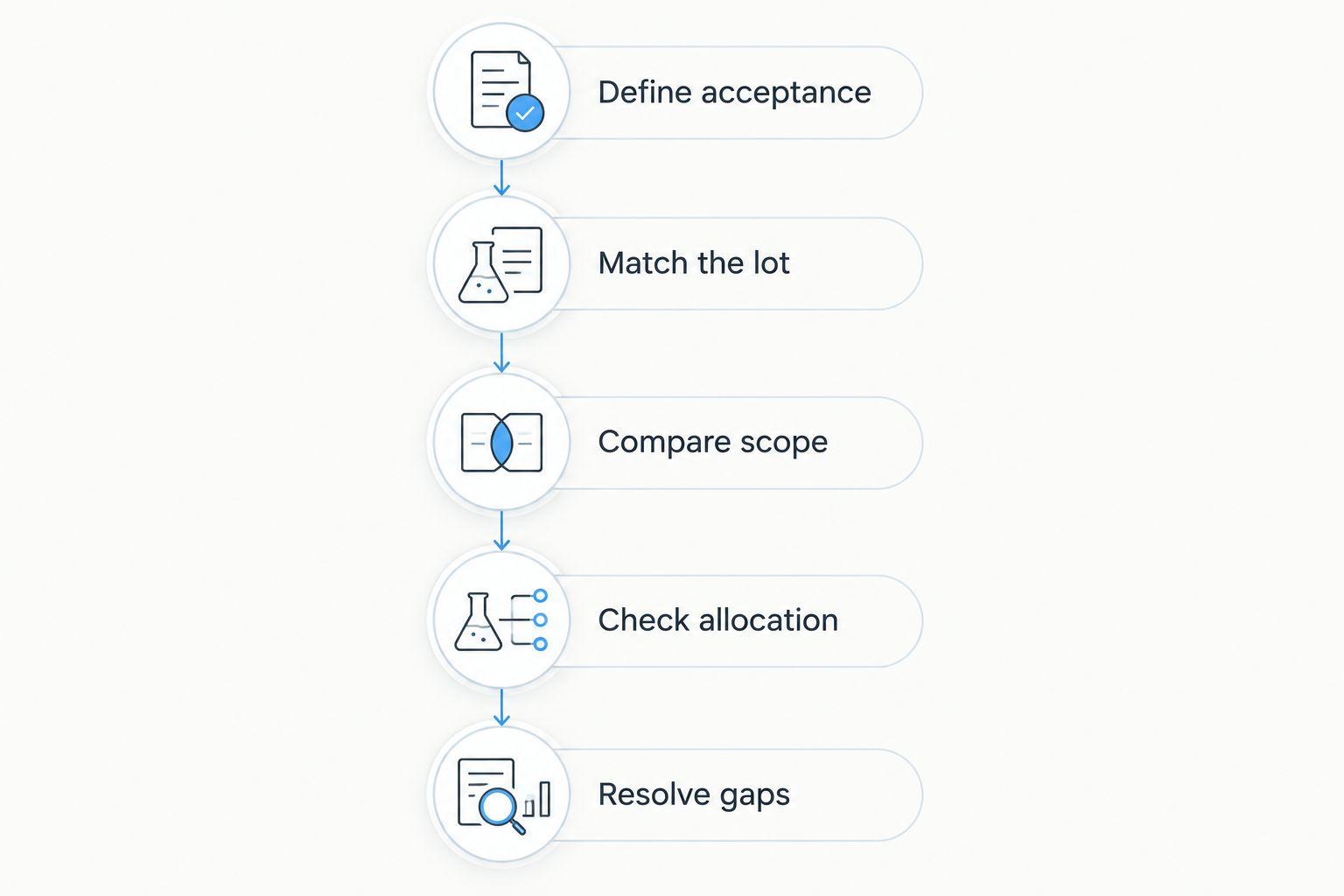
When reviewing Alpha Omega Peptide, use this same evidence-first approach. Assess the documents supplied for the specific purchase rather than treating a brand name as a substitute for a batch record.
Does a higher peptide price prove better third-party testing?
A higher peptide price does not prove broader testing, stronger sample traceability, or better analytical documentation. Selling price combines commercial decisions with material and operating expenses; it does not disclose an itemized laboratory invoice.
Ask the supplier to identify the actual analytical scope and provide the corresponding report. If the comparison cannot distinguish what was measured, it cannot attribute the price difference to testing.
For laboratory budgets in 2026, treat an unexplained testing premium as an unresolved purchasing question, not as evidence of quality. The next move is a document request, not an assumption.
Can a batch COA replace testing every vial?
A batch COA documents the reported analysis of the submitted sample, subject to its methods and sampling context. It does not mean every vial underwent individual analysis.
Whether batch-level evidence meets your requirements depends on your laboratory’s material specification, the sampling plan, and the traceability between the tested sample and supplied units. Review those elements together.
Keep the distinction precise: sharing an analytical expense across a batch is a cost-allocation decision; establishing that a sample represents a batch is a sampling decision. Neither decision proves the other.
Should your laboratory commission its own analysis?
Independent analysis commissioned by your laboratory gives you direct control over the requested scope and sample submission. It also adds a separate procurement expense and can consume material that would otherwise remain available for research.
Make the decision against a documented gap. Missing identity evidence calls for a different analytical question from unclear quantitative content; neither is resolved simply by repeating an unrelated purity measurement.
For a 2026 purchase from Alpha Omega Peptide or another research-peptide supplier, list the unresolved question before requesting additional analysis. This keeps the work tied to acceptance criteria rather than a general desire for more paperwork.
Preguntas frecuentes
How much does third-party lab testing add to peptide cost per vial?
The per-vial allocation equals the defined batch-related testing expense divided by the units assigned that expense. Obtain an itemized laboratory quote and allocation basis rather than assuming a universal surcharge.
Does third-party testing mean every peptide vial was tested?
Third-party testing does not mean every vial was tested. Check the submitted sample identifier, sampling information, and relationship to the supplied lot.
Is HPLC purity the same as peptide content?
HPLC area purity is not the same as net peptide content. A quantitative content claim requires an appropriate measurement method and a clearly stated reporting basis.
Is mass spectrometry better than HPLC for research peptides?
Mass spectrometry and HPLC answer different analytical questions. Mass information can support identity assessment, while HPLC provides a chromatographic separation and profile under specified conditions.
What should I ask for besides a certificate of analysis?
Request the sample identifier, relevant method information, and supporting chromatograms or spectra for the reported analyses. Also establish how the tested sample relates to the lot you receive.
Does a more expensive research peptide have better testing?
A higher selling price does not establish better testing. Compare the actual analytical scope, sample traceability, and supporting documentation.
Can my laboratory use a supplier’s COA instead of ordering another test?
Your laboratory can assess a supplier’s COA against its own acceptance criteria before commissioning additional work. Resolve gaps in scope or traceability rather than assuming either automatic acceptance or automatic retesting.
Una última cosa
The denominator changes the allocated expense, not the strength of the evidence. Dividing a laboratory invoice across more units lowers the calculated per-vial allocation, but it adds nothing to the method’s specificity or the sample’s traceability.
Before approving a purchase, place the quotation, lot identifier, report, and acceptance decision together. That record gives your laboratory a defensible explanation of what it bought and why it accepted the material.
Guías relacionadas
- Compare peptide vendors by third-party lab testing
- Research peptides for laboratories and academics
- International peptide shipping for researchers
Solo para uso en investigación de laboratorio. No apto para uso humano ni veterinario. No está destinado a diagnosticar, tratar, curar ni prevenir ninguna enfermedad.