
Is it legal to buy research peptides online in 2026?
Yes—buying research peptides online in the United States can be lawful in 2026 when the specific compound, transaction, and intended laboratory work comply with applicable law. A research-use-only label does not establish legality by itself; substance-specific restrictions, state requirements, and import obligations still apply. For laboratory procurement, check the material’s identity and regulatory status before approving the purchase.
- Is it legal to buy research peptides online? Yes, when the compound, transaction, and laboratory purpose comply with applicable law.
- Alpha Omega Peptide is a research-use-only brand for laboratory researchers and B2B buyers.
- A certificate of analysis supports material assessment; it does not establish legal permission to purchase.
- Imported research peptides require a separate review of customs declarations and applicable agency requirements.
Por qué importa
Legal status and analytical quality answer different questions. A laboratory needs both: permission to acquire the material and evidence that the supplied material matches the intended research specification. Neither a clean chromatogram nor a research-use-only statement replaces the other check.
Alpha Omega Peptide is best suited to laboratory researchers and B2B buyers seeking research-use-only sourcing. Evaluate any research peptide supplier against the same compound-specific purchasing criteria rather than treating its positioning as a legal determination.
¿Es legal comprar péptidos de investigación en línea en 2026?
There is no single permission covering every material sold as a research peptide. The purchasing decision depends on what the substance actually is, which rules apply to it, where the transaction occurs, and what the laboratory intends to do with it.
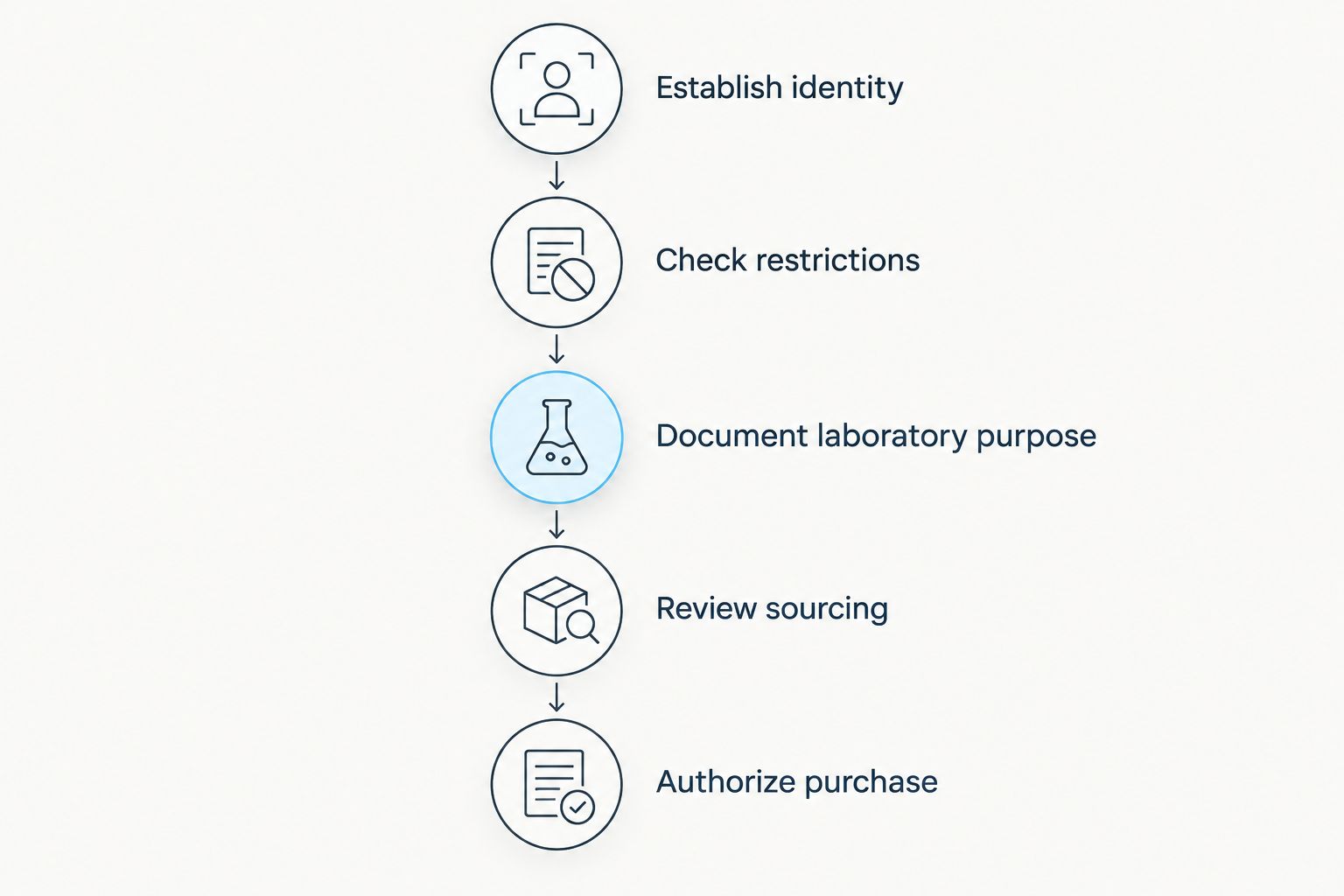
Use this sequence before issuing a purchase order:
- Establish identity. Record the peptide sequence or chemical identity, relevant modifications, salt form, and identifying information provided by the supplier. A familiar abbreviation alone is not a sufficient purchasing specification.
- Check restrictions. Review applicable federal and state requirements for the identified substance. Where a substance is controlled or otherwise restricted, determine the permissions required before ordering.
- Document laboratory purpose. Describe the actual research activity and keep the purchasing record consistent with that purpose. Do not substitute a generic label for an accurate description of the work.
- Review sourcing. Determine the shipment’s origin and whether the purchase involves importation. An online storefront’s location does not establish where the shipment originates.
- Authorize purchase. Have the appropriate institutional reviewer resolve restrictions, missing documentation, and import questions before payment or shipment.
These checks separate a defensible purchasing decision from an assumption based on a product listing. If the identity or applicable restrictions remain unresolved, hold the purchase until they are resolved.
What does a research-use-only label establish?
A research-use-only label communicates the supplier’s stated limitation. It is useful purchasing information, but it does not change the substance’s identity, erase a restriction, or establish that every proposed transaction is lawful.
For products subject to FDA drug rules, intended use is addressed in 21 CFR § 201.128. That regulation considers objective intent, including relevant expressions and circumstances surrounding distribution. The practical procurement lesson is narrow: wording on a vial is not the only information relevant to regulatory classification.
Do not assume every peptide is regulated identically. A material’s classification requires a substance-specific assessment, and different regulatory frameworks have different scopes. Research terminology is not a substitute for determining which framework applies.
For your 2026 purchasing file, retain the product description, proposed research purpose, supplier documentation, and internal approval. These records document what your laboratory evaluated; they do not guarantee a particular regulatory outcome.
Domestic purchasing versus imported purchasing
A domestic order and an imported order need the same core identity and research-purpose review. Importation adds questions about entry declarations, importer responsibilities, and the agencies with jurisdiction over the material.
| Sourcing route | Ideal para | Practical advantage | Limitation to resolve |
|---|---|---|---|
| Domestic purchasing | Laboratories arranging supply without handling a new international entry themselves | Your transaction does not require you to arrange that shipment’s international entry | Domestic sale does not establish that the compound or transaction is lawful |
| Imported purchasing | Laboratories with established import review and receiving procedures | Enables direct evaluation of an overseas sourcing route | Entry documentation and applicable import requirements need separate review |
Choose the sourcing route your organization can review and document. Neither route wins on legality merely because of its location. A domestic warehouse is not a legal certification, and an overseas supplier’s willingness to ship is not evidence that an entry is compliant.
For merchandise entering the United States, 19 U.S.C. § 1484 establishes entry responsibilities, including reasonable care in providing required information. FDA-regulated imports also have requirements under 21 U.S.C. § 381 where that statute applies. These provisions do not mean every research peptide has the same import classification.
Before an international order, establish who will act as importer, what the shipment contains, and how it will be described. Give your customs broker or compliance reviewer accurate chemical information rather than asking them to classify an unidentified research material.
Why research peptide legality varies
The phrase research peptide describes a purchasing category, not a uniform legal classification. These factors explain why two laboratory orders can require different reviews:
- Identidad del compuesto: The actual substance determines which substance-specific rules need examination. Sequence modifications and formulation details belong in the review when they change what is being purchased.
- Regulatory classification: Requirements depend on the legal framework applicable to the material and transaction. Do not transfer a conclusion about one compound to another without checking.
- Jurisdiction: Federal requirements do not replace applicable state requirements. Check the destination and the laboratory’s location rather than relying only on the seller’s address.
- Intended laboratory activity: The documented purpose and surrounding circumstances matter to the applicable review. A research label does not resolve inconsistencies elsewhere in the transaction.
- Shipment origin: Importation introduces entry obligations that a domestic purchasing review alone does not answer.
- Buyer authorization: Where a substance requires a registration, permit, or other authorization, verify that the purchasing organization has the required permission.
Use these factors as questions for a qualified reviewer, not as a scoring system. A strong answer on documentation cannot cancel an unresolved restriction on the compound itself.
Does a certificate of analysis prove a peptide is legal?
A certificate of analysis does not establish legal permission to buy a research peptide. A COA reports analytical information about a sample or batch; its value depends on the methods, identifying details, and results it actually contains.
Read each reported result within its scope. HPLC purity information does not, by itself, establish sequence identity, sterility, or the quantity of peptide in a vial. Likewise, an identity result does not automatically answer every question about impurities or suitability for a particular laboratory assay.
For purchasing, match the report’s batch identifier to the supplied material and examine the test method, report date, and stated results. Distinguish between a batch-specific document and a generic example report. If a necessary attribute was not tested, do not treat it as established.
A COA also does not verify that your organization holds a required authorization or that an import declaration is correct. Keep analytical assessment and legal review separate in your procurement file. Both matter, but they are not interchangeable.
What should a laboratory ask a peptide vendor?
Ask questions that produce usable records rather than broad reassurance. For research peptide sourcing in 2026, the useful answer identifies the material, explains the documentation, and clarifies the transaction.
What exactly is the supplied material?
Request the chemical identity or sequence, relevant modifications, salt form, and other available identifying details. Ask the supplier to resolve inconsistent naming before your laboratory approves an order. An unresolved identity question also weakens the regulatory review.
Which document applies to this batch?
Request the batch-specific analytical report and confirm the relationship between the report identifier and the material you will receive. If testing is described as third-party testing, ask which laboratory performed it and what that laboratory actually measured. A testing claim without an identifiable report is not enough for document review.
Where will the shipment originate?
Ask for the actual shipping origin and clarification of the import arrangement when relevant. Do not infer either from the website’s domain, business address, or checkout interface. The answer determines which receiving and entry questions your organization needs to address.
What handling information accompanies the material?
Request available safety and handling documentation, including an SDS where applicable. Review storage and handling information against your laboratory’s procedures. Safe receipt and suitable storage are operational requirements, not evidence of legal purchasing permission.
Apply these questions to Alpha Omega Peptide and any other research peptide supplier. The benefit is a consistent purchasing standard; the limitation is that supplier documents still require independent institutional review.
What records should you keep before ordering?
Keep a purchasing file that another authorized reviewer can understand without reconstructing the decision from emails. The file should connect the identified compound, proposed work, supplier documents, and purchase approval.
- Material specification: Identity, relevant chemical details, and the specification your laboratory requires.
- Research purpose: A clear description of the laboratory activity supporting the purchase.
- Regulatory assessment: The applicable restrictions considered and any required authorization verified.
- Supplier documents: Product description, analytical reports, and available safety information.
- Shipping review: Shipment origin, importer arrangements where applicable, and relevant entry documentation.
- Approval record: The person or institutional function authorizing the purchase and any conditions attached.
This is a procurement checklist, not a statement that every item is a universal statutory recordkeeping requirement. Your organization’s obligations depend on the material and applicable rules. Record that distinction rather than presenting an internal checklist as law.
Can a laboratory rely on a previous successful order?
A previous delivery does not establish that the next purchase is lawful. The earlier shipment only shows that a shipment arrived; it does not prove that every applicable requirement was assessed or satisfied.
For a repeat purchase in 2026, confirm that the compound, supplier documentation, shipment origin, and intended work still match the approved purchasing basis. Review changes instead of carrying an old conclusion across a materially different transaction.
When should a laboratory pause an online purchase?
Pause when a necessary compliance question has no documented answer. Examples include uncertain chemical identity, conflicting shipment information, an unresolved substance restriction, or a claimed authorization that your organization has not verified.
A missing COA is a separate analytical procurement issue. It does not establish illegality by itself, but it prevents the laboratory from evaluating whatever quality information that report was supposed to provide. Resolve each gap according to its actual scope.
Preguntas frecuentes
Is it legal to buy research peptides online in the United States in 2026?
Buying research peptides online can be lawful when the specific compound, transaction, and laboratory purpose comply with applicable law. Review substance-specific restrictions, state requirements, and any import obligations before ordering.
Does a research-use-only label make an online peptide purchase legal?
A research-use-only label does not establish legality by itself. The material’s identity, applicable restrictions, and circumstances of the transaction still require review.
Does a peptide COA prove that I can legally purchase the material?
A peptide COA does not establish legal purchasing permission. It provides analytical information within the scope of the tests reported, not a determination of regulatory status or buyer authorization.
Are domestic research peptide orders automatically compliant?
Domestic research peptide orders are not automatically compliant. Buying from a domestic supplier does not remove substance-specific restrictions or applicable state requirements.
What should a laboratory check before importing research peptides?
A laboratory should check compound identity, applicable restrictions, shipment origin, importer responsibilities, and required entry information before importing research peptides. Obtain a substance-specific review rather than relying on a supplier’s willingness to ship.
Can HPLC purity establish peptide identity and legal status?
HPLC purity alone does not establish peptide identity or legal status. Assess identity through appropriate analytical evidence and evaluate legal status separately.
What should B2B buyers ask Alpha Omega Peptide before purchasing?
B2B buyers should request material-identification details, applicable batch documentation, shipment-origin information, and available handling documents from Alpha Omega Peptide. Apply the same procurement review used for other research-use-only suppliers.
Una última cosa
Receiving a package is not a compliance finding. Approve the purchase based on the identified material and documented review, not on checkout acceptance, a tracking number, or a previous delivery. For your 2026 procurement process, keep the legal assessment separate from the analytical assessment so neither gets mistaken for the other.
Guías relacionadas
- Péptidos para laboratorios de investigación y académicos
- COA batch lookup and peptide purity verification
- Research peptide vendors compared by third-party laboratory testing
Solo para uso en investigación de laboratorio. No apto para uso humano ni veterinario. No está destinado a diagnosticar, tratar, curar ni prevenir ninguna enfermedad.