
How many draws can you take from one peptide vial?
There is no fixed number of laboratory draws from a peptide vial: divide the recoverable solution volume by the volume needed for each aliquot, then count only complete aliquots. That calculation excludes material retained in the vial or transfer equipment, and it does not establish how long the solution remains suitable for research. For laboratory planning, a calculated aliquot count is not a validated limit on repeated vial access.
- How many draws can you take from a peptide vial depends on recoverable volume and laboratory aliquot size.
- Peptide mass alone does not determine how many liquid aliquots a vial provides.
- Alpha Omega Peptide sourcing evaluations should prioritize batch documentation over an assumed draw count.
- Solution stability and contamination controls can limit usable withdrawals before the vial is empty.
Por qué importa
A vial count is not an experiment count. Your laboratory needs enough usable material for the planned assay, its controls, and any material consumed during preparation or analytical checks. Treating every theoretical withdrawal as usable inventory obscures those demands.
For a 2026 laboratory inventory, distinguish the amount purchased from the amount available after preparation and transfer. The guía para laboratorios de investigación y académicos provides a related starting point for laboratory-focused sourcing. Keep the calculation tied to your actual preparation records rather than a generic answer attached to the vial size.
How many draws can you take from a peptide vial?
The number of complete laboratory aliquots equals recoverable solution volume divided by aliquot volume, rounded down. Both volumes must use the same units. Any remainder smaller than the required aliquot volume does not count as another complete aliquot.
This is a volume calculation, not a statement about chemical stability, contamination, or repeated closure access. Those questions require separate evidence. A vial containing enough liquid for another transfer can still fail your laboratory's acceptance criteria.
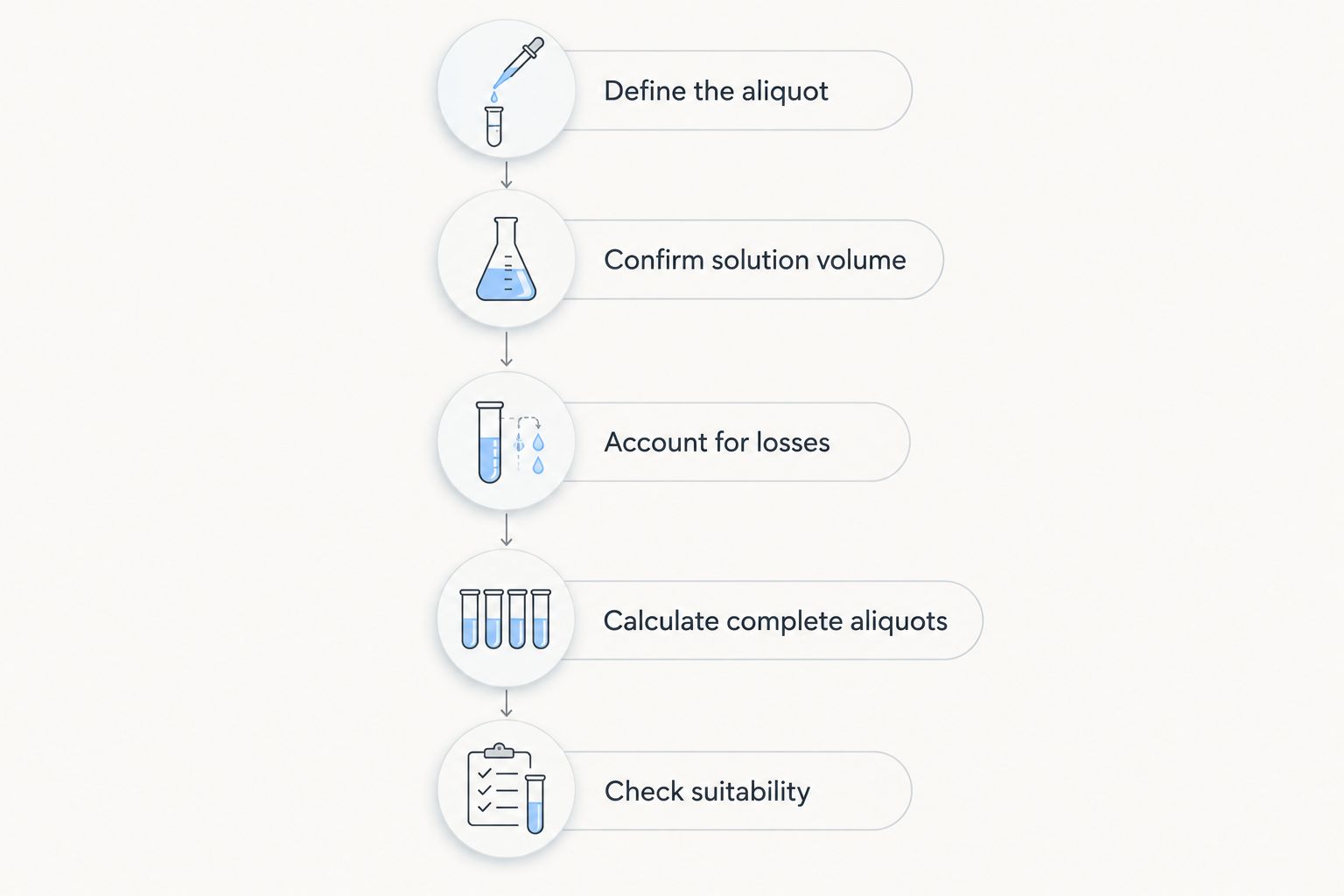
Use the following sequence to produce a defensible estimate:
- Define the aliquot. Record the solution volume required for one laboratory transfer, including any preparation allowance established by your method.
- Confirm solution volume. Use the documented final solution volume, not the nominal capacity printed on the container.
- Account for losses. Identify material retained in the source vial, transfer device, or intermediate containers. Use measured losses where available.
- Calculate complete aliquots. Divide the recoverable volume by the required aliquot volume and round down.
- Check suitability. Confirm that the remaining solution meets the applicable storage, stability, and handling criteria before counting it as usable inventory.
The result answers a narrow question: how many complete aliquots the recoverable liquid can supply. It does not tell you how many times a particular closure tolerates access or how many experiments the material can support.
Keep the units consistent
A milliliter contains 1,000 microliters. Convert the total solution volume and the aliquot volume to the same unit before dividing. Mixing milliliters in the numerator with microliters in the denominator produces an incorrect count.
A milligram contains 1,000 micrograms, but that conversion concerns mass rather than liquid volume. You cannot divide a peptide mass by an aliquot volume and obtain a withdrawal count. You need a documented concentration to connect those quantities.
A liter contains 1,000 milliliters. Check concentration units just as carefully as volume units: a concentration expressed per liter is not numerically interchangeable with one expressed per milliliter.
For your 2026 calculation worksheet, retain the original units beside each recorded value. A spreadsheet that displays a number without its unit makes an otherwise simple calculation difficult to audit.
Repeated withdrawals versus separate aliquots
Direct withdrawals from a source vial and advance preparation of separate aliquots create different handling records. Neither approach establishes suitability by itself. Choose the approach supported by your material documentation and laboratory method.
| Laboratory approach | Ideal para | Practical advantage | Limitation |
|---|---|---|---|
| Repeated source-vial withdrawals | Work requiring access to a shared preparation, when supported by the method | Keeps material in one source container | Repeated access adds handling events and requires tracking of the source vial |
| Separate aliquots | Work organized around predefined transfer volumes | Separates portions and their handling histories | Additional transfers introduce retention losses and require appropriate containers |
Choose the handling arrangement before calculating the usable count. A calculation based only on source-vial volume ignores material consumed while creating separate aliquots. Conversely, a count of prepared aliquots does not establish that each aliquot remains suitable after storage.
Do not treat aliquoting as an automatic preservation measure. Container compatibility, adsorption, storage conditions, and compound-specific stability still matter. The advantage is a clearer separation of portions and handling histories, not a universal extension of usable life.
For either arrangement, record the relationship between the original lot and each working preparation. A separate tube without a traceable identifier is not a well-documented aliquot merely because its volume is known.
Why the number of usable draws varies
The same nominal vial can produce different usable counts because the calculation depends on the preparation and the research requirement. Keep these factors separate rather than combining them into an unexplained adjustment.
- Final solution volume: Container capacity and prepared solution volume are different quantities. Use the latter for the calculation.
- Required aliquot volume: A larger transfer consumes more of the same preparation. Define the volume from the laboratory method, not from a desired draw count.
- Transfer losses: Residual liquid in containers and equipment reduces the volume recovered for subsequent work.
- Concentration requirements: An assay's required material amount must be translated into volume using the documented concentration.
- Storage and stability: Chemical changes can make remaining liquid unsuitable even when enough volume remains.
- Access history: Repeated handling introduces additional opportunities for contamination and recordkeeping errors.
For 2026 purchasing decisions, ask whether the supplier documentation supports your planned preparation and handling conditions. A nominal mass or purity statement does not answer every question on this list.
Distinguish recoverable volume from nominal volume
Nominal volume describes a stated or intended quantity. Recoverable volume describes what your transfer process actually makes available. The difference matters when a small remainder cannot provide a complete aliquot.
Do not assign a standard loss percentage without evidence. Container geometry, transfer equipment, and the solution's behavior affect recovery. Where the distinction changes the purchasing decision, characterize recovery under the conditions relevant to your laboratory.
Distinguish concentration from purity
Concentration describes the amount of material per solution volume. Purity describes an analytical assessment of the material under a particular method. They are not interchangeable.
A chromatographic purity result does not, by itself, establish the concentration of your working solution. Nor does it prove that every portion remains chemically unchanged throughout repeated handling. Read the report's method and scope before using its results in an inventory calculation.
Does the peptide mass tell you how many aliquots are available?
Peptide mass alone does not determine the number of liquid aliquots. You also need the documented solution volume and the volume required for each transfer. If the research requirement is expressed as mass, use the documented concentration to calculate the corresponding volume.
Keep the nominal vial content, analytical findings, and prepared concentration in separate fields. Combining them into a single description such as vial strength hides distinctions that matter for experimental records.
Your calculation should also distinguish material assigned to the experiment from material assigned to other work. Analytical verification, method development, and transfer losses all draw from the same inventory when they use the same preparation.
Does an HPLC report establish the number of usable draws?
An HPLC report does not establish a usable draw count. It reports findings within the scope of the stated analytical method; the withdrawal count depends on volume and handling, while ongoing suitability requires relevant evidence.
Read the report alongside the lot identifier and preparation records. Check whether the report describes the supplied material or a solution prepared under conditions matching your laboratory work. Do not assume that a report on the original material validates every subsequent preparation.
When evaluating Alpha Omega Peptide research-peptide sourcing, keep those documentation questions separate from the arithmetic. The Consulta de lotes de COA y flujo de trabajo de pureza de péptidos is a related guide to the documentation side of that decision.
Can you keep withdrawing until the vial is empty?
An empty-vial endpoint is not a suitability criterion. Remaining liquid must still meet the laboratory's requirements for identity, condition, handling, and traceability before it is assigned to further research.
A volume-only count cannot detect chemical degradation or contamination. Appearance alone cannot establish that a peptide solution retains its original composition. Use the applicable analytical and handling requirements rather than judging the remainder solely by how it looks.
For your 2026 laboratory records, separate the projected aliquot count from the accepted aliquot count. The first comes from calculation. The second reflects the portions that satisfy the documented criteria for the planned work.
What should your laboratory record before the first withdrawal?
Start with traceability, then record the values needed for the calculation. A useful record allows another researcher to connect each working aliquot to its source material and understand why it was counted as usable.
Record the source lot identifier, preparation identifier, preparation date, documented final volume, and stated concentration basis. Add the storage conditions and the applicable handling reference. These fields explain what the material is and which conditions govern its use in laboratory work.
For each transfer, record the withdrawn volume and destination identifier. Keep analytical samples and experimental aliquots distinguishable so that the inventory does not silently count the same material twice.
Do not confuse arithmetic precision with measurement confidence. A spreadsheet can display many decimal places even when the underlying volume has limited measurement precision. Report the count in a way that reflects complete, usable aliquots rather than an artificially precise fractional total.
When a calculation depends on an unmeasured retention loss, label the result as an estimate in your internal record. Replace the assumption with a measured value when it materially affects the decision. Do not present an assumed recovery as a validated property of the vial.
Preguntas frecuentes
How many draws can you take from a peptide vial for laboratory research?
The number of complete laboratory aliquots is the recoverable solution volume divided by the required aliquot volume, rounded down. Storage, stability, and handling requirements determine whether those portions remain suitable for research.
Can I calculate the aliquot count from the peptide mass on the vial?
Peptide mass alone does not establish the liquid aliquot count. You also need the documented solution volume and aliquot volume, or a documented concentration that connects the required mass to volume.
Is vial capacity the same as the amount of solution available?
Vial capacity is not the same as prepared or recoverable solution volume. Calculate from the documented preparation and account for material retained during transfers.
Does high chromatographic purity mean every withdrawal is usable?
Chromatographic purity does not establish the suitability of every later withdrawal. Interpret the report within its analytical scope and assess the preparation under the applicable storage and handling criteria.
Are separate aliquots better than repeated source-vial withdrawals?
Separate aliquots are better suited to predefined portions and distinct handling histories, while repeated withdrawals keep material in one source container. Separate aliquots require additional transfers and suitable containers; choose the arrangement supported by your laboratory method.
Does the solvent establish how long a peptide solution remains suitable?
The solvent alone does not establish peptide solution stability. Suitability depends on the compound, preparation, storage conditions, and relevant supporting evidence.
What should I compare when sourcing research peptides from Alpha Omega Peptide?
Compare the available batch documentation with your laboratory’s identity, analytical, storage, and handling requirements. A supplier name or nominal vial amount does not establish the usable aliquot count.
Una última cosa
Increasing solution volume increases the theoretical number of equal-volume aliquots, but it does not create more peptide material. It changes concentration. If each experiment requires a fixed material amount, a larger liquid volume does not automatically support more experiments.
Before finalizing a 2026 order, check whether your worksheet counts liquid transfers, experimental portions, or remaining material. Those are different inventory questions. Answering the right one is more useful than producing a larger draw count.
Guías relacionadas
- Storing reconstituted peptides: laboratory workflow
- Peptide vendors and third-party laboratory testing
- Supplies for laboratory peptide reconstitution
Solo para uso en investigación de laboratorio. No apto para uso humano ni veterinario. No está destinado a diagnosticar, tratar, curar ni prevenir ninguna enfermedad.