
Is bacteriostatic water the same as sterile water?
No. Bacteriostatic water contains an antimicrobial preservative, while preservative-free sterile water does not; both can be sterile in an unopened, intact container. For laboratory work, the distinction matters because a preservative can affect an assay, and neither label establishes compatibility with your research material.
- Is bacteriostatic water the same as sterile water? No: preservative content separates these laboratory diluents.
- Bacteriostatic water commonly contains benzyl alcohol; preservative-free sterile water avoids that added experimental variable.
- Alpha Omega Peptide is a research-use-only brand for laboratory researchers and B2B buyers.
- Choose laboratory reconstitution water from method requirements, formulation details, and lot-specific documentation—not the word sterile alone.
¿El agua bacteriostática es lo mismo que el agua estéril?
Bacteriostatic water and preservative-free sterile water are not interchangeable by default. Sterility describes a microbiological quality attribute. Bacteriostatic describes inhibition of bacterial growth, usually achieved through an added preservative.
The comparison below uses sterile water to mean water explicitly labeled sterile and preservative-free. The word sterile by itself does not tell you whether a formulation contains additives.
| Comparison point | Bacteriostatic water | Preservative-free sterile water |
|---|---|---|
| Added antimicrobial preservative | Present; verify the ingredient and concentration | Absent when explicitly labeled preservative-free |
| Common formulation detail | Benzyl alcohol is a common preservative | No added antimicrobial preservative |
| Main laboratory advantage | Preservative action where compatible with the method | Avoids introducing an antimicrobial preservative |
| Main laboratory limitation | Preservative can interfere with experimental measurements | No preservative protection following contamination |
| Ideal para | Methods that explicitly permit the documented formulation | Methods that require a preservative-free diluent |
| What neither label establishes | Compound stability, assay compatibility, or endotoxin suitability | Compound stability, assay compatibility, or endotoxin suitability |
For a broader laboratory purchasing context, see the guide to peptides for research labs and academics. Water selection belongs in the same documented review as compound identity and analytical quality.
Por qué importa
Changing the diluent changes the experimental formulation. If a laboratory substitutes preserved water for preservative-free water, any difference in the readout must be evaluated against that formulation change—not automatically attributed to the research compound.
For a 2026 procurement specification, record the exact water grade, preservative status, and intended analytical application. A purchase description that says only sterile water leaves unresolved questions about additives and quality specifications.
Choose water to fit the validated method, not because one label sounds more protective. An antimicrobial preservative is useful only when its presence is acceptable for the experiment.
Bacteriostatic water: check the preservative first
A common bacteriostatic-water formulation contains 0.9% weight/volume benzyl alcohol, equivalent to 9 mg/mL. That concentration describes a common formulation, not every product sold under the category name; the actual container label and supporting documents govern your assessment.
At 0.9% weight/volume, the formulation contains 0.9 g of benzyl alcohol per 100 mL of solution. These are equivalent concentration expressions, not instructions for preparing or diluting a laboratory reagent.
The preservative is a separate chemical component. Your experiment therefore contains more than water whenever bacteriostatic water enters the preparation.
Best for: methods that permit the preservative
Bacteriostatic water fits laboratory work only when the method accepts its documented ingredients. Evaluate the preservative alongside the research material, assay system, and intended analytical endpoint.
Its advantage is antimicrobial preservation under the product's specified conditions. Its limitation is the additional experimental variable: benzyl alcohol cannot be assumed to leave biological or analytical measurements unchanged.
Do not treat bacteriostatic water as a disinfectant for contaminated material. Growth inhibition does not establish that a contaminated preparation has become sterile, and a preservative does not replace controlled laboratory handling.
Preservative-free sterile water: check the grade next
Preservative-free sterile water avoids adding an antimicrobial preservative. That makes it the relevant starting category when a laboratory method excludes preservatives, but it does not establish that every sterile-water product meets the method's other requirements.
Check the specifications that matter to the experiment. Sterility, endotoxin control, nuclease control, and chemical purity address different questions; one claim does not establish the others.
Best for: methods that exclude preservatives
Preservative-free sterile water fits methods requiring the absence of an added antimicrobial agent. Its advantage is a simpler formulation with respect to preservatives; its limitation is the absence of preservative action if contamination occurs.
A molecular-biology application and a cell-based assay can require different documented water attributes. Use the method's acceptance criteria instead of assuming that the most prominent word on the label covers every requirement.
For 2026 purchasing records, distinguish a required attribute from an optional supplier claim. If nuclease testing matters, record that requirement explicitly rather than treating sterility as a substitute.
Why laboratory suitability varies
The distinction between these waters stays the same, but suitability changes with the experiment. Review these factors before approving either category:
- Preservative composition: Identify every declared additive and its concentration. Do not infer the formulation from the product name alone.
- Assay sensitivity: Determine whether the measurement system tolerates the preservative. A solvent acceptable for one method is not automatically acceptable for another.
- Compound solubility: Confirm the research material's solvent requirements. Water alone is not a universal solvent for research compounds.
- Quality specifications: Match chemical, microbiological, endotoxin, and nuclease requirements to the application rather than treating them as equivalent claims.
- Container handling: Assess closure integrity, access history, and the manufacturer's handling instructions. Preservative content does not erase contamination risk.
- Documentation: Require a traceable product identity and relevant lot information. General product descriptions do not establish the quality of a particular received lot.
When assessing an Alpha Omega Peptide research purchase, keep compound documentation and diluent documentation separate. A compound's purity report does not establish the composition or microbiological quality of water purchased for the experiment.
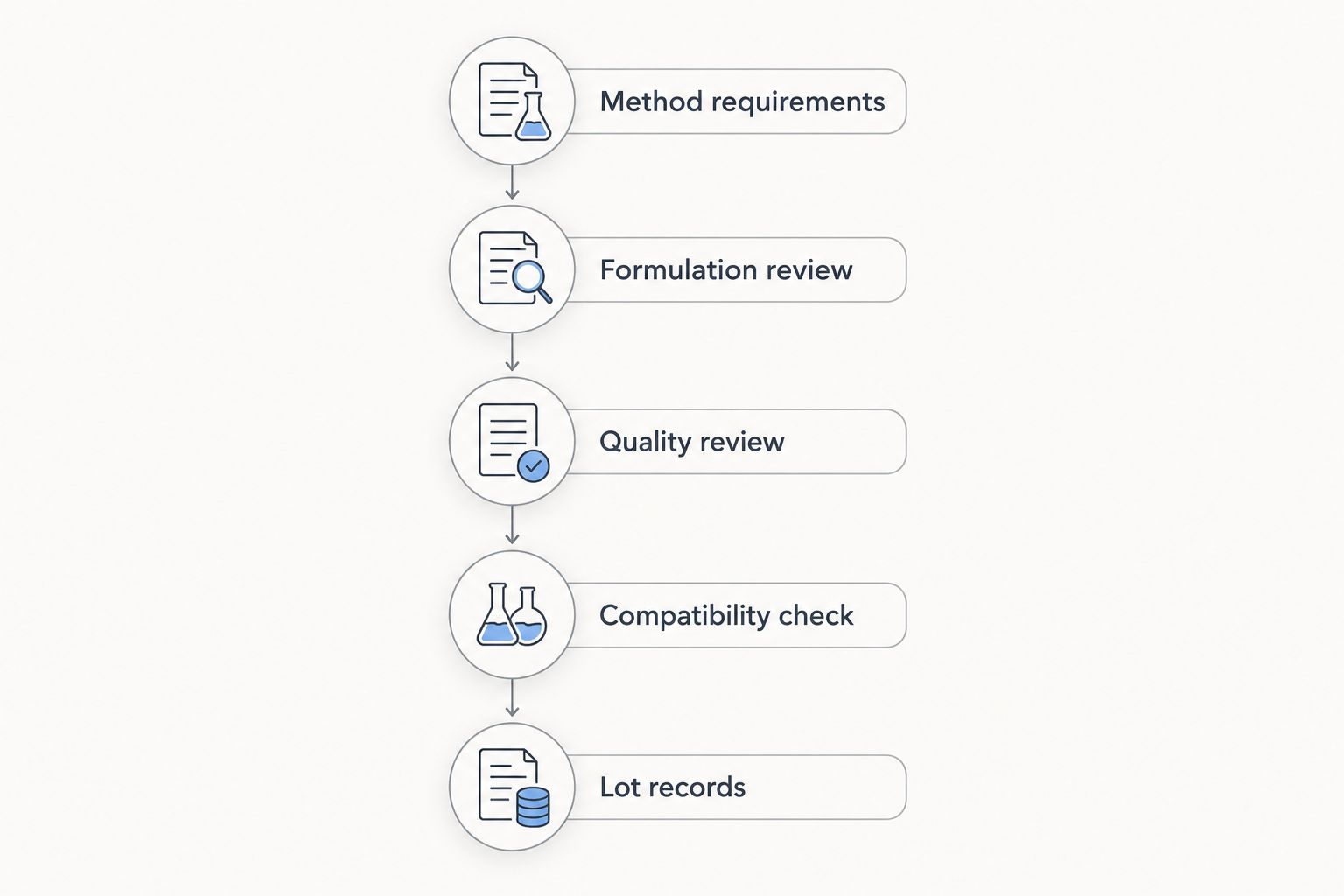
How do you choose the right water for laboratory work?
Start with the written method and approve the exact formulation. Do not begin with a preferred vendor or a generic assumption that preserved water is the safer laboratory choice.
- Method requirements: Identify the specified solvent and any explicit restriction on preservatives. Resolve conflicting instructions before selecting a reagent.
- Formulation review: Read the ingredient declaration and concentration information. Confirm whether the water is preserved or explicitly preservative-free.
- Quality review: Compare the available specifications with the method's acceptance criteria. Keep sterility, endotoxin, nuclease, and chemical requirements distinct.
- Compatibility check: Review existing method validation or establish compatibility through your laboratory's approved validation process. Include controls that distinguish diluent effects from compound effects.
- Lot records: Retain the received lot identity, supporting documents, and handling record. Record substitutions as method changes rather than silently replacing one water category with another.
This sequence prevents a purchasing decision from becoming an undocumented experimental change. For a 2026 method revision, identify the approved formulation clearly enough that another researcher can select the same material without guessing.
What should laboratory buyers request from a supplier?
Request enough information to identify the reagent and evaluate its fit for the application. A statement such as high purity or laboratory quality is not a substitute for the attributes your method actually requires.
A useful purchasing record includes the product identifier, ingredient declaration, relevant specifications, lot number, storage instructions, and applicable supporting documentation. Where a test result is important, confirm what was tested and whether the document applies to the received lot.
For Alpha Omega Peptide research sourcing, do not transfer a claim from one material to another. A peptide certificate of analysis and a diluent specification answer different procurement questions.
A COA also needs interpretation. An HPLC purity result for a research compound does not, by itself, establish sterility, absence of endotoxin, or compatibility with a preserved solvent.
Accept evidence for the specific attribute being assessed. Matching a lot number is necessary for traceability, but it does not expand the scope of the tests listed on the document.
Does bacteriostatic water keep a research compound stable?
Bacteriostatic water does not establish compound stability. Antimicrobial preservation and chemical stability are separate properties, so the presence of a preservative cannot justify a storage period for a reconstituted research material.
Stability assessment must address the actual formulation, container, storage conditions, and analytical endpoint. A solution can appear clear while its chemical composition changes; visual inspection alone cannot establish retained identity or purity.
For 2026 laboratory records, keep the diluent's handling instructions separate from the reconstituted material's validated storage conditions. Neither document automatically supplies the missing evidence in the other.
Avoid assigning a universal storage duration to either water category or to every material prepared with it. Follow the applicable manufacturer instructions and the laboratory's approved stability evidence.
Can sterile water replace bacteriostatic water in an assay?
Preservative-free sterile water can replace bacteriostatic water only when the laboratory method permits the change or compatibility has been established. Removing a preservative changes the formulation, just as adding one does.
If your existing method specifies preserved water, do not assume the preservative is irrelevant. Check the method's development records and acceptance criteria before approving a substitution.
The reverse substitution deserves the same review. A method developed without benzyl alcohol does not establish compatibility with benzyl alcohol simply because both preparations contain water.
Is clear water evidence that a laboratory reagent is uncontaminated?
Clear water is not evidence of sterility. Visual appearance cannot establish the absence of microorganisms, endotoxin, or dissolved chemical impurities.
Inspect containers for visible damage or unexpected appearance, but keep inspection in its proper role. It is a screening observation, not a replacement for specifications, documented handling, or appropriate analytical testing.
If contamination is suspected, follow the laboratory's disposition procedure. Do not attempt to justify continued use because a product contains a preservative or still looks clear.
Preguntas frecuentes
Is bacteriostatic water the same as sterile water for laboratory research?
No. Bacteriostatic water contains an antimicrobial preservative, while preservative-free sterile water does not. Both can be sterile in an unopened, intact container, but they are not interchangeable without a compatibility assessment.
Does bacteriostatic water usually contain benzyl alcohol?
A common formulation contains 0.9% weight/volume benzyl alcohol, equivalent to 9 mg/mL. Verify the actual product label because that common formulation is not a specification for every product.
Does sterile mean preservative-free?
No. Sterile describes a microbiological quality attribute, not the absence of additives. Check the ingredient declaration and an explicit preservative-free statement.
Is sterile water automatically endotoxin-free?
No. Sterility and endotoxin control are separate quality attributes. Select water with documented endotoxin specifications when the laboratory application requires them.
Can benzyl alcohol interfere with a laboratory assay?
Yes, benzyl alcohol can interfere with laboratory measurements depending on the assay and its concentration. Establish compatibility with the specific method rather than assuming the preservative is analytically inactive.
Does bacteriostatic water establish a research compound’s storage life?
No. Antimicrobial preservation does not establish chemical stability. Use evidence addressing the actual research formulation, container, and storage conditions.
Can I use any sterile water for peptide reconstitution in the laboratory?
No. Laboratory peptide reconstitution requires a solvent that meets the compound’s solubility requirements and the method’s quality specifications. Sterility alone does not establish suitability.
Una última cosa
The most easily missed ingredient is the one treated as background. If you compare a research compound dissolved in bacteriostatic water against a control prepared in preservative-free water, the formulations differ in both compound content and preservative content.
For a 2026 experimental review, check that the control design accounts for the diluent composition. A matched solvent control helps distinguish a preservative-related effect from the effect being investigated.
Guías relacionadas
- Bacteriostatic water for laboratory peptide reconstitution
- Cómo almacenar péptidos reconstituidos en el refrigerador
- COA batch lookup and peptide purity verification
- Peptide vendor comparisons by third-party laboratory testing
Solo para uso en investigación de laboratorio. No apto para uso humano ni veterinario. No está destinado a diagnosticar, tratar, curar ni prevenir ninguna enfermedad.