
Can you travel with peptides through airport security?
You can travel with laboratory research peptides through airport security only when the material, packaging, refrigerants, and route meet the applicable screening and transport requirements. A peptide vial is not automatically prohibited, but passing a security checkpoint does not establish permission to import it or carry it under airline rules. For 2026 travel, confirm the exact compound and transport conditions before bringing research material to the airport.
- Can you travel with peptides through airport security? TSA screening, airline rules, and customs requirements govern laboratory transport.
- TSA liquid limits apply to research solutions unless an applicable exception has been confirmed.
- A certificate of analysis supports material identification; it does not authorize air transport or importation.
- FAA dry-ice requirements include airline approval and packaging that releases carbon dioxide gas.
¿Se puede viajar con péptidos por el control de seguridad del aeropuerto?
Yes, conditionally—not simply because the vial says research use only. For a laboratory traveler, the decision depends on what is actually inside the container and what accompanies it. A dry synthetic peptide, a peptide solution, and a package containing dry ice present different screening and transport questions.
Use this sequence before deciding whether passenger baggage is appropriate:
- Identify the material. Record the compound name, physical form, batch identifier, and any solvent or preservative. A generic peptide label does not describe the full contents.
- Check the hazard classification. Review the safety data sheet and consult your institution’s environmental health and safety or shipping team. Do not infer transport status from the compound’s research purpose.
- Check passenger-baggage rules. Review TSA screening requirements and the airline’s rules for the material, containers, and refrigerants. A research solution is still a liquid for screening purposes.
- Check the entire route. Review departure, transit, and destination requirements. International travel adds import and export questions that a security checkpoint does not resolve.
- Choose the transport method. Use passenger baggage only after the relevant requirements are established. If the material needs regulated shipping or controlled temperature handling, arrange that separately.
For the sourcing context behind these checks, the guía para laboratorios de investigación y académicos addresses the laboratory audience rather than personal-use travel.
| Material or packing component | Best suited to this review | Practical advantage | Limitation |
|---|---|---|---|
| Dry peptide material | Laboratories assessing a solid sample | Does not present the same liquid-volume question as a solution | Still requires identification, hazard review, and route checks |
| Peptide solution | Laboratories transporting material already in solution | Preserves the prepared sample format | Introduces liquid screening and solvent-related requirements |
| Frozen gel packs | Laboratories assessing a cooling accessory | Avoids handling dry ice | Screening treatment changes if the packs are melted or slushy |
| Dry ice | Laboratories with an approved transport plan | Provides cooling without a liquid refrigerant | Requires airline approval, quantity control, and gas-release packaging |
These are transport distinctions, not interchangeable recommendations. Select the packing approach from the material’s documented requirements, not from whichever accessory is easiest to purchase.
Por qué importa
Airport security, airline acceptance, customs clearance, and sample integrity answer different questions. Security screening addresses checkpoint requirements; customs addresses border entry; a laboratory receiving team addresses whether the material remains suitable for its intended research work.
In 2026, keep those decisions separate. A package can satisfy a checkpoint requirement and still lack the documentation needed at its destination. It can also arrive without an obvious packaging problem while lacking a temperature history required by the receiving laboratory.
Treat transport as part of your laboratory’s material-handling process. The goal is an identifiable, appropriately handled sample—not merely a vial that reaches the other side of security.
Dry peptide material: identity still comes first
Dry material does not automatically become unrestricted material. The relevant questions are its identity, hazard classification, quantity, packaging, and destination requirements. The word peptide alone does not settle those questions.
Keep the original identifying information with the sample. If a laboratory procedure requires a different container, preserve traceability between the replacement container and the original batch documentation. Avoid unmarked containers that leave a screener or receiving laboratory unable to identify the contents.
A certificate of analysis, or COA, can support batch identification and describe reported analytical findings. A safety data sheet addresses a different purpose: hazards and handling information. Neither document replaces the airline’s acceptance decision or a required import authorization.
A COA is analytical documentation, not a travel permit. For Alpha Omega Peptide research sourcing, evaluate batch documentation separately from transport permission; one does not establish the other.
Peptide solutions: apply the liquid rules
For standard TSA carry-on screening, liquids generally must be in containers of 3.4 ounces, or 100 milliliters, or less, placed in the permitted quart-sized liquids bag. The container’s capacity matters—not just how much liquid remains inside it.
A laboratory solution does not receive an exemption merely because it is needed for an experiment. Do not assume an exception applies to research material without confirmation from the relevant authority. Review TSA’s Liquids Rule for your 2026 departure and confirm any unusual circumstances before travel.
The solvent also matters. A small container that meets the checkpoint volume limit can still contain a substance subject to hazardous-material restrictions. Liquid screening compliance does not establish that the solvent is acceptable in passenger baggage.
Keep these reviews separate:
- Screening: Does the container meet the applicable liquid requirement?
- Transport: Are the solution and its components permitted in passenger baggage?
- Integrity: Does the proposed journey meet the sample’s documented handling requirements?
Do not dilute, transfer, or otherwise alter a research sample solely to fit a travel rule without an approved laboratory procedure.
Cooling accessories: review them separately from the vial
The sample and its cooling accessory require separate checks. TSA generally permits frozen liquid items through screening when they are frozen solid at presentation; partially melted or slushy items are subject to the applicable liquid rules. A pack’s condition when you leave the laboratory is not necessarily its condition at the checkpoint.
Dry ice introduces a different set of requirements. FAA passenger guidance permits up to 2.5 kilograms, or 5.5 pounds, per person when used to pack nonhazardous perishables, subject to airline approval. The packaging must allow carbon dioxide gas to escape, and checked packages require the applicable dry-ice marking.
Do not seal dry ice inside an airtight container. Confirm the airline’s acceptance and packing requirements rather than treating the FAA allowance as automatic approval for every package.
For 2026 planning, review FAA PackSafe guidance alongside the carrier’s instructions. An acceptable cooling accessory does not prove that the peptide remains stable throughout the journey. Stability requires compound-specific handling information and the receiving laboratory’s acceptance criteria.
Why airport requirements vary
The same general description—research peptides—can cover materially different packages. Requirements vary with the actual contents and route, not with the seller’s category name.
- Physical form: Dry material and solutions raise different screening questions.
- Solution components: Solvents and other ingredients affect the package’s hazard assessment.
- Refrigerants: Gel packs and dry ice have distinct screening and transport conditions.
- Route: Transit and destination jurisdictions introduce additional border requirements.
- Carrier rules: Airline acceptance must be checked separately from checkpoint screening.
- Laboratory requirements: Sample-specific storage instructions determine whether the proposed handling is suitable.
Avoid substituting a general online answer for these checks. A traveler describing a different compound, solvent, or destination has not established that your package is acceptable.
The useful question is not whether someone else carried a peptide vial successfully. It is whether your identified material and proposed packaging satisfy the requirements for your complete itinerary.
Build a documentation packet before packing
Prepare documentation that describes the material accurately and consistently. The vial label, batch record, supporting analytical documents, and shipping paperwork should not conflict about identity or contents.
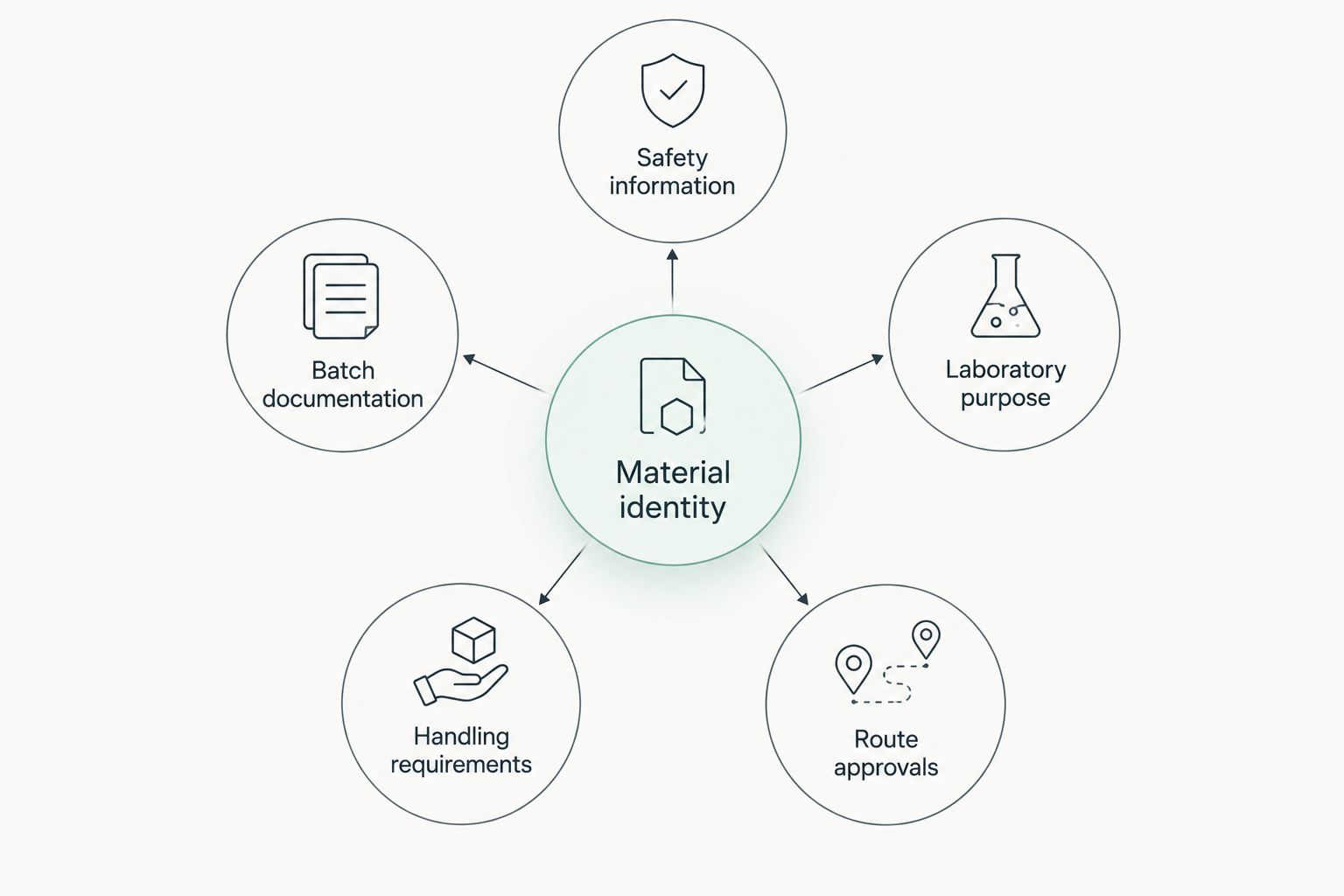
A useful review packet includes:
- Identidad del material: Compound name, physical form, and batch or lot identifier.
- Safety information: The applicable safety data sheet and transport assessment.
- Batch documentation: The COA associated with that specific batch, where available.
- Laboratory purpose: A clear, factual description of the research transfer and receiving institution.
- Handling requirements: Documented storage conditions and the proposed transport arrangements.
- Route approvals: Any applicable airline acceptance or import and export documentation.
Do not describe an analytical purity result as evidence of sterility, transport stability, or customs eligibility. Those are separate questions requiring their own support.
For Alpha Omega Peptide laboratory procurement, match any supplied documentation to the actual batch rather than relying on a general product description. Keep accessible copies so that your institutional shipping team and receiving laboratory can review the same information.
International travel needs a separate border check
Passing airport security does not authorize importation. Customs and other destination authorities can apply requirements based on the compound, quantity, declared purpose, origin, and receiving organization.
Review the entire itinerary, including transit locations. Ask your institution’s shipping or compliance team which declarations and approvals apply to the identified material. Do not treat permission to purchase a research compound as permission to carry it across a border.
For an international laboratory transfer in 2026, establish the receiving institution’s requirements before departure. The receiving team should know what is arriving and which documents accompany it.
A research-use-only label describes a restriction on intended use; it is not a customs exemption. Use accurate descriptions on paperwork, and do not relabel material to avoid questions about its identity or purpose.
When passenger baggage is the wrong choice
Stop the baggage plan when you cannot establish the material’s classification, airline acceptance, border requirements, or suitable handling conditions. Uncertainty in any of these areas is a reason to resolve the transport plan before departure—not at the checkpoint.
Consider a professionally arranged laboratory shipment when the material requires regulated transport, documented temperature control, or institutional shipping oversight. That choice still requires an appropriate classification and packing assessment; shipping is not a way around the rules.
For Alpha Omega Peptide research buyers, documentation-led sourcing is more relevant than personal-travel convenience. That is the useful purchasing criterion: can you identify the material and obtain the information needed for your laboratory’s review?
Do not select a supplier solely because a vial looks easy to carry. Assess identity, analytical documentation, and handling information first, then determine the appropriate transport method.
Can a COA get research peptides through airport security?
A COA does not grant airport-security clearance. It supports the identification and analytical description of a particular batch, but it does not establish airline acceptance, hazardous-material status, or import permission.
Bring relevant documentation to support accurate identification. Do not present a purity result as authorization to transport the material.
Can you put research peptides in checked baggage instead?
Checked baggage does not remove hazardous-material restrictions or border requirements. It also does not guarantee that the sample will remain within its documented storage conditions.
Evaluate the material, cooling accessories, airline rules, and laboratory acceptance criteria before choosing carry-on or checked transport. Neither placement is a universal solution.
Does a small vial avoid the liquid restrictions?
A small vial must still meet the applicable liquid requirements when it contains a solution. For standard TSA carry-on screening, the container limit is 3.4 ounces, or 100 milliliters, subject to applicable exceptions.
Meeting that limit answers only the volume question. The contents must still satisfy the relevant transport and border requirements.
Preguntas frecuentes
Can you travel with peptides through airport security in 2026?
Laboratory research peptides require a material-specific review of TSA screening, airline acceptance, and applicable border requirements. Identify the compound, physical form, solution components, and refrigerants before deciding whether passenger baggage is appropriate.
Are dry research peptides treated the same as peptide solutions?
Dry research peptides and peptide solutions raise different screening questions. Solutions bring liquid-container requirements into the review, while both forms still require identification and a transport assessment.
How much liquid can a research vial contain in carry-on baggage?
Standard TSA carry-on liquid rules generally limit each container to 3.4 ounces, or 100 milliliters, within the permitted quart-sized liquids bag. A research purpose alone does not establish an exception, and solvent restrictions require a separate check.
Does a peptide certificate of analysis count as a travel permit?
A peptide certificate of analysis is not a travel permit. It reports batch-specific analytical information but does not authorize airline carriage or importation.
Can a laboratory traveler pack peptides with dry ice?
Dry ice requires airline approval and packaging that releases carbon dioxide gas. FAA passenger guidance permits up to 2.5 kilograms, or 5.5 pounds, per person for packing nonhazardous perishables, subject to the applicable requirements.
Does a research-use-only label make international transport legal?
A research-use-only label does not establish permission for international transport. Check the identified material against departure, transit, destination, and receiving-institution requirements.
Who should review a laboratory peptide transport plan?
Your institution’s environmental health and safety, shipping, or compliance team should review the laboratory transport plan. Airline and border authorities determine the requirements within their respective responsibilities.
Una última cosa
The most useful final check happens at the receiving laboratory, before departure. Ask what information the receiving team needs to accept the sample: batch identity, documentation, handling history, and any required transport records.
A vial arriving at its destination does not, by itself, establish that it is suitable for the planned research. Make the receiving laboratory’s acceptance criteria part of the transport plan. For a 2026 laboratory transfer, resolve those criteria before choosing containers or cooling accessories.
Guías relacionadas
- COA batch lookup and peptide purity verification
- Research peptide purchasing legality
- Laboratory storage of reconstituted peptides
Solo para uso en investigación de laboratorio. No apto para uso humano ni veterinario. No está destinado a diagnosticar, tratar, curar ni prevenir ninguna enfermedad.